

My father raised me to believe my mother was ignorant. “Your mother, (implying like most women) is irrational. Fickle. Full of love and lightness, but not really a [deep] thinker.”
All women were (are) not as… capable as men, according to my father, as the woman’s primary job— her role in society of mom, caretaker, homemaker— isn’t like a real job and doesn’t take much brain power. He actually said to me, “Isn’t it odd that women can’t walk and talk at the same time,” and stopped to tell me this in all seriousness, while we were walking.
My father thought he was inherently smarter than my mother, or any woman. He was a MAN, after all. He claimed to be well read, had to be for business in the real world, unlike silly homemakers. (My mother read the newspaper daily, news magazines, new non-fiction and fiction monthly. My father read only Popular Mechanics, and watched TV. Cop and detective shows mostly, where the main white male character was rescuing ditsy, busty women.)
My mother graduated high school at 16, and attended Florida State University two years before most of the classmates she left behind in New Jersey. My father has no degree beyond high school.
My father went through five or more businesses, several of which failed, none of which ended up in substantial wins. My mother started a pilot magnet program at Cabrillo Marine Museum for underprivileged East L.A. kids, to teach them marine science. For almost 20 yrs she touched thousands of lives, many of whom I met personally, in the store or mall, when they stopped my mom to gush that they were now oceanographers and scientist because of her program. As a woman, she made 1/3 of the men whom she worked beside, offering comparable programs.
What is SEXISM?
Sure, most of us will agree equal pay for equal work, regardless of gender is an important step in ending sexual inequality. According to Variety, the top paid actress for a single film of 2021 was Jennifer Lawrence, at $25M. Actor Daniel Craig, made $100 million. Women had only 34% of the speaking roles in major movies, according to Women and Hollywood. (Women are half of the human population, yet no actress is even close to #2, 3, 4, in equal pay or presence in film.)
In 2020, almost 60 years after the United States passed the Equal Pay Act, Pew Research says a woman earns only 84% of what a man makes.
So, why, even today, are women fighting so hard for equal pay, which most of us agree is one obvious step to ending SEXISM?
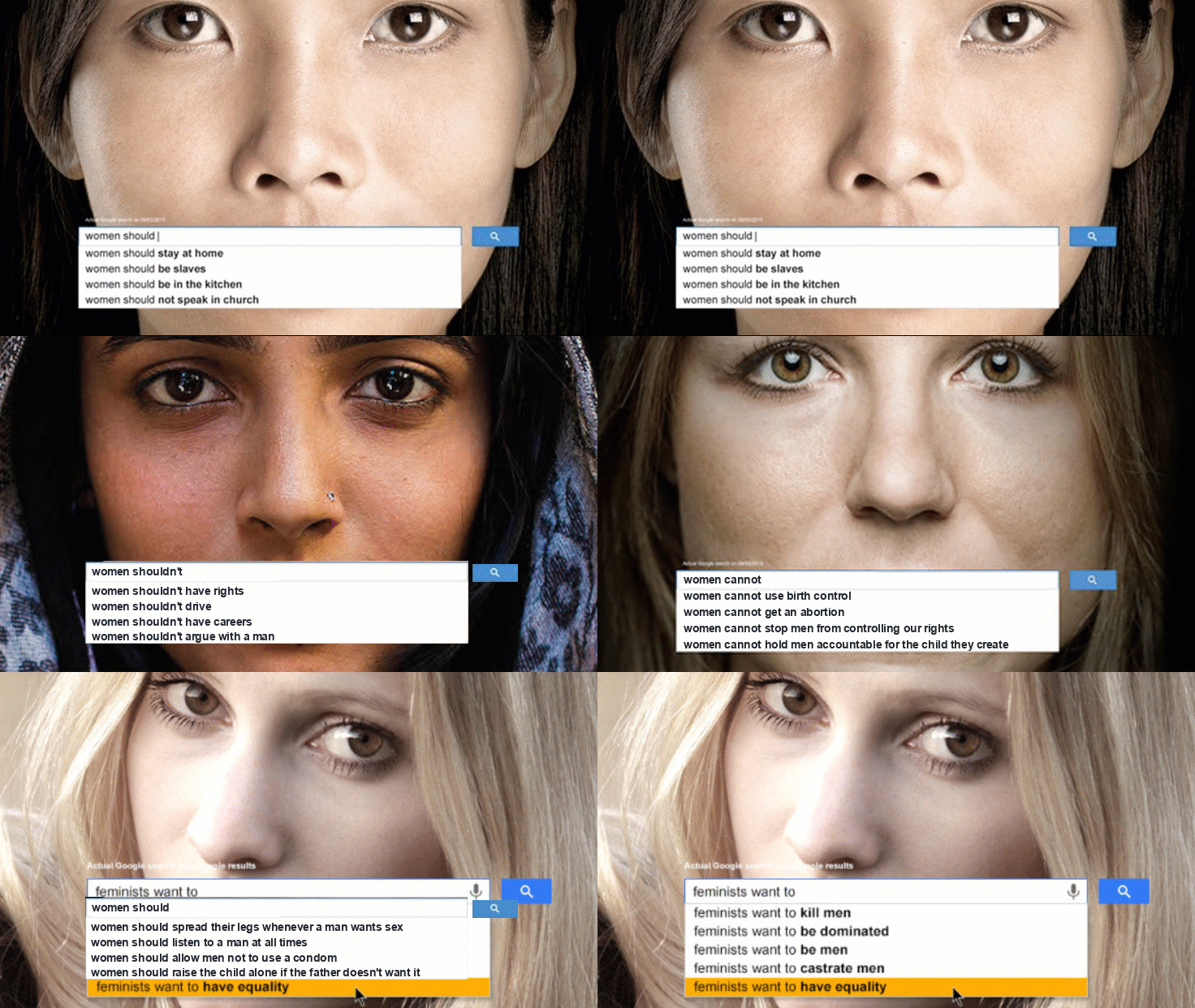
BELIEF. Both sexes still believe women are ‘less’ than men.
My father was born in 1929, when MEN WERE MEN, and everyone ‘knew their role.’ His mother, my grandmother, was a homemaker. His father, my grandfather, was a pianist for the New York Philharmonic, and the breadwinner for his family. To make it through the depression years, and the harsh realities of being a Jew through WW2, each family member had a role, a function to fulfill to assure the family unit was maintained—literally stayed alive, however modest an existence.
From caveman days through the 1940s many jobs required physical labor suited to a man’s physiology, as technology wasn’t here yet. Humans, not robotics, built our vehicles and appliances, and manufacturing was a man’s job even after the war, before it went offshore.
Fast forward to present day. Last Sunday my husband is reading me an article on the feminist #MeToo movement in the New York Times, while I cook pancakes for him and our two teens. At the end of the article he sighs heavily, his ‘this is absurd’ sigh, and says, “It gets so tiresome hearing women complain how hard they have it. It’s equally hard on men, and always has been.”
I looked at him incredulously, and said, “How many times have you been sexually assaulted on the job?”
He didn’t respond to my rhetorical question. I already knew his answer. Zero. He didn’t turn my question around. He knew an investor in my very first startup tried to rape me in my office at our Christmas party, then fired me that night for not letting him assault me. He knew my second job out of college, as an Art Director for 1928 Jewelry Company, the CEO came into the empty conference room moments after me, introduced himself, and instead of taking my outstretched hand, squeezed my breast, as if checking the firmness of an orange. I’ll never forget, he said, “Mmm, Nice!” before I pulled away, shamed as others I’d yet to meet walked in.
My husband wasn’t at my housewarming party, when a relative accompanying an invited guest tried to assault me when I found him at my work-space on my Mac. I could go on, but you get my point. And even knowing all this, my husband is “sick of hearing women whine about how hard we have it.”
Can’t blame him, really. My father-in-law talked down to my mother-in-law, probably all their lives together, but clearly in the 20 years I’d been on the scene of their married life. He was cruel and cutting with a continual barrage of snide ‘jokes,’ if he listened to her at all. My husband tells tales of his mom going ballistic on his dad every few months, probably when she’d had enough of trying to communicate with him while he verbally slammed her, or, by and large, ignored her.
To this day, most men do not BELIEVE a woman is as ‘equal’ to them as other men.
The problem is, most women BELIEVE this too. We do not feel equal. Why would we? We get paid less for the same job. Our bodies are more valued then our minds (as so many men, especially wealthy men—think Amazon’s Jeff Bezos, Fox News Roger Ailes, or Pres. Clinton—can’t seem to get their brain out of their little head). Our personal rights are being stripped away state by state as our Supreme Court dictates what we can do with our own bodies. Women are rarely taken seriously by the overwhelmingly male controlled business world, nor in our home environments.
How many women reading this post did most of the cooking and serving of your last holiday meal, even with a career/job? How many of you do most of the cooking, cleaning, chauffeuring of the kids, even working full time? The fact is, according to the 50 news articles I just read, women still do 80 – 90% of all domestic chores, including kid care, regardless of her job status. Equal pay for equal work, of course, but also equal WORK must be invested by both genders to reach sexual equality.
How do we get there from here? I honestly have no idea, other than to stand up, and say, “NO! Not OK,” whenever you are a victim, or see the action of SEXISM.
Since the mastodons are all gone, and we can now buy packaged meat at Safeway, we no longer require the muscular physique of the male physiology to survive as a race. Since most women are now bringing to the table of any union equal intellectual, logistical and financial support, men are rapidly losing their position of strength, figuratively and literally (with obesity at an all time high).
Men have dominated the business world from the beginning, and this too must change. It isn’t “locker room talk.” It is degrading, and women buy into it, thinking our value really is just in our breasts and how accessible our vagina to those that show interest. At the very least, women are made to feel we must acquiesce to this humiliating behavior men dish out to be heard at all.
This BELIEF, that women are lesser than men, by both genders must end, before SEXISM is a non-issue.
Humans, all of us, ACT as we BELIEVE.
Change the BELIEF, and change the actions of SEXISM.

 jcafesin.com