Why Tech WON’T Fix Your Business
A while back, a friend asked me what I thought about him taking a job offer at MIX.
“They’re the reboot of StumbledUpon,” he’d told me. “They want me to improve their recommendation engine, to keep the users they have with better recs, and to get new users by recommending them ‘better’ content.”
Hmm…MIX is a failing content curation platform started by Garrett Camp, co-founder of Uber.It has no valuable differentiators from Instagram or Pinterest, or even the dopamine rush of StumbleUpon’s random discovery model known as ‘intermittent reinforcement’— the most addictive reward system known in behavioral psychology.
“This is yet another startup looking for you to save them with tech,” I told him. He’d been down this road many times. As a seasoned data scientist, failing businesses reach out to his ML, NLP, and AI programming background, looking for him to come in and fix them—code collaborative filters and recommendation algorithms that will attract and retain users. But an AI rec engine isn’t going to fix MIX.
“Their platform is a marketing play,” I told my friend before he accepted the position. “This isn’t a tech fix. StumbledUpon at least was unique in its random “stumble” feature that made the site successful. Now MIX is trying to play catch up as just another content curation site. They need to continually come up with solid differentiators to attract users away from competitors, and tightly targeted ad campaigns to brand and sell their ever evolving unique features. And all that’s marketing.”
“A better rec engine could attract and keep users,” my wide-eyed developer assured me, stroked from landing the gig.
“What does a ‘better rec engine’ even mean? MIX can’t recommend content it doesn’t have. Neither can any other platform. Netflix rec engine sucks because they can only recommend movies in their library—content they have the rights to stream—and there are rarely any in their collection I’d like to see that I haven’t seen already.”
My friend glared at me because he was one of the original developers of Netflix’s rec engine. But he didn’t dispute the accuracy of my assertion.
“You asked me what I thought about you working for MIX, and I think it’s a bad idea. Job won’t last a year unless Garrett figures out he needs marketing now, not blowing capital on tech. I guarantee you, MIX needs campaigns that show unique benefits to attract users because they need content, and only when they have a lot of it will they then need you.”
Six weeks after my friend was hired, he was fired, along with the entire rec team. Bleeding cash from AI developer salaries, equipment and servers, Garrett was right to do so, even though he’d authorized every job req for his team of data science engineers. They were shocked to be abruptly terminated, as was an H1B employee, who, suddenly unemployed, found himself at risk of being deported back to India.
MIX has never had the reach that Instagram has, nor the communities Reddit, LinkedIn, or Facebook have built. They don’t need an AI correlation/recommendation engine at this point in their development. Almost a decade into MIX’s launch, they still don’t have enough users or sticky content to garner retention or quality affiliate advertisers.
Garrett Camp, the CEO, should have seen all of this coming had he been performing weekly competitive analysis, but his background is data science. He thinks, like so many developers, that all business problems can be solved with more tech. He got lucky with StumbledUpon, launched in 2002, the same time Google was getting popular. He got funding from Accel, one of the biggest VC firms in the Valley, which launched his trajectory into the entrepreneurial community.
StumbledUpon did not innovate, up their game with unique horizontal or vertical features, benefits, or new offerings. A few months after it launched, I got on it for a year or two, until Google provided the search results I wanted. MIX’s value became nominal, so I stopped using it. My behavior is typical. Retention, and sustained growth are continuous hurdles for most SaaS offerings.
StumbledUpon integrated Garrett into the startup and VC communities, which propelled him to his next, now infamous startup, Uber. And Garrett designed and built the first prototype UberCab, but he wasn’t the guy who made it a unicorn. That was Travis Kalanick, his co-founder. Travis studied coding in college but wasn’t a coder. He was a business guy, a salesman—the #1 job of a [good] CEO. Out of nine startups Garrett founded to date, all but Uber, and Eco (pivoted) have collapsed. This is typical for engineer-founded and run startups, which is likely why he gave job recs for engineers, instead of building out a pro-marketing team for MIX. Garrett clearly needs another Travis to achieve sustained startup success, or one hell of a marketing team for his content curation platform.
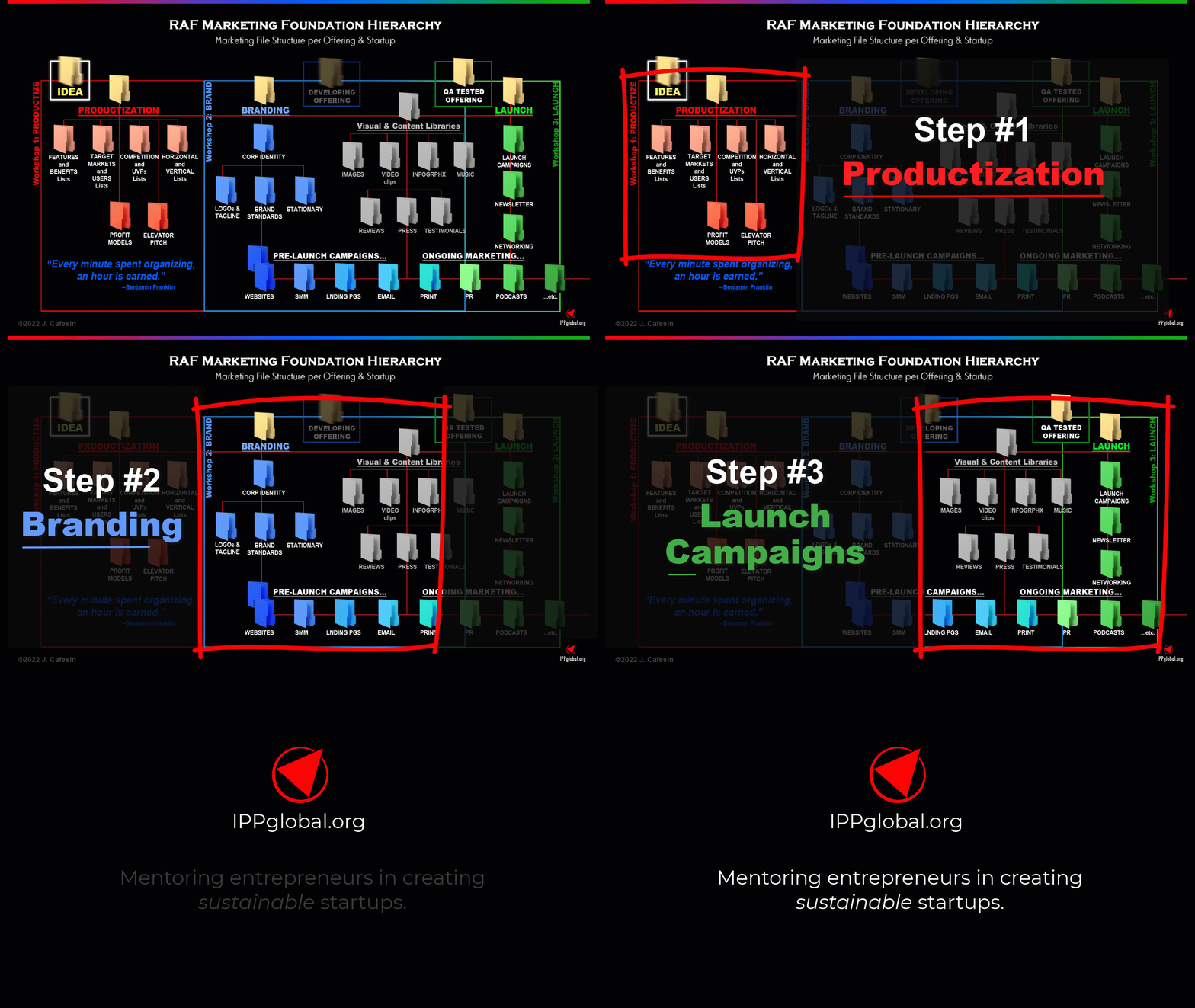
As of this writing, MIX is currently hanging on by a thread, experiencing a significant, multi-year decline in active users and traffic. To avoid becoming among the 90+% of startups that fail, MIX is going to need many users producing ‘quality’—sticky (as in funny, cute, informative, visually arresting, interactive)—content. And to get these users to their site, then get them excited to join, and stay engage on the platform, is NOT a tech fix. It’s a marketing play! Garrett must put a marketing foundation under MIX, go back to the beginning of the marketing process to propel his startup into a thriving, sustainable business.
PRODUCTIZATION (1st phase of the marketing process) of MIX:
- Identify Features and Benefits of MIX.
- Find and Profile Target Markets and Users.
- Discover Competitors.
- Identify and/or Create uniquely valuable Differentiators.
- Develop Horizontals and Verticals for a pipeline of new releases.