Most Everything I Know About People I Learned from Driving

I’m born and raised L.A. and have been driving since I was 14. And yes, illegally, but growing up in the 70s, if you wanted to go anywhere in the Los Angeles area, you had to drive there. There was no Metro Rail back then, and the buses weren’t safe for young girls, or anyone else really, and they were never, ever on time.

If I average out the time I’ve spent behind the wheel — from cruising most of So California until my first full-time job at 16, to crossing the Hollywood Hills at a snail’s pace, or sitting in traffic on the 101 or 405 going to school or work daily, to road tripping 1000 miles to Colorado every year for Christmas — best estimate, collectively I’ve spent a quarter of my life driving. And over the last 50 yrs, I’ve learned a ton about how people think by the actions (or lack thereof) they initiate behind the wheel.

To get good at anything takes practice, which is why most who’ve driven with me would say I’m a skilled driver. Scary, for sure, but I move through traffic smoothly, quickly, often getting to destinations an hour or more ahead of Google’s estimates. I can’t sit in my car on my cellphone, or space out behind the wheel like the Tesla or VW driver crawling along in front of me. Navigating traffic is a game, a psychological study weaving in and out, squeezing into open spaces, always looking ahead for what is going on, and around me for opportunities to move.

I’m not a defensive driver as the DMV handbook suggests. “The #1 rule of driving,” I told my kids when I taught them to drive: “Stay away from other drivers.” To accomplish this, especially in L.A. or any major city, one must be an aggressive driver.

The trick is knowing what type of vehicles to squeeze in front of, when to cut into a long line and what cars aren’t going to let you. It’s understanding who will chase and harass you if you cut them off or race them out, who to let pass, how to lose the idiot pacing you in your blind spot. A quarter of my life driving, and all these years behind the wheel has provided me a window into the psychology of the drivers of most every major automotive brand.

BMW drivers are categorically the worst on the road. Ranks #1 for total negative infractions* (tickets or crashes). Demographics of an average BMW driver (all models) tells us about them:

  • 70% Male
  • White, then Asian
  • Early-to-late 50s
  • Affluent
  • Highly educated

These are generally arrogant men, born of privilege yet internally angry, going through a mid-life crisis after achieving their financial and familial goals, but now, maybe even still, feel empty. They’ll cut you off in their M or 3 Series BMW sports models, then slow down in front of you while on their phone, completely unaware, or don’t even care there’s a line of 20 cars backed up and pissed off behind them.

Cut off or squeeze in front of a BMW driver, and most won’t chase or ram or shoot you. They’re not really paying attention to you, or driving, which is why you want to stay away from them!

RAM drivers are ranked #2 for worst drivers on the road. The RAM 3500 also has the ominous distinction of being the #1 deadliest vehicle, responsible for the most fatalities in the cars they hit. Their demographics tell us why:

  • 80+% Male
  • 70+% White, then Hispanic
  • Mid-30s to early 60s
  • Middle or above income
  • Careers in construction, agriculture, military
  • Politically conservative

These are MAKE MEN GREAT AGAIN followers. Pay attention on the road, and you’ll notice many RAM trucks with American and Support Police flags, or vote for [not my] pres stickers plastered on their bumpers and back windows. They’re generally disenfranchised men, often kids who failed out of school and became veterans, or are running small businesses on tight margins. They’re prone to flash anger and violence, and are gun rights advocates, so don’t piss them off behind the wheel.

Do NOT cut off, race out, or move in front of a RAM truck. Most drivers will harass you — follow too close, flash their lights, put on high beams, or worse. I’ve had a RAM truck race me out for 20 miles after I went around him going too slowly in the fast lane on I5 driving from the Bay to L.A. I’ve had another RAM driver pace me for miles so I wouldn’t pass him, then roll down the passenger window and point a gun at me, though he raced away without pulling the trigger.

Tesla drivers rank #3 for infractions, averaging approx 43 total incidents per 1,000 drivers. While Tesla commands over 50% of the EV market nationwide, owners are concentrated in very specific areas of the country. California has the highest Tesla sales holding half a million registrants. Florida and Texas are far below, followed by Washington. And as a SF native, and part-time resident of Seattle, I’d personally rank them #1 for worst drivers on the road. Two distinct demographic groups tell us why:

  • White Males
  • Asian/Indian Males (35–40% market share in SF and Seattle)
  • 25–50 years old
  • Single/Divorced
  • Highly educated
  • High earners
  • Careers in tech or medicine

First, you have the Driving while Arrogant issue. These are the privileged elite, and they know it. Wear it. Live it. Next is the ‘Driving while Asian’ (DWA) problem, the colloquialism known for a reason — Asian drivers tend to be slow, cut you off frequently, and seem rather unconscious of those around them. Add to this that these Tesla drivers thinking they own the road we all share, and it’s best to steer clear. Passing them is fine. They’re so busy on their oversized monitors or cellphones, they won’t notice.

The 26% women who own Tesla’s that aren’t a replica of the above males, are Woodstock nostalgics — with bumper stickers that say, “I bought this before Elon went crazy.” They’re too blank to know Elon was always crazy, and they’re not saving the planet with an EV because 83% of energy consumption in the US is still fossil fuel, and 58% of that is for the electricity fueling their Tesla’s.

Five decades behind the wheel has shown me the psychology of the driver by the vehicle they chose.

Speeding this along…

VW is ranked #4 for worst drivers on the road. They are one of the few car brands purchased almost equally by men and women (depending on the model). And you know their spacey drivers — the dippy 20 to 30-something putting on makeup or gaily chatting away on her cellphone completely oblivious to you, or anyone else on the road.

Cut them off, even flip them off and they generally don’t notice. If they do, they may give you the finger back, taking no responsibility for going 55 mpg in the fast lane in a 65 mph zone, oblivious they’re creating a dangerous road hazard forcing traffic to move around them.

Suburu is ranked #5 on the list of worst drivers. Ever sat behind a Suburu mom going exactly the speed limit with no one in front of her while she’s handing juice boxes to the kids in the back seat? And these are the safe Suburu drivers — with the fewest accidents, though they likely cause many with everyone passing them. Pass them, for your safety, and theirs.

The #5 rank comes from the Crosstrek and Impreza models. Both hold standalone crash rates where approx 10% of drivers have an active accident claim on their record. These are often young, first-time car buyers, and closely split by gender, urban college students, young professionals. The Problem with 20-something Brains, on Substack. Reading the post should cue you in on best practices for dealing with these drivers on the road.

Averaging 3 hrs a day behind the wheel and on the road with other vehicles, I’ve learned most drivers suck. Whether arrogance or ADHD, most drivers aren’t paying attention to the act of driving, which is why I taught my kids the #1 rule when operating a motor vehicle is to stay away from other cars! Colliding with a BMW or Tesla driver on their phone running the red light or cutting in front of you for that parking space at Trader Joe’s is statistically likely, while hitting a tree or one falling on your car is not.

To become a competent driver, and not just in your own mind, for everyone’s safety, and to lower our skyrocketing insurance premiums, PAY ATTENTION TO DRIVING! Note the psychology of the drivers behind the brands they drive, and act accordingly. But regardless of what you drive, here are some tips (not in the DMV handbook) from a seriously skilled driver with 50 yrs behind the wheel:

  • GET OFF YOUR PHONE.
  • Stop playing with your navigation (music, maps…etc).
  • Pass cars that go too slowly, or SUVs and trucks that impede your vision forward.
  • MOVE OVER to let cars pass who want to go faster (even exceed the speed limit — you are not a cop!).
  • DO NOT PACE other vehicles, especially in their blind spot. Give them a chance to move quickly should they lose a tire or want to avoid something in the road.
  • Stay away from other vehicles!

Road rage doesn’t come outta nowhere. It’s created by bad drivers.

Top 20 Car Brands — Total Negative Incidents per 1,000 Drivers
(“Negative incidents” = speeding tickets, DUIs, at‑fault crashes, non‑injury collisions, reckless driving citations, other moving violations.)

  1. BMW — 44.9
  2. Ram — 44.7
  3. Tesla — 42.8
  4. Volkswagen — 40.6
  5. Subaru — 40.3
  6. Acura — 39.6
  7. Infiniti — 38.8
  8. Mazda — 38.2
  9. Hyundai — 37.8
  10. Kia — 37.5
  11. Audi — 36.9
  12. Dodge — 36.7
  13. Chevrolet — 35.9
  14. Ford — 35.7
  15. Nissan — 34.8
  16. Toyota — 33.4
  17. Honda — 32.9
  18. GMC — 32.7
  19. Chrysler — 31.8
  20. Buick — 30.4

*CITATIONS
While the citations below confirm stats in this post, this essay is meant to entertain and enlighten, not infuriate. And even if you’re driving one of the above mentioned ‘worst drivers’ on the list, YOU aren’t one of them, right? ;-}

Vehicle Infraction List (accidents, tickets, DUIs):

BMW stats:

RAM stats:

Tesla stats:

VW stats:

Suburu stats:

Energy stats: https://www.eia.gov/energyexplained/electricity/electricity-in-the-us.php

Marketing to Believers

Do you believe in God and Jesus?

Why?

Likely because your mother taught you to — marketing to you throughout your formative years the benefits of belief:

  • Community
  • Solace
  • Salvation

Your beliefs were marketed to you through holiday celebrations, and maybe Sunday school and prayer. Even if mom, and/or your dad, didn’t directly push their beliefs onto you, they likely sold your religion to you via example: crossing themselves when hopeful; saying (and believing) “thank god,” instead of giving the credit to the person or people who brought about whatever they were thankful for.

Religion is a PRODUCT. Always has been — a way for the few in power to control the masses. Christians, Jews, Muslims, and all major religions have become successful, thriving businesses through MARKETING.

For most, your entire belief system is based on what has been advertised, marketed, and sold to you through your family first, then media, and likely your social circle — Christians hang out with other Christ believers, Jews with Jews, Muslims…etc., associate with their own “kind.”

Christianity is by far the largest held religious construct with 2.5 BILLION believers, almost a third of the global population.

By far, Christianity produces more marketing than any other religion. Like fake news, Christianity not only sells you on believing in the ethereal but also sells you on what to believe. They sell you on who and what to vote for, what you buy, and often who you shop from.

It is impossible to find real numbers on how much Christianity spends on advertising. Christian marketing pros make sure it’s a black box because they don’t want you to know they are spending trillions annually to sell you on believing, or concertizing your existing faith by selling you politicians, books, and businesses that megaphone Christianity. Christian books, too many to begin to count, Christian Superstores and Mega-Churches, TV and online evangelist, and movies like The Passion of the Christ, Noah, Heaven Is for Real, all are subtle (and not so subtle) marketing campaigns to convince you to become a Christian, or buy the products and services of Christian organizations if you are already a believer.

In fact, Christianity’s foundation is not God or morality. It is MARKETING. By Christian law, it is every Christian’s obligation to market — PROSELYTIZE Christianity to the world.

Most of you believe as you do because your belief system was manufactured and marketed to you continually throughout your life.

Faith-based marketing (FBM), generally Christian, is a strategy that recognizes the importance of religion to consumers. FBM attempts to tie an organization or specific product to a religion. Chick-fil-A, Hobby Lobby, Tyson Foods, Jet Blue, and the list goes on, associate themselves as Christian organizations to better market their products to the over $5.1 trillion a year spent by Christian buyers. Most of these companies use Christianity as a convenient cover story, but they do not practice Christian values. The struggling clothing retailer, and Christianity advocate, Forever 21, demoted most full-time workers to part-time status to avoid paying them medical benefits. This is typical for companies espousing Christianity. They market to your beliefs, quote the Bible to manipulate you into thinking they have any morality at all, to maximize your Christian dollars.

Passengers on Alaska Airlines received pocket-sized prayer cards along with their refreshments (until the backlash by customers threatened to hurt their income). Businesses that are not affiliated with any religion, like Coca-Cola, Pepsi, Bank of America, Dairy Queen, McDonald’s, Clorox, Delta Airlines all sponsor MegaChurch events. 20th Century Fox has a division called FoxFaith that produces religious-oriented films, often sponsored by the companies vying for your Christian dollars, and the Republican Party (GOP Marketing).

Christianity has been marketing to Republicans since the mid-1950s. President Dwight D. Eisenhower spearheaded the phrase “under God,” be added to the Pledge of Allegiance, and the 1955 law requiring “In God We Trust” to be printed on all U.S. currency. Dwight was not religious, but saw the Republican base swung strongly Christian, so he converted to Presbyterian, was publicly baptized, and won reelection a year later by a landslide.

In the early 1980s, a coordinated effort by the executive director of the College Republicans for Ronald Reagan, Ralph Reed, Pat Roberson (700 club televangelist), and Jerry Falwell (Young Warriors for Christ) campaigned to Christians to turn them into “America’s most powerful Republican voting bloc.” He sent direct mail marketing to church mailing lists across the U.S. to convince them that ‘liberals,’ and non-believers were destroying America, and reminding the church members about their obligation to vote for candidates that espoused Christianity. And it’s worked!

Republicans are now THE party of Christians. During the Capital Riots, Christian signage was everywhere: “Jesus Saves!” and “God, guns & guts made America, let’s keep all three!” Most of the Capital Rioters were/are Christian ‘believers.’ Crowds chanted, “Shout if you love Jesus!” And the crowd cheered back, “Shout if you love Trump!”

Target-marketing to Christians, especially low — mid-income Christians, has exceptionally high conversion rates — gets these people to buy, try, and subscribe with each campaign.

Why?

Conservative Christians are way more likely to buy into marketing than any other target demographic.

But why?

It is pretty simple, really. People who choose to believe in fairy tales (like a virgin birth of a married woman, resurrection, and eternal afterlife with a judge at the gates), without THINKING— just believing, taking it on faith that their mother and society must be ‘right’ — are exponentially easier to convince to believe in anything, no matter how absurd. So, when Fox News and other conservative media flood the internet and TV with marketing claiming the ‘2020 Election is a fraud, and Trump won, not Biden,” Christians tend to believe it.

Looking for high engagement with your marketing? Target and SELL your products, services, and ideas (real or fake) to true Christian believers.

What Happened at MIX

Why Tech WON’T Fix Your Business

A while back, a friend asked me what I thought about him taking a job offer at MIX.

“They’re the reboot of StumbledUpon,” he’d told me. “They want me to improve their recommendation engine, to keep the users they have with better recs, and to get new users by recommending them ‘better’ content.”

Hmm…MIX is a failing content curation platform started by Garrett Camp, co-founder of Uber.It has no valuable differentiators from Instagram or Pinterest, or even the dopamine rush of StumbleUpon’s random discovery model known as ‘intermittent reinforcement’— the most addictive reward system known in behavioral psychology.

“This is yet another startup looking for you to save them with tech,” I told him. He’d been down this road many times. As a seasoned data scientist, failing businesses reach out to his ML, NLP, and AI programming background, looking for him to come in and fix them—code collaborative filters and recommendation algorithms that will attract and retain users. But an AI rec engine isn’t going to fix MIX.

“Their platform is a marketing play,” I told my friend before he accepted the position. “This isn’t a tech fix. StumbledUpon at least was unique in its random “stumble” feature that made the site successful. Now MIX is trying to play catch up as just another content curation site. They need to continually come up with solid differentiators to attract users away from competitors, and tightly targeted ad campaigns to brand and sell their ever evolving unique features. And all that’s marketing.”

“A better rec engine could attract and keep users,” my wide-eyed developer assured me, stroked from landing the gig.

“What does a ‘better rec engine’ even mean? MIX can’t recommend content it doesn’t have. Neither can any other platform. Netflix rec engine sucks because they can only recommend movies in their library—content they have the rights to stream—and there are rarely any in their collection I’d like to see that I haven’t seen already.”

My friend glared at me because he was one of the original developers of Netflix’s rec engine. But he didn’t dispute the accuracy of my assertion.

“You asked me what I thought about you working for MIX, and I think it’s a bad idea. Job won’t last a year unless Garrett figures out he needs marketing now, not blowing capital on tech. I guarantee you, MIX needs campaigns that show unique benefits to attract users because they need content, and only when they have a lot of it will they then need you.”

Six weeks after my friend was hired, he was fired, along with the entire rec team. Bleeding cash from AI developer salaries, equipment and servers, Garrett was right to do so, even though he’d authorized every job req for his team of data science engineers. They were shocked to be abruptly terminated, as was an H1B employee, who, suddenly unemployed, found himself at risk of being deported back to India.

MIX has never had the reach that Instagram has, nor the communities Reddit, LinkedIn, or Facebook have built. They don’t need an AI correlation/recommendation engine at this point in their development. Almost a decade into MIX’s launch, they still don’t have enough users or sticky content to garner retention or quality affiliate advertisers.

Garrett Camp, the CEO, should have seen all of this coming had he been performing weekly competitive analysis, but his background is data science. He thinks, like so many developers, that all business problems can be solved with more tech. He got lucky with StumbledUpon, launched in 2002, the same time Google was getting popular. He got funding from Accel, one of the biggest VC firms in the Valley, which launched his trajectory into the entrepreneurial community.

StumbledUpon did not innovate, up their game with unique horizontal or vertical features, benefits, or new offerings. A few months after it launched, I got on it for a year or two, until Google provided the search results I wanted. MIX’s value became nominal, so I stopped using it. My behavior is typical. Retention, and sustained growth are continuous hurdles for most SaaS offerings.

StumbledUpon integrated Garrett into the startup and VC communities, which propelled him to his next, now infamous startup, Uber. And Garrett designed and built the first prototype UberCab, but he wasn’t the guy who made it a unicorn. That was Travis Kalanick, his co-founder. Travis studied coding in college but wasn’t a coder. He was a business guy, a salesman—the #1 job of a [good] CEO. Out of nine startups Garrett founded to date, all but Uber, and Eco (pivoted) have collapsed. This is typical for engineer-founded and run startups, which is likely why he gave job recs for engineers, instead of building out a pro-marketing team for MIX. Garrett clearly needs another Travis to achieve sustained startup success, or one hell of a marketing team for his content curation platform.

As of this writing, MIX is currently hanging on by a thread, experiencing a significant, multi-year decline in active users and traffic. To avoid becoming among the 90+% of startups that fail, MIX is going to need many users producing ‘quality’—sticky (as in funny, cute, informative, visually arresting, interactive)—content. And to get these users to their site, then get them excited to join, and stay engage on the platform, is NOT a tech fix. It’s a marketing play! Garrett must put a marketing foundation under MIX, go back to the beginning of the marketing process to propel his startup into a thriving, sustainable business.

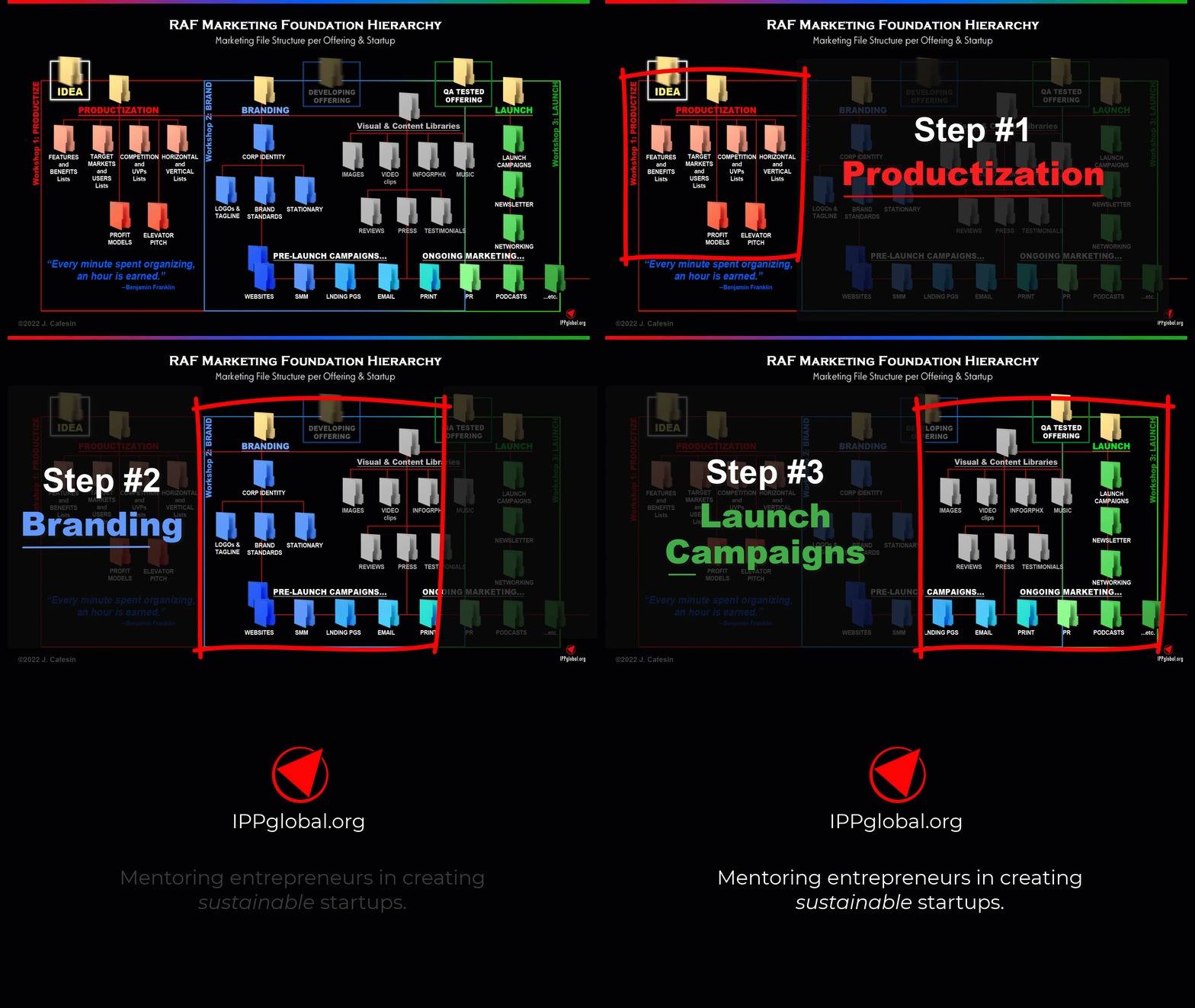
PRODUCTIZATION (1st phase of the marketing process) of MIX:

  1. Identify Features and Benefits of MIX.
  2. Find and Profile Target Markets and Users.
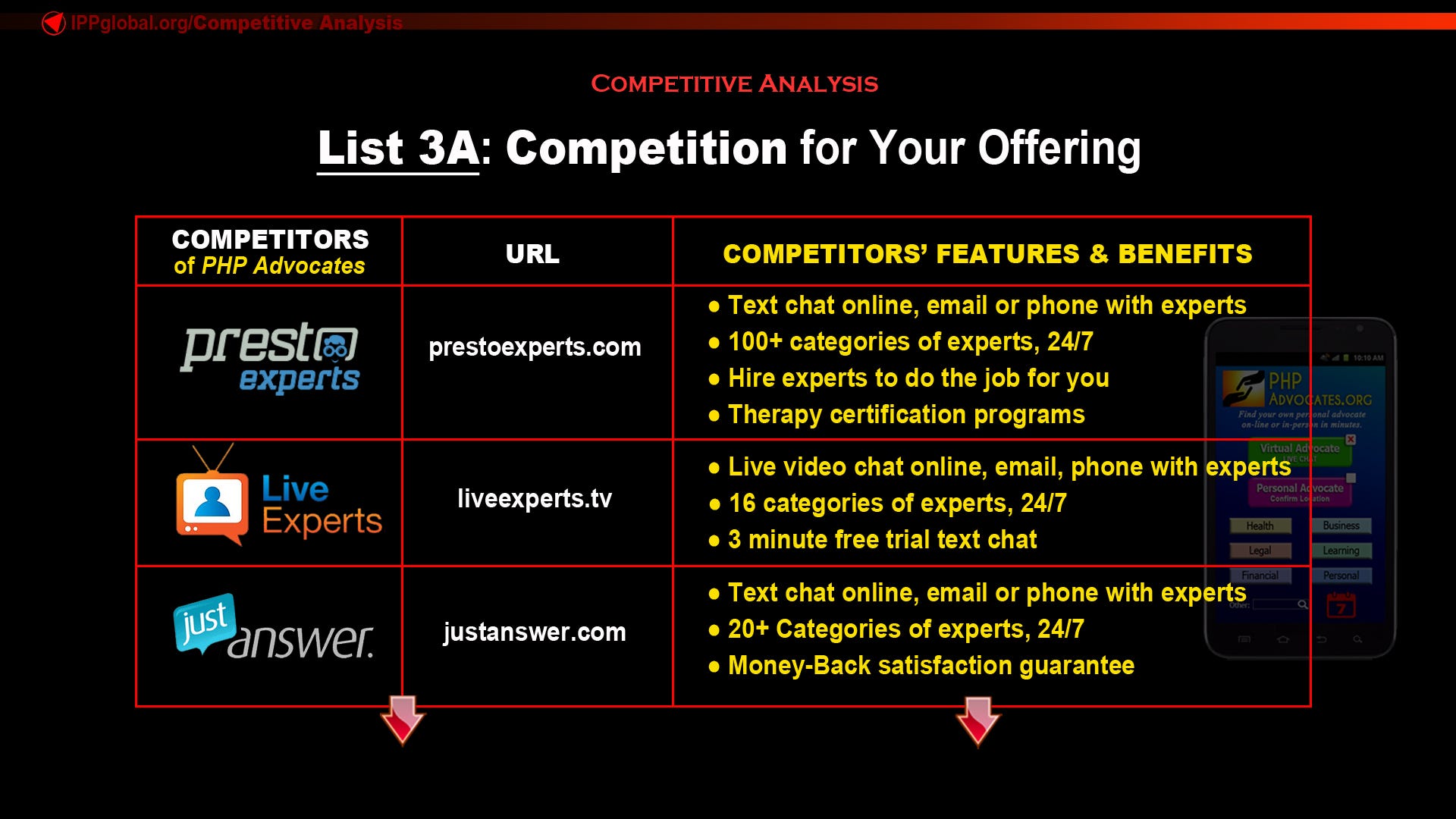
  3. Discover Competitors.
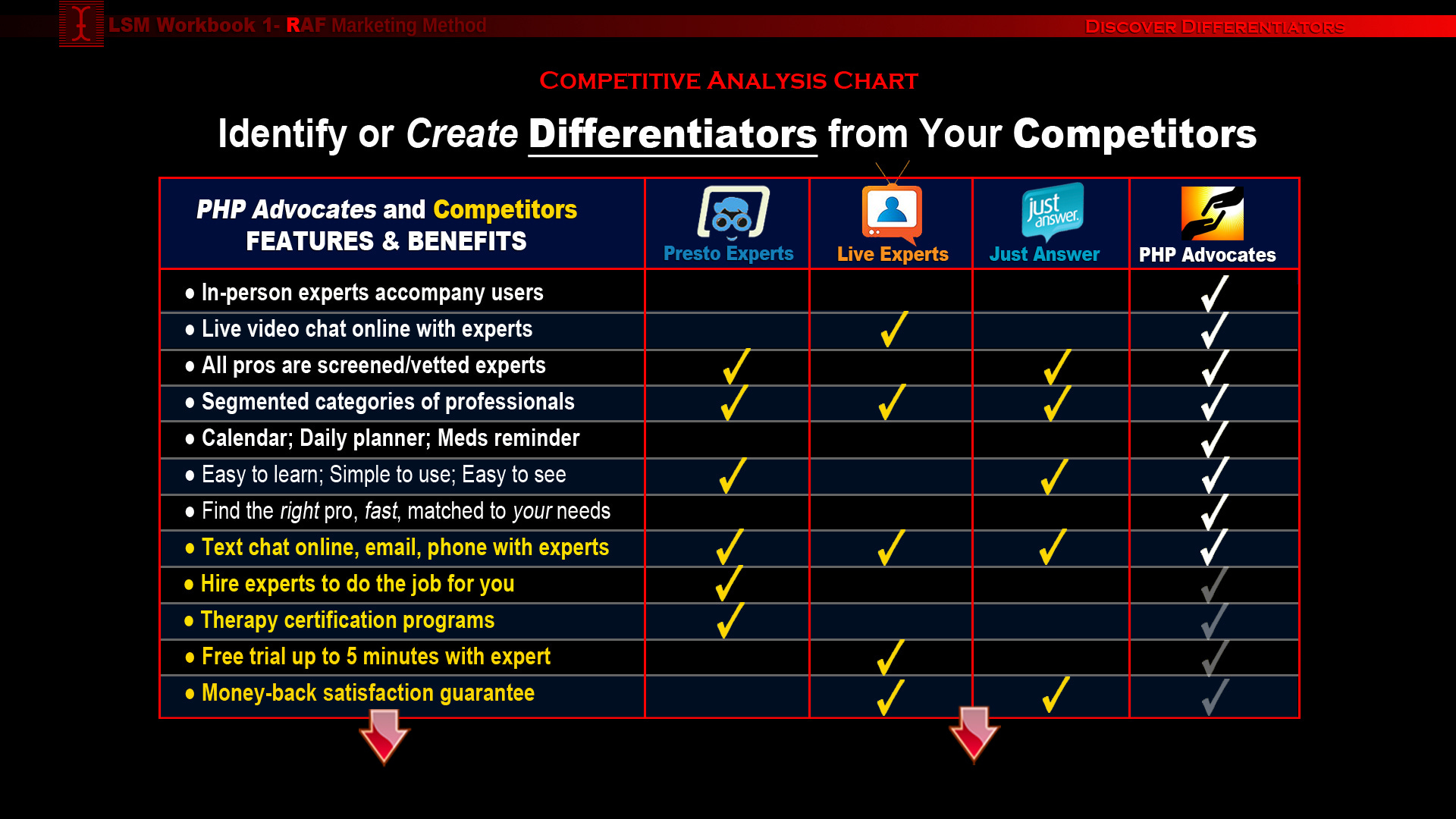
  4. Identify and/or Create uniquely valuable Differentiators.
  5. Develop Horizontals and Verticals for a pipeline of new releases.

How to Find Startup Competitors

The Competitive Analysis process, step-by-step…

I want to find competitors for my fantastic AI SaaS application. Well, let me be clear. I don’t want to find competitors already producing my brilliant offering, but I know it’s smart to look for them before investing a lot of time (and time is money in business), in developing and marketing an idea that’s already available.

I am unsure of who my competition may be. As stated, I really don’t want to find any, so my brain probably isn’t accessing the possibilities of who these companies could be if my heart isn’t into the competitive analysis process. I need a plan, a method, some steps to follow and perform, to find out what I don’t want to know.

I must be brave and locate my competitors.

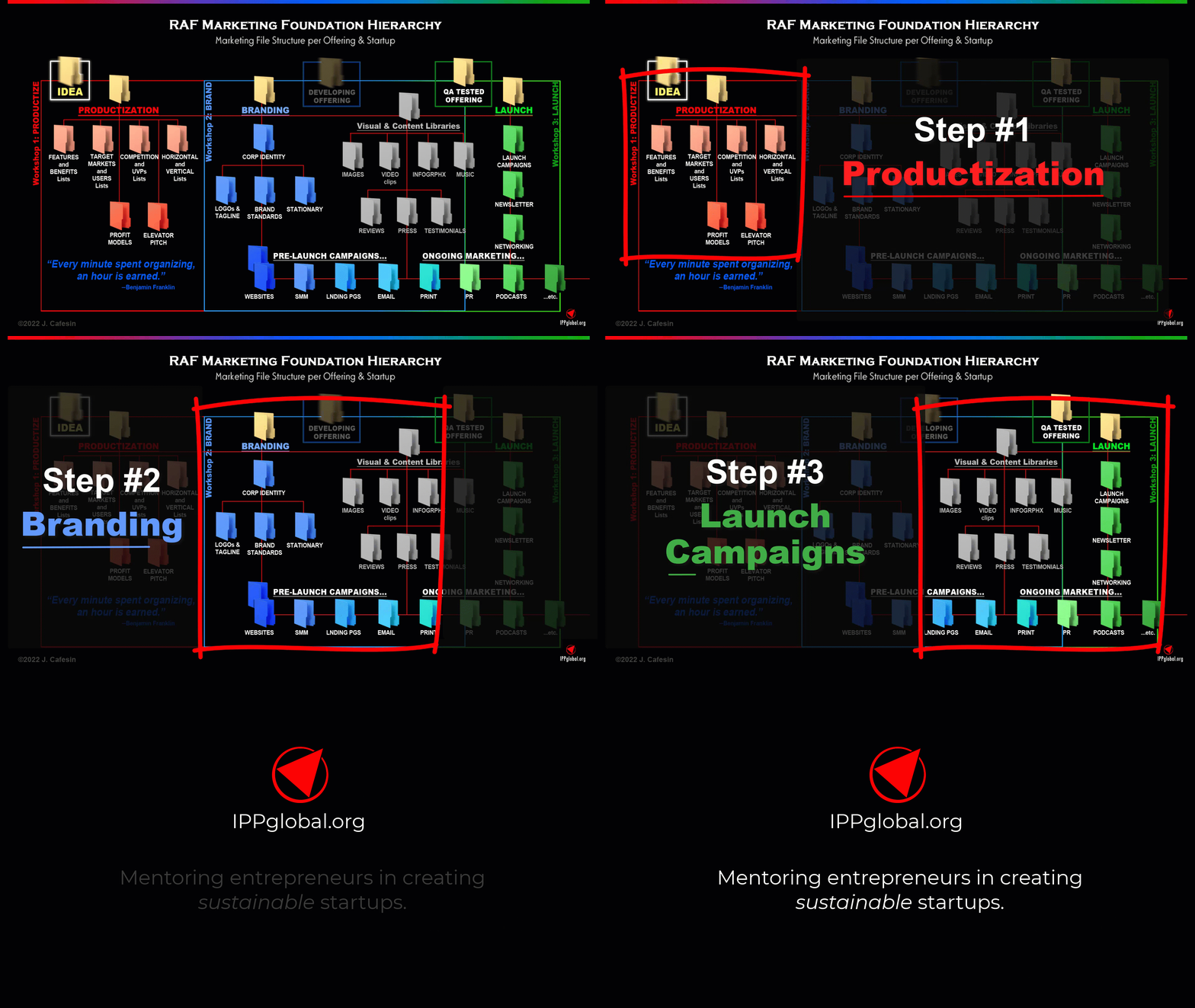
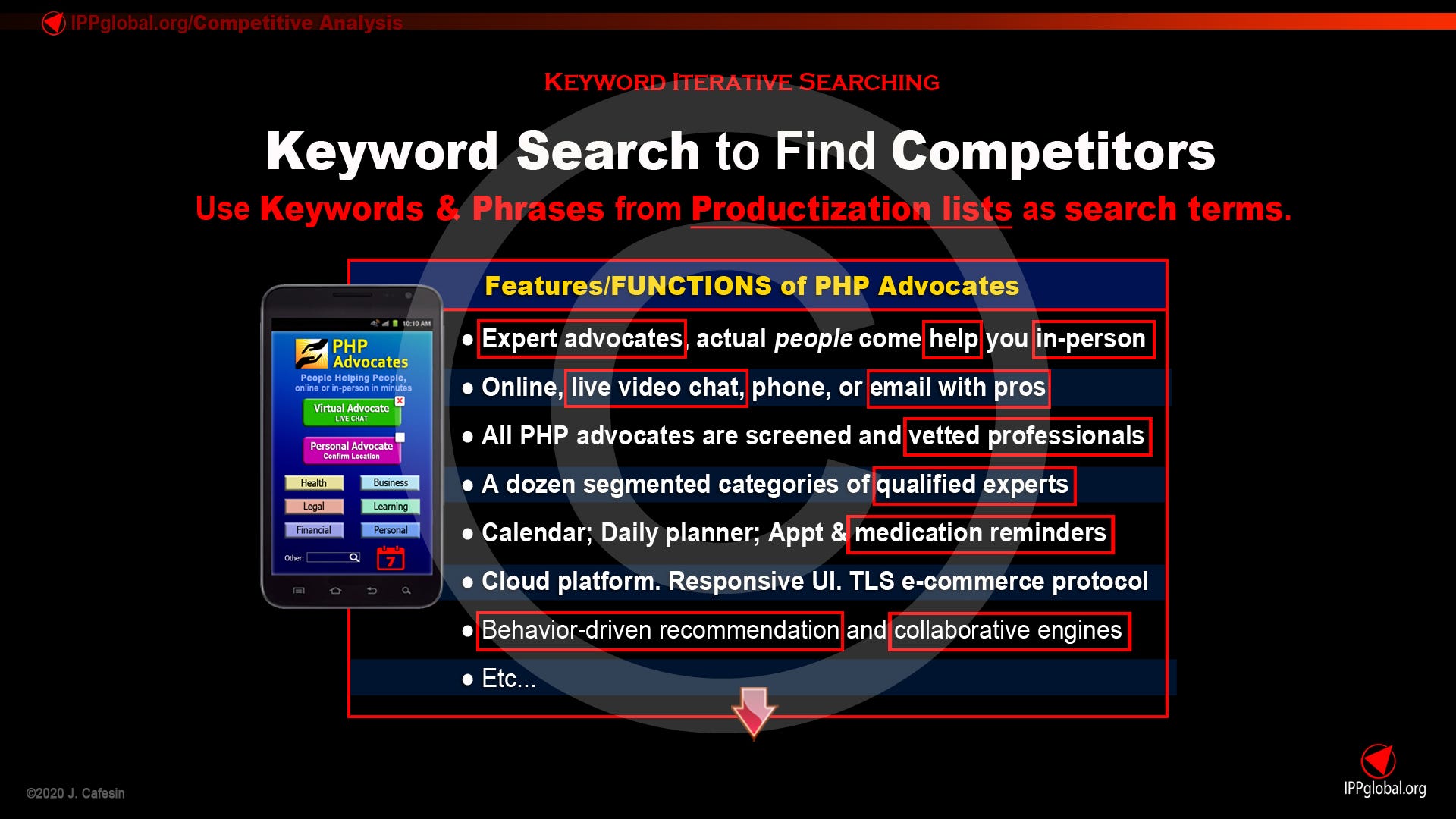
To quickly locate direct and indirect competition for your offering, use the iterative search process. Choose keywords and phrases closely related to your offering as search terms. How do you choose the most efficient words to begin your initial search? If you’ve done your Features and Benefits list first, you have bullet lists of keywords and phrases directly related to your offering on your first 4 (of 8) Productization* lists.

Utilize these Productization lists by lifting words and phrases to use as search terms. Find competitors producing an offering directly or indirectly related to yours, meaning, not only very close to your offering, but similar offerings as well.

Of course, you’re going to find competitors, if you are thorough, and tenacious, and keep searching until you find them.

When you do, you may start to think it would be brain dead to spend time developing and launching an offering already being done by others, currently building the market share you want. Most every innovator runs up against this issue when they perform competitive analysis. But remember, it doesn’t mean your idea is dead just because you’ve got competitors.

A part of your job as the CEO of your idea, is working around roadblocks. THINK about what you must add to your original product idea to make it unique. Consider what your target users are not getting from your competitor’s and provide them your improved offering. Disrupt an industry, or the status-quo with your unique new offering to the business marketplace.

It is critical to the success of your business, any business, to keep a dynamic list of your competition. Carve time out of each week to do a quick search. Look beyond Google and Chat as these apps only return what it ‘thinks’ you want to see. Research publications from your industry.

Fridays, with your morning coffee, iterative search the internet, and identify any new competitors that have popped up, or discover a known competitor’s product upgrade or new release. Do not delete competitors that go out of business but indicate the date they folded or liquidated. There is a wellspring of information in a business failure, and a user-base looking for an alternative to the defunct business.

By continually searching for your competition, you’ll find out about them quickly, and be able match, or surpass each of their offerings with great new offerings of your own. And it’s imperative you release updates, or new offerings every 9 – 12 months or so. If you don’t, your competitors likely will.

*https://www.ippglobal.org/competitive-analysis

How to Generate Product IDEAS

Need an IDEA [that will likely SELL] to Startup?

Many want to be entrepreneurs, but most people lack product ideas, or can’t think of a service (or app) that isn’t already available.

For over a decade, I taught entrepreneurship at Stanford and Cal Berkeley/Haas. I designed a course to teach the process of turning an IDEA (or product in development) into an offering that SELLS, and building sustainable startups.

Below is the 1st CHALLENGE in the course. It is designed to teach the PROCESS of PROVING an IDEA will sell BEFORE (taking the time and investing the money) developing it.

CHALLENGE #1: Generating PRODUCT Ideas

If you already have an idea (or product in development), skip this CHALLENGE. Focus your learning through the process of validating your existing IDEA.

It is highly recommended that you have an idea to actualize, in order to realize the full potential of this course. The idea is less important than working the process, so don’t dwell on creating a brilliant offering, or even one that you will produce right now (if ever). Learn by engaging in the process, and you’ll be able to actualize most any idea you have now, or any that may come, by simply following the steps of the RAF Method, in order (kind of like working a math equation ;-).

Imagine creating something that solves a recurring problem. Now, come up with a basic (even vague) idea of a fix for your recurring issue…

1. THINK of at least five (5) PROBLEMS you frequently encounterand create a document titled: “MY FREQUENT PROBLEMS.” Number each problem as shown (though your LIST does NOT need to be by priority).

Examples:

  1. Trash bags that don’t fit or stay fixed to the rim of the can.
  2. Spending an hour or more online looking for a movie you’ll actually like (since Netflix’s rec engine, as with all streaming services, only recommend the content they have).
  3. Xfinity’s internet access that keeps crashing while you’re watching the movie it just took you an hour to find.
  4. Your kids are not doing well in school.
  5. You have no one with whom to share how you really feel, and you can’t afford therapy.
  6. You get tired by 3:00p.m. and want a wake-you-up, but slow burning energy snack.
  7. You can’t get a good job without work experience. And you can’t get work experience without a job.
  8. You know it’s unhealthy for your dog to be locked inside all day, but there’s no way to let him run and play during your workday.

2. LIST [at least] five (5) SOLUTIONS to your list of problems.

Examples:

  • 1a: Trash bags made to fit a variety of can sizes, with a 3” wide rubber-band around the top.
  • 2a: An app that figures out individual preferences for movies and recommends platforms with your desired content.
  • 3a: Some issues we can’t do anything about. If Xfinity is your only internet provider (as is ours), you’re screwed.
  • 4a: Software that recognizes bottlenecks in learning, and dynamically provides content geared to what student likes or will engage with.
  • 5a: Chatbot specifically designed to engage in therapy, available when you need to talk 24/7.
  • 6a: My organic, low-fat, gluten-free, great-tasting cupcakes and scones.
  • 7a: A platform, both online and live meetups, that matches students or recent grads with corporate internships.
  • 8a: A P2P service of local, professional pet care advocates, from doggie daycare to personal pet assistants.

3. Pick ONE (1) of your SOLUTIONS. Use the solution you’ve discovered in this challenge as the IDEA you’ll validate and market for profit throughout the LSM workshops. Walking the RAF method, even with an IDEA that you’ll never actualize, teaches you the PROCESS of taking any IDEA, and PROVING it will sell BEFORE developing it.


CHALLENGE #2: Generating STARTUP Ideas

Unlike finding solutions to problems, as in CHALLENGE #1, in this exercise you will begin with what you enjoy doing. While I’d like a trash bag that stays on the can, I wouldn’t find much joy in developing this particular product, as I have no interest in plastics, rubber bands, or trash.

To endure the missteps and do-overs required in launching any business takes real tenacity, that will be challenged again and again with each disappointment. You’ll want to give up, but don’t quit! You’ll learn to iterate (or pivot as they say in the Valley).

It’s important to build your business around something you enjoy doing, a task you [generally] like to perform (whether you’re being paid or not). A job that engages, excites, will help you weather the onslaught of hardships, as you’ll be iterating on what you already enjoy doing.

1. LIST three (3) of your top interests. Be as specific as possible!

What do you love to do (or even like to do)? Are you a gamer? An athlete? Like to bake? Shop? Read? Enjoy traveling? Gardening? Crazy in-love with your dog, or cat, or parrot?

2. LIST [at least] five (5) things you like to do — activities you enjoy engaging inDon’t worry about how profitable they may be. Just list what you enjoy doing. Note, you won’t always enjoy even tasks you generally like.* I’m a writer, and often find the writing process frustrating, but overall I love to write.

3. Come up with ONE (1) IDEA for a product or service that’s in-line with one [or more] of your interests and/or pleasures.

Examples:

  • You’re a gamer and have an IDEA for an MMOG that’s better than World of Warfare.
  • You bake the best scones on Earth, and you want the world to taste ‘em.
  • You’re a science fiction fan, and want to share your thoughts on movies, shows and other finds on an All Things SciFi podcast.
  • You’re an avid reader and want to share your thoughts on a literature review blog.
  • You love real estate and want an app that gives all the information about a property instead of the current platforms like Redfin hiding critical data.
  • You love your mom, and she need someone to take her to her doctor’s appts, shopping…etc. — Uber meets vetted and qualified (medical, financial…etc. pros) on-call personal assistant.

Use ONE (1) IDEA to actualize through the RAF Method, and create offerings of value, for profit, with a job you’ll love to do, daily.


*You won’t always get to do things you like when validating and actualizing IDEAS into products for profit. You’ll have to take on job functions you hate, but are necessary to launch and grow any business. I love to write, but I hate marketing my work!

Marketing Data Science

What motivates people to RESPOND (click, like, share, comment), and CONVERT (buy, try, sign-up, subscribe) from your marketing efforts? This is a very important question, because the point of marketing is to get people to [think or] do what our campaigns [suggest or] direct them to do.

At the foundation of all marketing is Psychology. To be effective at marketing — getting people to buy our offerings or believe in our message — we must seek to understand what motivates our behavior.

BIG data science—the AI of today—monitors and categorizes our digital and cellular interactions, but NOT what motivates individuals to take a particular action. I use the word BIG because without a LOT of data, there is NO SCIENCE in data analysis. BIG data can recognize GROSS PATTERNS OF BEHAVIOR, which can be applied when marketing to large segments of the population, however, for most businesses using only paid digital ads to brand or sell your stuff is generally a waste of your marketing dollars.

Data science doesn’t work at TIGHTLY targeting individuals because PEOPLE LIE.

Psychology is more an art than a science. Humans are complex beings, our [perceived] needs and desires constantly changing with age, and life circumstances. We lie to ourselves — tell ourselves we need* things we don’t, or make promises we never keep, like dieting, exercise, control spending, be more productive, less time on our devices, YouTube…etc. We lie to each other, because we believe it ourselves, or we want to appear smarter, kinder, wiser. We ALL fib, exaggerate, fabricate, remember wrong, because memory has been proven to be faulty. Humans are fickle, which is what makes figuring out what motivates us particularly difficult when we often don’t know ourselves.

Facebook, Google, Instagram, most every site you visit now is ‘analyzing’ your digital (and cellular) footprint with their large language models (LLMs), and large action models (LAMs). Platforms selling digital advertising, and unfortunately their users, rely on AI to ‘target’ your marketing, but they know virtually nothing about YOU because AI can’t tell the truth from a lie.

We are just beginning to identify a few basic behavior patterns common to most of us through BIG data collection and analytics. However, identifying patterns and categorizing behaviors does not automatically give us the reason why someone chose to take an action.

Today’s AI doesn’t ‘learn’ what motivates each of us, regardless the hype. It mimics learning by recognizing patterns, then correlating, categorizing, and collaborating distinct behaviors into groups. The ballooning BIG data (AI) industry has great marketing though, because they’ve convinced most (young) marketers that creating campaigns on analytics alone will garner greater SALES, though this is a lie.

Remember, our psychology is what gets us to believe in a cause or take any action. Humans are dynamic, complicated, volatile, erratic, and to get what is truly motivating us is really hard since we lie so often to ourselves and others. We all do, as previously stated. Like it or not, every one of you reading this post lies. A lot! We lie to appear politically correct, even though we are all born racists. We tell ourselves all kinds of crap to excuse unhealthy behavior, and rationalize our positions with even more crap that we tell others. Everyone does. Lying is a human condition, like self-interest. We all lie/justify/rationalize to ourselves, and subsequently others — loved ones, friends, colleagues, strangers — most every day of our lives.

TARGETED [digital] marketing is supposed to get advertiser’s ads in front of the people most likely to find interest in them. The truth is, Google, Insta, TikTok…etc. don’t have a clue who is posting lies, or why. So, when your analytics dept, or AI on the Facebook Ads app tells you it KNOWS the target markets for your offering, without intimately knowing the best bits about the offering you’re selling, FB’s lying to you. Even with all their BIG data analytics of our digital footprint, quantitative data doesn’t tell us qualitative reasons why anyone really does most anything.

Response rates average between .05–2% with most digital advertising, which is actually LOWER than with email, TV, even print and other ‘traditional’ media.

So much for the wonders of data science making your marketing work to sell your offerings. And all the Likes and Shares in the world won’t SELL YOUR STUFF. Smart marketing requires more than letting Google Ads’ interface pick your target markets, even write your ad copy while you upload an image or vid. If you want better response rates, as in CLICKS on the links you provide in your ads, you need to take the following steps. IN ORDER:

1. List as many real, potential [and perceived] FEATURES of your offering as you can.

2. Identify the PEOPLE (target markets) who will BENEFIT from the best FEATURES of your offering.

3. Create original marketing and ad campaigns that align/sync/match the best FEATURES of your offering with those most likely to BENEFIT/want them.

Effectively marketing an existing offering, new product/service/message, or even an idea requires actually THINKING about the TYPE of person who will likely BENEFIT the most from the unique FEATURES of what you’re selling.

When Google and Facebook tell you they know who (target markets) will find interest in your offering knowing nothing about what you’re selling, or the people that will BENEFIT from using it, well, they’re lying to you. Their ‘targeting’ is KEYWORD based—NOT our psychology. Additionally, when people post on their social feeds, they often post falsehoods/lies, either because they’ve convinced themselves it’s the truth, or because they are trying to market, i.e. SELL/brand themselves to others. Facebook’s AI can’t tell the truth from a lie, especially since so often we can’t, even to ourselves.

Another TRUTH: most advertising lies. Marketing sells real benefits, as well as perceived benefits. Apple sells the perception their devotees will be ‘more creative’ if they use Apple devices, but this is a lie. Creativity comes from inside of us, not from the technology we use to create it.

Sure, there’s bound to be many who will tout success with data science, especially large corps and political orgs that spend billions annually flooding our feeds with ads. Thing is, throw enough shit against a wall and some of it will stick, which is why digital ad platforms can show results. They’ll spend your marketing dollars for more bullshit stats of Likes that may feed egos but does nothing for sales.

  • Google, FB, social media ads [generally] get a .05 – 2% response rate.
  • Networking yields 20-40% response.
  • Email gets [approx] 25% open rate.
  • Even print [geotargeting] will garner 4.4 – 9% response.

Smart marketers/marketing—the kind that yields SALES—knows what they are selling, intimately. They design, write, and produce campaigns that will spark interest, engagement, and funnel to sales because they’re always marketing the FEATURES of their offering that fulfill a desire or BENEFIT a specific TARGET MARKET. Producing SMART MARKETING with every campaign will SELL YOUR STUFF, without using data ‘science’ at all.

*NEED is a philosophical construct. We don’t NEED anything, not even food if we don’t care about living. Humans DESIRE things—possessions, children, relationships; to feel ‘happy,’ satisfied, sated…etc.

Smart marketing creates [perceived] NEED from DESIRE.

R.I.P. Information Hwy

Your phone is a tool you’re using, or a tool that’s using you…

I’m watching The Politician on Netflix while working out. The scene is on a teen and mom in their kitchen, arguing about which state senator to vote for in the upcoming New York election.

Teen is a first-time voter, just 18. She’s going to vote for the 24-yr old male candidate on the Green ticket, running solely on the climate platform, with no political or real work experience. She’s disgusted with the middle-age female incumbent, virtually unchallenged in every election the last 20 yrs, until now.

Boomer,” the teen mocks her mother’s choice of the older incumbent. “The world is gonna end in 10 years, Mom.”

“I am barely a boomer, okay?” the mom defends. “So don’t throw that shit at me,” she says. “And the world is not going to end in 10 years, Jayne!” She starts listing all she does for her daughter — the vegan cooking, the composting, and even the hyper-vigilant recycling her child insists on. “And still, I’m the problem, according to you.”

“Not you, Mom. People your age.”

Watching this scene unfold, I feel my body tense as I run on the machine. I AM her mother’s age.

“Let me tell ya something, Jayne. People your age think you know everything and you are fucking naive. When I was your age, I thought I knew everything too.”

“We’re not naive, Mom. We’re informed. You had, what, like two newspapers, three networks. I’ve got a SUPERCOMPUTER in my pocket.”

She is, of course, referring to her cellphone, and, in fact, showing me how naive this teen really is.

Unfortunately, Mom didn’t come back at Jayne. Mom doesn’t know (nor the writers of the show apparently) that the SUPERCOMPUTER in both their pockets, well, isn’t informing them of anything but what they already believe, and about things they likely want. So, in effect, it is MANIPULATING this ignorant, yet rather arrogant child, (and many others) into believing they have a SUPERCOMPUTER in their cellphone.

The cellphone you all carry around, (as I don’t have a smartphone, so really, it is all of you), isn’t INFORMING you, it’s ‘recommendingyou read, watch, buy, and even think about what advertisers on the internet want you to.

Today’s internet is NOT unlimited access to unfettered information like the world wide web once was. You’ll be hard-pressed to find anything through any Search engine that hasn’t been filtered through a rec system which parameters have been defined by the data you (or others like you) have willingly given.

The Netflix documentary The Great Hack makes it clear the SUPERCOMPUTER in your pocket is manipulating you, and millions like you to believe in lies through the endless onslaught of personalized advertising. Throw enough shit against a wall and some of it will stick. Russia paid Google, Facebook, Insta…etc. fortunes in ad campaigns pushing the conservative Republican agenda to get Trump elected. Twice.

The internet is now a MARKETING ENGINE to make media platforms and SaaS apps money. The cellphone, tablet, laptop you’re using has become proficient at USING YOU. Every time you log onto Instagram, Facebook, YouTube, ChatGPT, Google, they ‘scrape’ your posts, simultaneously putting ‘cookies’ on your device to follow you wherever you go on the net, and in real life.

Your mobile has an accelerometer in it tracking how fast you’re moving (so your car insurance knows how often you’re over the speed limit). GPS informs Google, Verizon, and their like where you are on the planet, revealing typical behavior patterns like when and where you shop.

Your pocket SUPERCOMPUTER collects who you talk to, what you say, what you read, watch, and frequently visit. Most every online interaction is ‘data mined.’ Trillions of posts, texts, IMs, searches, online (and in-store) credit card purchases are continually collected, stored and analyzed. Retail knows how much you make by how much you spend, and charges you more the more you make, or if your address is Beverly Hills. Not a conspiracy theory. It’s called dynamic personalized pricing.

Watching The Politician, Jayne’s mother doesn’t seem to get any of this. I’m deep into the second season and mom’s as addicted to her cellphone as her daughter. Jayne doesn’t want to believe she’s being exploited, or doesn’t really care if it’s true. She gives her data away freely, every time she signs onto the internet. She clicks, “I AGREE,” and never bothers reading the disclaimers.

Machine Learning (ML), Natural Language Process (NLP), Deep Learning, AI (LLMs, LAMs, AGIs), are all software processes used to analyze then correlate BIG DATA for patterns of behavior.

COLLABORATIVE FILTERS [à la] Wikipedia:

Collaborative filtering is a method of making automatic predictions (filtering) about the interests of a user by collecting preferences or taste information from many users (collaborating).

In other words, gathering and filtering your data from the net tells Amazon, Google and Instagram what you (and those like you) will likely buy, or what rhetoric you’ll likely buy into — believe in. Then these platforms slam you with marketing targeted AT You, NOT “For You.” They want to SELL YOU offerings and ideas supported by their affiliate marketers (like Republicans, and Russia).

Google Search prioritizes Search results by businesses that buy the most ad space on their platforms. Corps spending millions dominate the digital ad space, skewing response results for smaller businesses.

I used to get many pages of returns on any given Search a decade ago. Not anymore. Google will not give you information that they feel you don’t need (and won’t serve their agenda), based on your internet and ‘SUPERCOMPUTER’ cellphone activity and history.

My GenZ daughter and her friends are on the same page as Jayne in The Politician. They’re simply ignorant of what they’re addicted to — how their phones are manipulating them to THINK, FEEL and ACT. She is SURE that “no one is manipulating me, Mom!” She “knows” when she’s being hit with ads, and she just “ignores them.”

I call BULLSHIT.

We can’t ignore what we don’t even know is happening while we’re IMing through Instagram on our mobile.

Just IMAGINE my friend Mary’s experience:

Mary is IMing a good friend on Insta, whining about her marriage.

Instagram’s algorithms are scraping her and her friend’s IM for SENTIMENT ANALYSIS to find out where Mary might be vulnerable to purchase something…anything really, as Insta has advertisers that sell just about anything.

The next ad Mary sees on her mobile is for a singles dating site. The ad is targeted at divorcees, showing an older woman having fun with a stunning man, and the copy says, “Your last chance at true love.” In a few short sentences, the copy describes the relationship you’ll find on their site like a Cinderella story.

A while later, Mary goes on to Facebook, and YouTube, and the next series of ads she sees vacillate from singles dating sites to divorce lawyers. These ads, and recommendations for movies, articles, blogs, posts about dating after divorce…etc. appear in her email, and in her social feeds, and most everywhere she goes online.

Mary never mentioned divorcing her husband when IMing her friend. She’d not even thought of it, really. In fact, she’s frequently sounded off about her marriage to friends through IM, as many women do. And it isn’t the first time Mary has gotten these dating and lawyer ads. It’s been going on a long time now, one ad after the other every time she even posts a back-handed joke about marriage in general. And after this last fight with her husband, well, like the ads keep saying, Mary deserves more! Like the ads say, she can find someone better than her husband. And like the ads say, a divorce will, “Open her life to the possible!

These ads appear whenever Mary is expressing her frustration with her marriage. (Marketing is an iterative process.) And instead of looking to make it work with her husband, after a while all Mary wants to do is divorce and ‘open her life up to new possibilities.’

To Instagram, Mary’s divorce is a WIN! Their algorithms and the engineers who code them don’t care they’ve torn apart a family, for their profit. The software did its job and rewarded their advertisers. Some lawyer who advertises on their site just got themselves a client. Some dating app that spends millions annually in affiliate marketing on their platform just got a new subscriber. Multiply that with the hundreds of thousands of businesses doing affiliate marketing on the net, and you have, well, today’s internet.

NOT a SUPERCOMPUTER. And no longer, “The Information Highway.” But simply a marketing tool in which YOU are the PRODUCT of your online experience.

The TRUTH about Mark Zuckerberg

IMAGINE working your ass off all through high school, studying instead of partying, volunteering with school and community groups so you can get into a good college. You send out your applications, to Stanford, Harvard, Princeton, as you have a 4.8 GPA, and all the right clubs on your resume. Your mom kisses each envelope before mailing, “for luck,” then hugs you, with her silent prayer that you’ll be accepted everywhere, that the world will see her beautiful daughter the way she does.

Pins and needles until the letters start coming in, or maybe they won’t, and no college will want you, keeps playing in your head, until March rolls around and letters DO come. Cal Berkeley wants you! UC Davis wants you! Stanford wait-listed you. And Harvard ACCEPTED YOU!! You’re dancing in the kitchen with your mom, dad, and little brother, laughing, hugging, celebrating your achievement of hard work and tenacity. For the moment, you let yourself bask in the glow of your family’s pride.

August comes around, and you are settling into your dorm room at Harvard. Your roommate is nice enough, though she’s hardly there. Unlike you, she’s very social. She got into Harvard on her daddy’s dime. He went there too. She has a 3.6 GPA, but got a free pass into the school, as did ex-president George Bush Jr (with a 2.35 GPA). If nothing else, Harvard is incestuous. Known as ‘Legacy students,’ over a third of Harvard students are related to past students, with money.

You love your classes. Your professors. A few months into your Harvard experience you are doing well academically, even if you haven’t made any real friends. You assure your mom you’re fine, though you don’t tell her you’re feeling more than a bit lonely. The popular girls, like your roommate, came in with money, and come from money. They dress trendy, buy expensive, look sharp, act confident. Make it in Harvard, or not, they have no worries after school. The rich rarely have to worry like the rest of us.

You come back to your empty dorm room one afternoon, turn on your computer, and are about to get started on the paper you have to write for Expository, but the image on the screen stops you dead. Your face stares back at you, next to some sexy female student. Headline reads, “We were let in for our looks? No. We will be judged by them? Yes.” Subhead says, “Who’s Hotter? Click to choose.” Under YOUR PICTURE voters agree you’re not.

This is the beginning of Facemash, which eventually became Facebook. This is MARK ZUCKERBERG’S idea of fun — making women feel like shit for his entertainment. IMAGINE what that girl must have felt when she saw NOT under her Harvard profile picture. IMAGINE if it was YOUR CHILD. Or YOU.

And here’s what ZUCKERBERG said the first night he released Facemash: “I almost want to put some of these faces next to pictures of some farm animals and have people vote on which is more attractive.

This is MARK ZUCKERBERG then, and THIS IS MARK ZUCKERBERG NOW! He is still the same ugly, petty, small man/child, pulling the same ugly crap, indifferent to anyone but himself, ignoring the pain he is causing around the globe now.

Zuckerberg was already a second-year student at Harvard when he began Facemash. He was not a child. If ZUCKERBERG was a decent man, a man of compassion, empathy, not cruelty, he never would have COPIED HOT OR NOT, an app that was already out there. Zucky just ripped it off! To debase Harvard WOMEN. Shame on you ZUCKY, and your MAMA and PAPA, for not teaching you how to treat others with respect and kindness!

ZUCKERBERG is still indifferent to anyone but his own needs, even today. His Facebook recommendation engine helped get TRUMPY ELECTED! Twice! How? Facebook only shows you what ZUCKY WANTS YOU TO SEE. You do NOT see all your connection’s posts. ZUCKY only shows you posts that REFLECT YOU. Upset about inflation? FB will show you Russian and Republican advertisers (disguised as friends and connections) who sell you that Trump will fix the economy. We are all merely seeing posts that reflect our personal concerns and opinions now.

ZUCKY only sees his own reflection too. It’s what allowed him to debase women at Harvard. It is allowing him to keep his screwed-up recommendation engine on and running. Republicans spreading lies, ZUCKY doesn’t care. He cares about getting and keeping advertisers. His “fake news” AI department is a joke. I know someone working there, and they tell me he isn’t trying to stop it at all. It doesn’t serve him to do so. He wants advertisers, and you don’t get them, and keep them, limiting ad sales.

He got lucky debasing women from an app he RIPPED OFF. Now he’s god to so many in Silicon Valley. Sadly, they are so blinded by his “success” that they cannot see the ugly little man/child he was @Harvard and still is. Humans get our moral fiber, our value systems, between 0–8, maybe up to 10 years old. Mark clearly didn’t get much moral guidance from his parents. And amoral people rarely change. They need a brick to the head, to ‘hit bottom,’ and ZUCKY ain’t fallin any time soon. In fact, Mark’s aligned himself with powerful Republicans to protect his self-interests.

The spoiled, self-serving brat is guiding the world to disaster after reaping huge profits on fake news without restraint to get Trumpy elected again. We now have a fascist running our country [into the ground] for the second time. Why? On top of getting him elected again, ZUCKY is paying Trump millions (billions?) to stop the Fed’s from breaking up Mark’s META monopoly.

MARK ZUCKERBERG, your power was wielded by the wealth of your parentage — mere chance, dumb luck. You’ve prioritized status and image over compassion and authenticity. Behind every great fortune is a great crime. Your crime, Mark, is the narcissist you’ve chosen to be.

Imagine how you and your wife, Priscilla Chan, would feel if YOUR DAUGHTERS, Maxima and August, were voted NOT HOT, deemed UGLY their first year at Harvard, as no doubt they’ll go there with the money you have made on the wasted hours all of us have spent on FACEBOOK and INSTAGRAM.

DELETE Facebook

DELETE Instagram

Parenting

Trump

Musk

WhatsApp

Engage in Learning About People

Marketing 101: How to motivate people to DO what you want them to do…

An entrepreneur recently asked me: “What specific skills or knowledge do you believe will be most crucial for aspiring entrepreneurs in 2025 to navigate this complex and dynamic environment?”

My response: “The greater understanding one has of what motivates people, individually and in groups, the greater chance of success in any field. The trick — how to open yourself up beyond just yourself to become aware of those around you.”

Most of us live inside our own heads, thinking about whatever, but rarely watching others closely. Time to step outside your own head, and think differently. To become proficient at marketing, you must watch what people DO to understand what attracts our attention and motivates us to ACT — buy; try; subscribe; give.

All of us engage in marketing every day of our lives. We market to ourselves to exercise, eat right, take care of business when we really would rather be binging Netflix. We market to our kids to get good grades, clean their rooms, make friends IRL, not just on their devices. We market to our partners to be fair and equitable. We market to potential bosses for a job, or actual bosses or clients to sell them on our efforts.

I teach Lean Startup Marketing @Stanford. I also mentor startup teams and individual entrepreneurs with an idea they want to license or build into a sustainable business. Below is one of the first Challenges I give my students to help them become proficient at marketing — i.e. motivating people to do what we want them to do.

CHALLENGE #3

1. For ONE WEEK, seven full days, observe and journal about the people you see (at work, at home, at Starbucks). Watch what we actually do, (not what we say we will), and write down what you observe, into your laptop, onto your phone, or actual pieces of paper.

• Keep each observations under 100 words (preferably less). Observe and journal only scenes to which you play no part. You must be an impartial observer of what you choose to describe.

• Create separate documents per day with [at least] five observations of any individual’s behavior, or of two or more people interacting. Observations can be people at school, work, or someone at a cafe, but you must not have any interaction within the scenes you observe and document.

• OBSERVE CAREFULLY, and write down only what you see and hear. Do NOT add or embellish anything you see when documenting your observations. Do NOT judge, or give your opinion on what you see. Simply transcribe each event as they unfold.

Choose to document scenes of interest. Do NOT describe someone passing you on the sidewalk staring at their cellphone like everyone else you pass by. NOTICE the subtleties, if they exist. What are they doing on their phone (if you can see)? Three out of the five cellphone screens that I could see at Back-to-School night at my kids high school, the people — mostly women, mid 30s to late 50s, White and Asian, upper-income — were checking their email, or Facebook feed, or playing some inane online game like Candy Crush.

Pay close attention to your subject’s mannerisms, how they talk — expressive, with a lot of hand gestures? Low key, quietly leaning in to whomever they are speaking? You may see an extreme expression like a frown, or a broad smile or outright laughter, but try NOT to interpret an expression as “they looked bored,” or “happy,” or any other judgment call. Do NOT give any interpretation of what you see. Write only what you observe and hear watching any individual, couple, or group of people.

2. Log Demographic, Geographic, Psychological, and Behavioral data:

• Title each entry with the DATE, TIME and LOCATION of each observation.

• Start your observation with gender, age (approx.), race, and other obvious demographic data, like someone wearing a religious symbol, we can assume they follow that particular religion.

• Note mannerisms and behavior. Does your subject look away when someone looks at them? Do they boldly stare back? Solicit conversation with someone close by, or are so absorbed in their cellphone they hold up the line at your cafe?

• Note purchases at shops in the mall, or at the grocery store when you’re waiting in the checkout line. What is being purchased, in what sizes (small or large), in what quantity, by whom?

Example: I’m in Nordstrom’s, watching a 20-something, slender Black woman in a tan blouse tucked into a straight, knee-length navy blue skirt, try on six pairs of shoes. She finally purchases a pair that look just like the black pumps she wore into the store.

You likely have not gone a day in your life without marketing to yourself or someone else. Even screaming during infancy is essentially marketing to a parent or guardian to take care of your needs.

At the foundation of marketing — figuring out what really motivates ourselves and others — is Psychology. And the human psyche is massively complex. We lie. ALL of us lie — to ourselves and everyone else — to look smart, capable. To feel good about our choices and behavior regardless how counter-productive, or flat our destructive it may be.

Potential and intent are worthless constructs, marketing we tell ourselves and tout about others. (He is so smart!). To understand what really motivates people, you must observe our behavior and actions.

Want to get that job, get your husband to do the dishes, convince your kids to study? Sell your baked goods or software service (SaaS)? Take CHALLENGE #3 to learn how to get this person (even yourself), or that group to DO what you want them to do.

The Fallacy of Palestinian Protests

My daughter, a college senior, told me yesterday that she joined the Palestinian protest on campus.

“I believe that genocide is wrong, Mom. So, I stood up for what I believe.”

I think she expected me to be proud of her, but her words made my skin crawl. My daughter knows nothing of the history of either country. She has no idea why there is a war between Israel and Palestine now, how the war even started, or why Israel is bombing the Gaza Strip. In fact, she has no idea where the Gaza Strip is, or why it is there, or who their govt is.

I raised my kids to stand up and speak out when they encounter racism, sexism, ignorance, hate. I did not teach them to blithely go along with the crowd. That’s how Nazis came about.

Do you know that Hamas, the government of Gaza, launched an unprovoked attack on Israel, killed over 1,200 people, and kidnapped 253 in October of last year?

No.

And did you know Hamas was raping 12–48 yr old girls and women they kidnapped, then posting it online to terrorize victim’s loved ones?

I haven’t heard that. All I heard was Israel was bombing civilians in Palestine and killing mostly women and children.

Do you know that the government the Palestinian people voted in are using their women and children as cover for their terrorist shit, and that is why they were getting killed in Israeli bombings?

No. But it doesn’t make it right that Israel is killing kids.

No. It doesn’t. I didn’t say Israel is right. There is no right here, baby. Both sides are wrong. I’m not pro-Israel. They know that Hamas is sacrificing Palestinian children, yet instead of targeted strikes against Hamas, they are wielding an iron fist. Badly. Ugly. For sure. 100%.

So, what’s wrong with me joining the protest then, when even you don’t believe Israel is right? she asked me, exasperated.

My beautiful daughter, siding with one side or the other is divisive in the extreme. It perpetuates the problems there, and creates more here, between us. Call out bad behavior, like Israel knowingly killing civilians regardless of their reasons. Or Palestinians voting in a fanatical religious government with an agenda to kill all Israelis. Neither is right. Call out bad behavior, not an entire nation. Do not get on the PC train because your friends are and you wanta fit in. Do the research before taking a stand. Blind faith means turning off your brain. And that is never OK.

So you think I shouldn’t have joined the protest?

Do you know professional agitators are targeting campuses like yours to get all you kids riled up? And that most of these protests wouldn’t even be happening if not for the pro-agitators who are paid big bucks to get online and throw a protest.

I thought they were all student here. Who would pay someone to do that?

I don’t know. But right now I’m betting on the Republican party. They want to destabilize our nation because the more chaotic the better Trump’s chances of winning the election.

Seriously? she asked, aghast, as she feels like I do about our misogynist x-pres.

I don’t know, honey. What I do know is ninety-nine point nine nine nine…etc. percent of these college protesters have no clue about what is going on over there, just like you don’t. They catch news bites online, and the bloodier the bites the more eyeballs they get. The news just loves a great car crash!

Standing up for ONE SIDE when you don’t know the history, the region, the people, the conflicts that have been there since the UN decided Israel’s borders, the wars, how they started, or why they started is, well, ignorant. So you were out there with a bunch of ignorant students who are creating more conflict, more hate, more antisemitism with their protest. And it won’t change a thing because the universities will not cut all ties with Israel. Ever. Israel is a collaborative partner in research and development of medicine to tech, the primary function of any university. With all this in mind, do YOU think you should have been out there protesting?

The energy was so electric with all those people, Mom. It sure felt like we were doing something meaningful.

Promoting ignorance and hate is never meaningful, baby. Don’t just go along with the crowd and create more conflict like these protests do. Making a real difference takes work, honey. Lots of work, over a long time. Think, research, a LOT, since so much of the internet is lies. Then form your own opinion, and act to be part of the solution.