I sat on the floor in the back of a bookstore in old-town Pasadena perusing the selections. It was Saturday, late afternoon, another sunny day in L.A. I didn’t notice the store owners hustling everyone out the door and they didn’t see me in the back on the floor. After a while, I picked a book I liked, got up, and went to pay for it. The store was empty except for an old man sitting at a large desk awkwardly placed in the center of the main aisle. It blocked my way to the checkout so it was impossible to ignore him.
I greeted him with a quick ‘Hi,’ and smiled as I wriggled around the desk. He smiled back and asked me if I could get him a glass of water before the signing. I told him I didn’t work at the store. Then he asked me what I was still doing there. Buying a book, I told him. He took the book out of my hand and read the title, looked at me, and smiled. This is good, he assured me and handed the book back but kept staring at me with this funny grin on his face, like he had a secret.
He looked familiar but I couldn’t place him. There was a tall stack of books on the desk next to him. The Martian Chronicles, one of my all-time favorites. Then I noticed the sign on the easel in front of the desk. Ray Bradbury Live! Today at 5:00.
I blushed. He smiled with my acknowledgment. Ray Bradbury was one of my few idols and he was sitting in front of me. I was speechless at first, which is rare for me. The man was what I aspired to be, a great writer. I picked up one of the ‘special addition’ hardcover books on the desk and held it up. This is really good, too, I assured him. He laughed. In the five years I’d been seriously writing I knew nothing I’d written touched his talent.
And then I got sad.
I felt the tears come. I couldn’t stop them. I smiled at him, put his book back in the stack, and turned away, started to walk to the checkout but he stopped me. He asked me what was up but I told him he couldn’t possibly understand, knowing who he was, what he was, and what I was not. Try me, he insisted.
So I did. I explained that I wrote too, but didn’t label myself a writer. Though it was easy for me to recognize talent when I read it, it was impossible for me to see it in my own work. Every time I put word to paper I questioned if it was any good.
Surprisingly, he laughed. Then he told me that he too had the same question running through his head with everything he wrote. More often than not when he read his own work he thought it was crap.
I was astonished. The man was a renowned novelist. How could he still question if he was any good? I had assumed once my work was recognized the uncertainty would never plague me again. The idea that I would have to battle my self-effacing ego the rest of my life, published or not was appalling, and I told him so.
His expression softened and he shook his head. Then he asked me why I write.
I’d never really considered the question before. I’d been writing for as long as I could remember, diaries and journals when I was younger, then stories and eventually novels. I assumed that once I got good enough someone would publish me and I could quit my day job and write full-time, but that hadn’t happened yet. Clearly, I wasn’t good enough. Perhaps I never would be. I constantly questioned when I should give it up, though the thought of not writing anymore was on par with going blind.
I write because I love to, I told him.
He smiled. Good answer, he said. The question is not if you’re any good, but if you love the process of writing. Published or not, keep writing as long as you love doing it.
And so I have. I still get disheartened, every other day it seems I’m back to black, trying to talk myself into making my day job my career. Even though I’m publishing now, there isn’t any money in it. Yet. Hope springs eternal. Good or not, published or not I keep writing though, because I love to write.
There are bookstores around the country that will put an author on a bestsellers list if the store decides to carry their book, regardless of sales. One of these was Rakeshaw Books in Danville, CA. I’d finished my first novel, REVERB, and got a small publisher to pick it up, but as with most publishers, even famous ones, the author is still required to market their work.
I went to Rakeshaw Books, only a few miles from my home, to ask them to carry my book since I was a local writer. It was 10:10 in the morning, just after they opened. The salesclerk was the only one in the store, an older woman, gray hair, sagging face, crinkles around her blue eyes with her welcoming smile.
I asked her if Rakeshaw would carry my book. She told me NO. They only carried books from publishers like Random House. I felt like crying right then having hit this wall so often, and the clerk saw my expression and continued.
“I’ve been working here for 40 years,” she told me. “Part-time raising my kids. Full-time after that. You are one of the many writers I’ve had to turn away. But over the years I’ve noticed a pattern I’d like to share with you.” And she paused and stared at me, like asking for my permission to continue.
“Ok…” I said, but honestly, I really didn’t care at that point.
“There are writers, and there are authors,” she said. “The writers who come in here look a lot like you,” and her eyes walked over my leggings and ripped T, then to my mess of hair and my makeupless face. “Writers write. Most every day. They are recluses, absorbed by the process of writing itself. They aren’t genre-specific, but explore many and often integrate several into their work. They generally only get small publishers to pick them up, if they get one at all, which is a shame because they are usually great storytellers spending the bulk of their time writing — honing the craft.
“Authors write books for recognition. They typically write the same characters over and over, putting them through different paces. They build an audience that way, writing formula fiction, but their passion isn’t the writing itself. Authors adore the limelight. They typically enjoy public readings and gatherings that writers do not.” She examined me across the counter. “They are gregarious people, always selling — themselves and their work. Do you understand what I’m trying to tell you?”
“That I’m screwed?”
She smiled but shook her head. “Take solace that your passion lies in the process of writing. You never need be bored. Whether you are widely read or not, your work will have an impact, likely a greater impact on those who read it than the work of most authors out there.” She bobbed her head up and down confirming her own rhetoric, but I was grateful for her kind sentiments.
I thanked her and left but her words have resonated. I’ve met many who write over the 20 years I’ve been writing to publish — to get read. Some are famous. You’d know them if I name-dropped. Most are not, even if in some distant past they were once a NYT Bestseller. Thing is, I too have noticed the pattern the clerk described. Whether they became famous and turned into authors, or they started as authors writing formula fiction, writing the same characters and basic narratives over and over sells books.
I am a genre-diverse writer, (which hasn’t helped my sales). I’m told by selling authors that I should pick a genre and write religiously to that genre to market myself more effectively. In fact, series are even better! Romantic detective series, or dystopian fantasies with a strong female lead.
Shoot me now if being a selling writer means traveling the formula road.
If I told you the truth of how few books I’ve sold, you’d call me out as crazy for continuing to write. I call myself out daily every morning I sit down at my laptop and start typing. Why am I still doing this!? Go back to marketing startups and make some real money! But I don’t. I write, and hope it will resonate with readers, thinking readers who love stories that spark self-reflection, and maybe even a new awareness.
Ray Bradbury once reminded me of why I write, and regardless of sales, I know I’ll never give it up. Writing fiction is intoxicating. Fully engaging. Hot. Sexual. Physical. Cerebral. Virtually touching real as I enter the scene. And I’m a million miles from Lonely.
ONE WISH. Right now. What would it be? Mom asked me and my sister on our drive home from school when I was 10. She often came up with non sequiturs to kill the silence following our monosyllabic responses when she asked about our day.
To get those new knee-high black leather boots, my sister said, and she paused for our mom’s response but got none. Which I know you won’t let me, she snapped.
What about you, Dolly? What would you wish for, Mom asked, looking at me in the rear view mirror.
World peace. I gave her my canonical answer when anyone asked what I’d wish for. I wanted it more than anything else, growing up watching my mom cry fixed on the TV News looking for her son, a front line Marine in the jungles of Vietnam at the height of the war.
What a stupid answer, my sister proclaimed. Never happen. Why don’t you ever wish for something you could actually get?
I slumped, but crossed my arms over my chest and countered, Peace is possible. Anything is possible.
Not world peace, she assured me. She was parroting our father.
Nothing ever changes, was Dad’s canonical refrain. Humans are aggressive, territorial, warring beings. We will always be combative, competitive, violent— a product of our foundation, forever encoded in our DNA.
Not true, I’d argue through the years. We’ve advanced from apes, developed complex languages, laws to protect and care for each other. We’ve risen from hunter/gatherers to farmers that now feed billions, created technology that allows us to communicate globally—
And we’ve invented better ways of killing each other, was always Papa’s rejoinder.
But we can learn how not to, I’d add with less vigor, sensing he was right, at least in that we’d invented a way of killing every living thing on our planet decades before I was born.
–
Fast forward 20+ years— a generation drop. Went to see Dances With Wolves at the Piedmont Theater with some friends. An epic film, made for the big screen, about an Army Lieutenant’s experience with Native Americans in the Dakota/Wyoming territories in the mid 1800s. Opening scene: U.S. civil war, blood, gore and all. Two scenes in, Army Captain blows his brains out. Couple scenes later, wagon driver pierced threw the chest with an arrow. Scene after scene showed violence. Americans killing Americans; Americans killing Indians; Indians killing Americans; Indians killing Indians with warring tribes. Ten minutes before the film ended I’d had enough. I ran from the theater, outside to the curb and threw up in the gutter.
My father is right. My father is right, was screaming in my head. We were engaged in the Gulf War back then, yet another stupid skirmish over territorial control, like dogs peeing to mark their spot. We’re better than this, a part of me pleaded. No. We’re not, I heard my dad say.
A beater BMW full of young guys watched me as they slowed almost to a stop alongside me on the curb. The driver stuck his tongue out and waggled it at me. A guy in the back seat behind the driver was catcalling me, making whistling noises like he was calling his pet. Piedmont is a wealthy suburb of Oakland, but it isn’t immune to assaults or drive-bys. Fear and disgust suddenly had me retching in the gutter again and the BMW took off.
My father is right. Nothing ever changes. We’re still barbarians, taking what we can, killing each other over nothing everywhere. My father is right.
I was blowing the blind date my girlfriend and her new husband set me up with that evening, silently staring down at the sidewalk while he paced me as the four of us walked to the Rockridge Cafe near the theater. I couldn’t stop tears from welling as we all sat down for a late dinner, excused myself and hid in the bathroom to get it together, but stood in the rather small, dim space and cried. Within moments my friend knocked to come in.
What is going on, she demanded, less concerned than annoyed. My ‘date’ was a friend of her husbands, and I suppose I was shaming them.
I apologized, willed myself to stop crying, but almost every time I blinked tears fell anyway. It’s just…I hesitated. Then I tried to explain to her I’d spent a lifetime denying my father’s ideology, and it turns out he may be right about humanity. We are a doomed race, with the emotional maturity of monkeys and the technology to annihilate our planet.
What difference does it make what we are or aren’t, my friend snapped. There’s no way to know what’ll happen in the future, so why worry about it? And if you’re a little less sad sack, even if you don’t like Mike (the date), you’ll find a guy like I have if you lighten up. You’ll start a family, move to some safe enclave with people like us and you’ll be so busy raising your kids and living the life you won’t feel a need to save the world anymore.
I stopped crying then, wiped my eyes on my sleeve and looked at her. She sounded like my pollyanna mother. You don’t get it. What’s the point of having kids if not to move us toward a more creative, compassionate, kinder, equitable future? Seriously, do you really want our kids, or theirs, or their kids kids to wade through the mire of the crap we do today? The sexism? The systemic racism and inequity it perpetuates? The violence we tolerate. Still!
She just stared at me. Then, You really need to chill! Splash some water on your face then come out and have a glass of wine or two, or three, and something to eat and you’ll feel better. And be nice! She commanded before reaching for me and pulling me in for a hug then left the bathroom.
–
Fast forward 20+ years more— another generation drop. Just finished The Hunger Games series with my 13 year old son. Normally, I never see movies or read books that involve kids getting hurt anymore. As a parent, I can’t touch that terror. But my son insisted Suzanne Collins was the ‘best writer he’s ever read,’ a high endorsement for a kid who reads three or more books a month, and requested we read it together for our traditional nightly read. And as a fiction writer, I just had to see why my kid loved this series so much more than any before it.
The first book, The Hunger Games, was captivating at first read. Engaging. Fast. Edgy, but a smooth, entertaining ride. Knowing there were two more books in the series made it plausible the main character, Katness, went along with the games with only the vaguest of questions about the morality behind them. Alliances were formed for survival, not partnering for innovation or love. The novel focused on the games themselves, the dystopian society, exploitative, ugly, and violent in the extreme, but it didn’t occur to me until the end of the first book there were no real characters on the pages. Ultimately, most everyone was out for themselves.
The Hunger Games was sad, dark, deeply disturbing from opening line to closing sentence, a grotesque statement on our character— Ms. Collins’s self-proclaimed interpretation on the popularity of the reality show Survivor. My son promised me the series provided a happy ending.
We finished Mockingjay last week, the last book in the series. The novel was disjointed, too many quick cuts with no real depth scene after scene. Beyond exploitative, reading it was like watching CNN— a barrage of video clips of what’s happening, and only the briefest explanation (and generally singular POV) as to why. And though Katness and her band of tortured cronies eventually win the day, the author makes it very clear the new order is the same as the old one, equally ugly, most having learned nothing from their past persecution and perilous fight to overthrow ‘the Capitol.’
My father is right, according to Suzanne Collins.
Nothing ever really changes is not a happy ending. After finishing the full series, I realize the novels are more effect than substantive content, on par with reality TV, as the writer claimed was her model for the series.
Been feeling somewhat ripped off for wasting my time with her three novels, and a bit pissed off for the message that Ms. Collins is subtly selling to our children.
My husband and I are raising our kids with the belief that people are malleable. We can, will, and do change. In fact, the human race is in the process of change constantly, albeit slowly, and not just our physicality, but our minds— we are evolving beings. We encourage the notion we can reach our amazing potential for invention, empathy, connection, with enough collective intelligence to create and sustain flourishing societies through communication, cooperation, compassion, and compromise. We promote these concepts to empower our children with the mindset they are changeable, bad habits are breakable, contempt and anger minimized when we are respected, feel valued, loved. War, famine, disease, hate are all eventually resolvable if we allow our massively complex, creative brains a safe harbor to thrive.
Idealist, my father, and seemingly Suzanne Collins mock me. Better an idealist then the cynic resigned to impending doom, or the author who exploits our frailties from voyeurism to sadism for book sales and then lays our current character flaws in stone to our children.
We must believe fundamental change in our character and nature are possible for each of us to begin living our kinder, smarter, more creative and productive selves forward.
Way before writing novels, I was a storyteller. Before I could write, I used to come to breakfast and recount tales of elaborate adventures I’d had during the night with my stuffed dog, Checkers. The purpose was to garner my mother’s attention, a precious commodity given mainly to my manic-depressive brother and egocentric sister. The stories I chose to relay often had a point, a message I was trying to communicate. I was saved from evil kidnappers by a kind stranger because my parents weren’t there to help me. I climbed the Matterhorn ride at Disneyland and rescued the children stuck at the top, illuminating my prowess, and kindness.
Like most professional writers, I’ve written since learning to write, at first in diaries, then personal journals. I now publish essays, short stories, and novels. I love the process of writing, even editing, again and again—honing my words to transmit to the reader the scenes unfolding in my head, and the essence of those in the narrative.
Similar to storytelling as a little kid, each work I pen to publish has a point. I write fairy tales that challenge social norms. I write personal essays against the grain of the status quo that often inflame readers. But beyond writing to publish, I still am and will always be a storyteller. I use stories as parables, to teach with, to convey ideas, thoughts, and feelings, to my kids, my husband, my students, my peers, basically most anyone I interact with. The stories I share are things that happened—sometimes to me, though often just things I’ve heard along the way—to communicate, or to fit the lesson. More precisely, I elaborate on things that happened. I fabricate truths to add drama, or context to the tale, or to drive a point home. Admit it, or not, we all do.
Long time ago, I was told the best way to pull off a lie is to keep it as close to the truth as possible, just “tweak the truth.” It’s easy to pull off a realistic tale this way, since most people aren’t paying that close attention anyway. We take what is said (or what we read) at face value, only questioning its validity if it’s too far out there. I find I need to tweak the unvarnished truth more often than not to be heard, or believed, as truth is either too boring, or too bizarre—truly stranger than fiction so much of the time.
Fiction may be truth, tweaked, but so are blogs, memoirs, non-fiction, even ‘news’ articles—they are all simply the point of view of the writer/storyteller trying to communicate a feeling or message. FOX Media is the Republican point of view, and will give you a completely different take on the ‘news’ than CNN, or PBS. But truth tweaked goes far beyond the news media. Even the most far out fiction like Twilight or Harry Potter resonates with us because they communicate real, true feelings that are familiar to us all. They exploit the truth of our hopes for a better world, a more just society.
Storytelling is the foundation of human communication. Before written languages, sharing stories was how we passed on our history, learned from our experiences, instilled morality into our communities, and advanced our race. We all elaborate on our stories, writing them down, or simply recounting an event in our day. We all tweak the truth to serve us, to present an image, teach our children, or convey our fears, desires, and dreams.
For as long as I can remember, most every time I tell anyone I’m a writer, they respond with, ‘Oh, I write, too,’ (because they keep a diary), or, ‘I’m going to write my story soon.’ Used to bug me. I felt dissed by their self-proclaimed association, while they invested little to no effort in my chosen, but absurdly challenging profession. And though most will never actualize their writing ambitions, the fact is, they too are telling a tale to communicate an image to me, and to themselves—that their stories are valuable, their life meaningful, tweaking the truth to serve their agenda. We are all storytellers indeed.
Went to the Jelly Belly Factory on a field trip with my daughter’s 2nd grade class. The young man assigned to escort us on the tour misquoted a brilliant saying by one of my favorite icons.
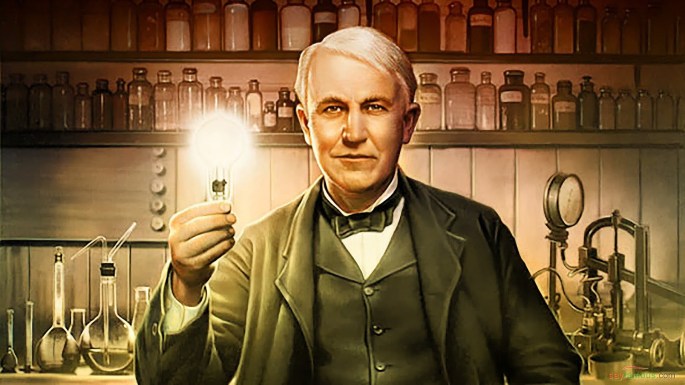
The guide delivered his canned speech, spoke of how long and complex the process to make even one single jelly bean, but that nothing great ever came easily, “as the inventor, Thomas Edison said: ‘Genius is 10% inspiration and 90% perspiration.’”
But that is NOT what Tom said. He said, “Genius is 1% inspiration and 99% perspiration.”
So what is my issue with the mere 9% our tour guide misquoted?
Mr. Thomas Alva Edison was trying to tell us that to get good (‘genius’) at ANYTHING takes HARD WORK (‘perspiration’), and a lot of it. He should know. It took him, and an educated team of men many years and over 5,000 exploded glass bulbs to invent the light bulb.
Still, you say, it’s only 9%. The 8 year old’s the tour guide was talking to didn’t even know what “percent” meant. And while this may be true, there were 15 adults with the pack of 40 kids the guide was leading. And the parents understood. Most had probably never heard the quote before. It is somewhat obscure, which is a shame because it is an astounding insight. What the tour guide misquoted did not communicate the gravity of Mr. Edison’s meaning.
In the beginning of the 4th grade our son failed several math tests in a row, and upon inquire we found he didn’t understand the material. When asked why he hadn’t asked for help from either his teacher or us, he confessed he felt afraid he’d look dumb. Having always done fairly well in math, when he got lost, he felt too stupid to ask for help. He was supposed to be smart, but maybe he wasn’t, he cried, clearly shamed.
I hugged him, held him, and reminded him of old Tom’s saying for the hundredth time. Then my husband and I got to work, played tag team, alternating afternoons, evenings and weekends to teach our son what he needed to know. Within three months of daily math lessons he not only grasped the material presented but excelled to the top of Math Swap in his grade level and remained there through elementary school.
Our son now loves math. It’s his favorite subject. He works hard at it and that hard work just placed him in the most advanced math class at his new middle-school. Failing those math tests in the 4th grade turned into a great education for all of us. We got to see directly how hard work pays off. And though our son may not always tow the line of excellence, he now knows that ‘smart’ is not given, but earned.
The New York Times Magazine had an article a while back on ‘genius.’ It sited Anders Ericsson’s research on The Making of an Expert, which concluded ‘genius’ wasn’t born, as previously thought, but made.
“Outstanding performance is the product of years of deliberate practice, not any innate talent or skill,” according to K. Anders Ericsson, Michael J. Prietula, and Edward T. Cokely.
Most everyone starts out with the 1% inspiration. It comes with being human, and our ability to think abstractly.
Few of us have the tenacity, or the determination to endure failure after failure and continue through that last 5-10% it takes to achieve excellence. Most of us settle on gawking at greatness instead of pursuing it.
So, the question is not, ‘What is genius,’ or even excellence, but what motivates persistence?
Achieving good grades, or becoming a killer guitar player, or great at soccer, or even parenting, takes “deliberate practice.” We need to impart Tom’s wisdom to our children, teach them by example, with unwavering diligence, that reaching their potential can not be achieved blowing most of the day binge watching Netflix, or YouTube, or gaming. To actualize ‘greatness’ means devoting the 99% perspiration— the time, energy and effort necessary to create anything of lasting value. Whether it be a school report, a science project or a math test, genius is not only doable for most every child, but for all of us with hard work and persistence.
I keep putting marketing projects in front of me to avoid fine writing.
Writing fiction is HARD.
It’s the second hardest thing I’ve ever done beyond raising my kids, and husband.
Marketing, helping companies, especially startups grow is engaging. Working with entrepreneurs, especially engineers, to find their targets, and create campaigns that sell their stuff is empowering.
But it ain’t like writing fiction.
My muse comes out and plays with me when I write fiction. She and I intertwine, not just intersect like with marketing. We make love. We fuck. She drives me harder and harder…to THINK, imagine, create. One idea follows another, in rapid succession at first, then quicker, breathtakingly fast the story strings itself together, not like beads or pearls, but a continual stream of light energy. I’m riding it as it illuminates each character in their own dynamic colors, some blending harmonically, others clashing grotesquely.
I’m never bored, or lonely making it with my muse.
So, WHY do I keep taking on marketing projects when I passionately LOVE writing fiction?
It’s not a money thing. I’ve spent 20 yrs writing fiction, produced two novels and two short story series, and haven’t made enough to pay for a family vacation to [pick your favorite vacation spot]. Marketing has always paid the bills, so the minimal sales on my books isn’t preventing me from writing fiction like my full-time ‘real’ career did.
If it ain’t money, then I’m thinking it must be my ego preventing me from writing fiction. Beyond paying bills, making money is very validating! So is helping moms looking to become CEOs, or coders developing their latest SaaS—it’s fun turning entrepreneurs onto the knowledge they need to make their marketing work to grow their business.
But it ain’t the challenge of writing fiction.
Fiction requires my full attention. Total immersion into another space, another place, not the real one I’m in. So the real world needs to be VERY QUIET, so it doesn’t pull me out of the world I’m creating. And as I write this I’m watching a truck back up on the street, BEEPING and BEEPING as it backs into our driveway to deliver drywall to the studio we’re building out behind our home. The dog is BARKING and BARKING cuz there are installers outside, crossing back and forth through her yard. Then there is our neighbor across the street cutting down huge cedars that take over properties here in the Great Northwest. And the tree cutters tossing branches into the crusher RUMBLING and GRINDING the limbs to mulch. And our next door neighbor installing a new fireplace, after drilling out the old one all last week.
Real hard to travel to virtual places when the real world is so invasive!
Yeah, I’ve tried noise-canceling headphones, and those squishy orange ear-plugs, but they both irritate, and are distracting.
Three months ago, we moved from the overcrowding and noise of East Bay, S.F. to Woodinville WA. The name perfectly describes this place. Densely wooded. Being far from towns and freeways, with acres between homes, I’m hoping once the studio is finished I’ll have a quiet place to write fiction. But I feel scared, anxious about committing to fine writing again. I’m afraid I won’t have the focus, the stamina I’ll need to create cohesive, complex story, and characters that will linger, stay with the reader long after the read. Quiet or not, writing fiction is HARD.
I’ve committed to January 2021 to begin fine writing again.
But between commitment to some future reality and actual reality is the Grand fucking Canyon…



 jcafesin.com