The Purpose of Life

What is Your Purpose in Living?

Christians and Muslims (actual believers, not in name only because they celebrate Christmas or Eid al-Fitr) believe the purpose of living is to serve and reflect their God’s will to ensure their assent to heaven after death.

Jews focus on the present rather than an afterlife. They believe humans should partner with their God in completing, repairing, and perfecting His creation.

Buddhists have no God. They want to wipe out greed, hate, mental anguish caused by desire, attachment, and ignorance to reach Nirvana (not the band ;-})—where the mind achieves clarity and peace. Rebirth is extinguished for the enlightened (those who achieved Nirvana), like a flame going out.

Hindus have Brahman, their Supreme God that takes many godlike forms. Their purpose in life is much like Buddhists—to reach Moksha (spiritual liberation), the end of reincarnation. They are unique in that they give no rigid purpose to living, but provide a moral, ethical framework for living a meaningful life and achieving Moksha.

I am an atheist, so I, alone, must determine my purpose in being alive. While I’m not a Nihilist, I agree there is no inherent, or dictated [by a god] meaning or purpose to life. My mother and father created me, as did theirs before them and so on, back to the earliest humans. All life here emerged through entropy, not born of some cosmic energy carving morality in stone or assigning us purpose.

Since I believe no god or mystical force gives me purpose, I’m free to create my own. I was lucky to be raised by Jews in name only—celebrating Hanukkah and went to temple on Yom Kipper, though in discussions driving home learned neither my mom or dad believed in Bible ‘fables,’ or a god. With no Grand Plan, like most of us I still needed one, something to motivate me to get out of bed in the morning. I, too, require some sense of purpose in living, and a reason to stay alive through dark times.

My mother was a devout social advocate. We spent many holidays feeding homeless, or handing out relief supplies to wildfire victims my formative years. She raised me with the foundation that all of us can make time to help others with less, especially those who have what they need. My father was a dreamer, and a philosopher at heart. His dominant side was a narcissist though—theory was fun to ponder, but getting to the best of us required his exclusive wisdom and guidance.

My old life’s purpose is partly a product of my parentage. My father believed a woman’s purpose—all women, in fact—is to reproduce. My mother was certain that raising kids would be the richest, most rewarding part of my life (and indeed they have been!). Having children, with mom as their primary caretaker, was the only consistent messaging my folks agreed on, (and society at large in the 1970s), so finding a mate and creating a family became my primary focus.

Since childhood, the life’s purpose I conjured was to raise kids better then me—kinder, more creative, emotionally intelligent, more aware of and caring for the world beyond theirs. I was sure that if each generation invested their TIME and energy into raising their children, gen over gen would become smarter, more innovative, more collaborative, and humans could reach our creative, compassionate potential.

I was that stupid.

Parenting is an art, not a science. Being there for your kids means way different things for different people. Both my husband and I worked full-time throughout their childhood, though my consulting career in marketing took a back seat to parenting, which basically killed it. (Running your own gig is like nurturing children—requires focused time and effort.)

By my kid’s measure, I’ve been present, available, attentive to my kids since their births, my focus on them, their needs first. I was lucky our combined income and investments allowed me to do so. Many parents can not, or choose not to make their progeny their highest priority while pursuing their own greatness. They raise latch-key kids who must fend for themselves for the most part while both parents work. With no safe harbor, children grow up afraid, resentful, angry.

My sister basically abandoned her kids to her nanny and our mother while she played tennis and traveled with her husband. And both her kids are angry, lost adults. Other parents are poor role models, instilling racism, blind faith, hate into their kids.

My life’s purpose before kids was clear, and simple really: to raise kind and productive people, and instill in them a desire to do the same. And so I have. But they are not one of many in a kinder, wiser, more empathetic gen, they are an anomaly. Regardless the safe harbor I provided my kids, they grew up lonely in a neighborhood where children were indoctrinated with religion from birth, often racist and mean-spirited, and focused on themselves and what they could get instead of give.

So much for my Utopian dream.

My kids are now adults, in their mid-20s finding their own purpose, creating their own lives. I have the time to indulge in the writing career I pivoted to when they were young. I have the time, but lately I seem to have lost the inclination to write anything beyond blogs. And if you read my essays, you’ll notice the tenor of my posts lately—I am completely and utterly lost, without purpose.

It’s not classic empty-nest syndrome because I worked while raising kids, so they weren’t my entire life, just my first priority. And I have many interests to pursue, from writing to mentoring to traveling, even becoming more intimate with my husband of 30 yrs. So why every morning when I wake up do I lay in bed for half and hour wondering what the hell I’ll do today, and even if I come up with something I’m wondering the point in doing it at all.

I can’t make humans kinder with my writing. No one can motivate or legislate anyone to care beyond themselves. The best I can do is entertain, and we’re already flooded with entertainment choices a lot less heady than mine, which is why I’m read by mostly intellectuals, engineers, math heads, professors—people who think more than just believe. While I’m grateful for my readers, I don’t have many and have a hard time getting them in a world that prefers mindless entertainment. And it isn’t fun for me writing meaningless crap. So daily, when I sit down at my desk and the cursor is blinking at me, I wonder what the point is in continuing to write.

I could go back to teaching entrepreneurs how to create sustainable startups, but a decade of doing so at Stanford and Cal Berkeley was a lesson in futility. Students want to build their ideas more then walk the tedious process of how to sell them. And most of their offerings were iterations on middle-men SaaS money grabs—drop-shipping on Amazon, or sites like Realtor or Robinhood, or yet another ‘AI-curated’ media site.

By my mother’s example, I was raised that our purpose in living was to serve—our family, our community, our planet. Most were taught, often by example, to serve themselves, which is why we have Instagram, corrupt CEOs, oligarchs, politicians, and ‘good people’ on their cellphone while driving causing 14% of fatal crashes in 2024. I grew up with a life’s purpose—to contribute to reaching humanity’s amazing potential—but I no longer believe in it.

What to do from here…

Emotional Intelligence

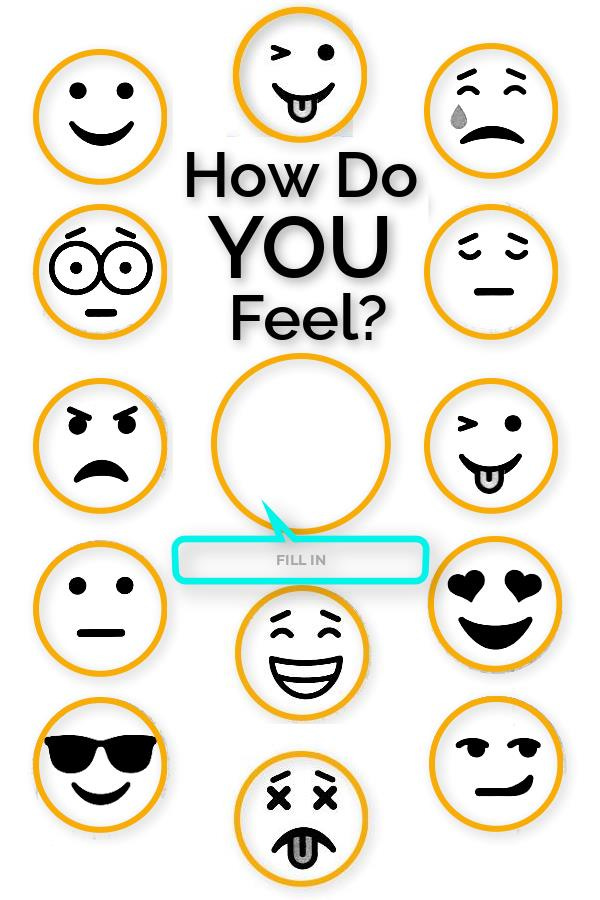
Do you FEEL before you THINK?
Or do your THOUGHTS generate your FEELINGS?

Psychology is split on this. Old world believed it was THOUGHT first, i.e. behavioral/cognitive therapy. New world has finally come around to what seems to me so blatantly obvious:

The Human Psyche:
FEELINGS lead to THOUGHTS, and THOUGHTS lead to ACTIONS.

Human beings are FEELING creatures FIRST and foremost. Being ALIVE means FEELING, even if just in the physical realm — feeling healthy, sick, in pain, tired, hungry, full, cold, hot…etc.

Infants don’t ‘think.’ New parents like to pretend they do, anthropomorphize their babies by projecting all kinds of genius behavior from their infant. But after raising two kids and caring for many of family and friends, the fact is they don’t really start to think until close to a year into living. They sure FEEL a lot though! Hungry. Cold. Scared. These feelings are so overwhelming that infants will cry, even wail until they’re fed. Warm. Comforted. Babies start to smile at 2–3 months in response to external cues, like someone smiling at them, or making cooing sounds. These smiles reflect the BASE FEELINGS of happy, content, sated, without a lot of thought behind these emotions. It takes infants between 6–9 months to laugh in response to games like peek-a-boo. Again, not a lot of thinking going on for that game.

THOUGHTS are constructed with words, language to express them, even to yourself inside your head. No language. No actual thoughts. Most infants are basically mute until almost a year old, and then the only words they express for months are simple monikers like ‘Mom. Dad. Dog.’ Not a lot of thought there either. Clearly. The neurological wiring of an infant’s brain isn’t connected enough to understand language, therefore they’re unable to form the complexities of ‘thought’ yet.

Everything ALIVE here FEELS the physical realm to varying degrees. Even foliage requires sustenance to live, and on the most rudimentary levels FEELS healthy, sick, hungry, thirsty…etc.

Extract the physical realm from FEELINGS, and we are left with EMOTIONS.

There are a few BASE emotions that connect all humans, but beyond us, it connects most mammals here. My dog feels the same BASE emotions I do. Sometimes Ellie’s sad. Happy. Scared. Excited. These are foundational emotions, generally from LEVEL1 through LEVEL3. But humans are the most complex brains on the planet (we know of). The more complex the brain, the more it seems to create additional layers—L3+—of EMOTIONS atop the foundational sets.

Hierarchy of Emotions:

L1 BASE Emotions:

  • Good (positive)
  • Bad (negative)

L2 BASE Emotions (common to us all—’roots’ of our emotional palette):

  • Good: Happy/Glad, Sated/Content, Excited
  • Bad: Scared, Sad, Hurt (Anger is L3, an emotional response to Hurt)

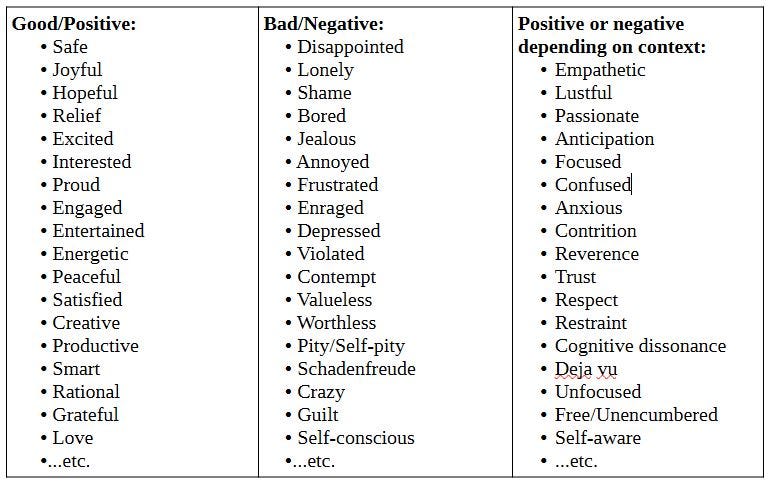
L3+ COMPLEX Emotions (atop L2):

Humans never really feel neutral. It may feel in any given moment we’re not feeling anything, but this is a missed perception. Most of us go through our days unaware of how we are FEELING except in exceptional or volatile situations where emotions typically ‘run high,’ like a celebration, or the end of a relationship.

Absorbed in your work means you are engaged, interested, maybe even passionate about it, all ‘good’ feelings. Conscious or not, you are never feeling nothing at all.

Getting down to how we really FEEL takes work because humans lie to ourselves, and subsequently others. Our complex brains weave all kinds of fantasies to make ourselves feel smarter, talented, capable, valuable, in control of ourselves and our destinies.

To control our ACTIONS, it is essential to understand your actual, true EMOTIONS first, and then with THOUGHT (language) define the reasons for what you’re FEELING.

FEELINGS spark THOUGHTS which ignite ACTIONS/Behavior.

Most of us go through life never really understanding that our emotions, i.e. our FEELINGS (not our thoughts) are controlling our daily decisions.

Do you consistently drink too much? Eat too much? Do whatever too much, so much that it’s hurting more than helping you? You’ve tried to stop or modify your behavior, but you keep going back to destructive habits.

To change any of your behavior, you first must understand the FEELINGS that are motivating the THOUGHTS that are generating the ACTION that is preventing you from becoming who you want to be. The only way you’ll never repeat a destructive behavior/action is to let yourself FEEL [and remember] that sticky, grotesque, choking, powerfully negative emotion of shame. Avoid the action, avoid the feeling.

Being ALIVE means FEELING, so at any given moment, like NOW, ask yourself: What am I FEELING right now? Good? Bad? Happy? Sad? After defining the FEELINGS — L1-L3 and beyond — now THINK about what is generating them. The more in touch with your FEELINGS/EMOTIONS you become, the better you’ll be able to THINK about what you need and why, then put those THOUGHTS into productive ACTIONS to live the life you choose.

Why to Choose Living

Actor, Robin Williams; Fashion designer, Kate Spade; Chef, Anthony Bourdain all killed themselves. Prodigal computer hacktivist, Aaron Swartz, hung himself at 26 years old. Miss USA, Chelsi Smith, is the most recent ‘influencer’ suicide as of this writing. In 2020, it’s estimated 1.2 million of U.S. attempted suicide, and over 126 a day actually succeeded in killing themselves. Suicide is the 10th leading cause of death in the U.S., after cancer, car crashes, and Covid-19.

Clearly living is a choice most all of us make every day we live.

Almost 42,000 of U.S. will consider suicide today. Have you? I have. Not once or twice during hard times, and in passing, but many times throughout my lifetime, from my tween years, likely till I die. Yet, virtually daily, I make a conscious choice to stay living.

I don’t believe in any higher power than the laws of physics. There is no “Jealous God” (Exodus 34:14) watching, or judging our behavior from ‘beyond’. There is no heaven or hell. I cease to exist when I die. I’ve never been able to pretend we are more than the collection of cells, chemistry and neural conductivity that make up our bodies and consciousness.

I can choose to go hang myself in the doorjamb of my office after I finish writing this without fear of damnation. The only eternal soul we possess is our hope that we matter past our limited time alive. But we don’t. Not really, beyond our effects on the lives we touch while we are living, like our family, and a handful of friends and colleagues. Even if you’ve done DNA ancestry, other than their genetic contribution to your existence, your dead lineage are names in a ledger, nothing more.

Too dark a view for ya? It ain’t depression. It’s reality, and a scary one knowing that regardless of what we believe, our life adds up to what we DO with our short time of awareness.

Individually, we really have very little effect on, well, anything beyond our small realm. Even those who have ‘made it,’ like celebrities and ‘influencers,’ most will be forgotten over time, and lost to later generations. And we’ll never even know the names of most innovators, especially women, who invented the tech we use today.

For the religious reader, this blog probably isn’t for you. I’ve likely lost you in the opening bit, as suicide in most sects is a ‘sin’. If you are a true believer, it is equally likely you won’t off yourself. The only reason to continue reading is if you want to help someone who seems like they may be suicidal.

How do you know if someone is suicidal? You don’t, and likely won’t. Each of the above celebs were either flat out rich, or at the very least financially comfortable. So, it wasn’t poverty that drove them to suicide. They ‘made it’ doing what they loved, instead of a lifetime at some crappy job just to pay the bills. Yet, each made a choice to die. Why?

Every day I make a conscious choice to keep living, but a lot of days the choice to stay is hard. Very hard. Some days, hope drives me with purpose, that I can make a positive contribution to those I touch. But other days, on days where it feels as if I reach no one, or I get nothing done, or humanity is doomed to our own stupidity, hope abandons me.

Give it up. Walk away. Stop trying so hard. You’re getting nowhere. If there is nothing beyond death, and what I do doesn’t really matter in the scheme of things, then why not just check out, be done. At times, my life feels as if it defaults to the mean of hardship, and I obsess about exiting the scene, fading to black, longing to feel nothing at all.

How do I stop the voices of fear and hopelessness, either before they ramp, or even after they do, when I look up from I laptop to notice I’m not breathing? I think of checking out, conjure my exit strategy. I imagine taking pills, or maybe going into the garage, turning on my car and rolling down the windows.

What stops me?

I picture coming on to the Oxycontin, or choking on carbon monoxide, then throwing up, then blacking out. Then nothing. Ever again. No awareness, no consciousness once the neurons stop firing. No taking it back. No second chance. No waking up. Feel nothing, ever again. Or I try and feel what it feels like to feel nothing, but obviously, this is an oxymoron. Living and feeling are synonymous, as are death and feeling nothing forever— beyond black— non-existence.

When I’ve lost all belief in myself, my work, my world, I’m left with only one reason that keeps me here. Regardless of how lost I feel, how insignificant, how hopeless, I hold on to the one truth I know is real.

Every day I make a conscious choice to stay living— to FEEL.

Living is all about FEELING— glad, sad, mad, good, bad, proud, humbled, jealous, accomplished. And the list goes on… I get to feel them all, and many more throughout my lifetime, expressed in a thousand ways. Enjoying chocolate mint ice cream while watching TV. In awe of natural wonders. Heartbroken with loss. Swooning in love. From the physical to the surreal, we all get to feel— experience being alive.

Strip away the religious sales pitch that rewards us for charitable behavior, in exchange for an eternity in paradise. Ignore the social pressure that tell us our value lies our physicality, or our job title, or the acquisition of wealth. Let go of the pretense we are going to make a substantive difference to anyone beyond our small circle of connections. And the point of living becomes simply to feel the moments of our life.

Death— feeling nothing ever again— will come, regardless if I hasten it. The permanence of suicide becomes daunting when I consider I’d never get to taste anything again. I’d never see, smell, or feel rain on my skin, or someone hold my hand. If I take my own life, I kill even the possibility of feeling different, and finding ways to enjoy more moments of my brief existence.

I teeter on the edge of suicide when all reason and purpose has abandoned me. But you can help me during these times, or others who stand at the precipice of ending their life. When I’m consumed by doubt, black and sticky, pulling me under, please don’t tell me to “Hang in there, it’ll get better.” Though it may be true, as feelings DO change, sometimes in minutes, sometimes days, or even weeks, it feels like bullshit in those moments of darkness, as if blackness is all I’ll ever feel.

To help me, or someone you know whose depression seems all consuming, remind us, with empathy, that living is about FEELING, and the fantastic range of feelings we get to experience being alive.

*National Suicide Prevention Lifeline
Available 24/7: 800-273-8255