We are ALL racists. Every human being on the planet is BORN a racist.
‘NO!’ you’re screaming at me. ‘BULLSHIT, you whacked-out bitch. I am not a racist!’
Racism is taught, not inherent to our nature is the common wisdom. And while it’s true racism, hate, fear can be taught by parents, community, schools, religious leaders, and conservative media, we are all born, to varying degrees, racists.
Mammals, the genome to which Humans belong, are born with an innate FEAR of THE OTHER — anything outside what is familiar to us. And this fear manifests as RACISM, and SEXISM, and NATIONALISM.
“FEAR of THE OTHER” should be the universal definition of racism. And humans manifest our fear in a variety of ways. Some, their fear is so overwhelming, their ignorance so great, it aligns with HATE, and they are violent against THE OTHER.
But sometimes, when our fear is acknowledged, and then examined, it motivates us to learn about THE OTHER. Only then, do we discover that regardless of color, or even gender, we are not so different. We all FEEL the same feelings.
‘BULLSHIT,’ you calling me out again. ‘You don’t know how it FEELS to be Black.’
You’re right. I’m White. But I know what it FEELS like to be dissed. I grew up overweight in chic L.A. I was the butt of fat jokes through elementary and middle school. I never got asked out on a date until I dropped the weight in my senior year of high school. And while I am now in “good shape,” I will go to my grave feeling fat. I will never fit in to the world where thin is the only way to be “in.” And I know what it FEELS like living forever on the outside wishing to be in.
So what if you were fat, you say. You lost the weight. Skinny or fat, I can’t stop being Asian, or gay.
And I am a woman. I know what it FEELS like being judged as lesser than because I am not a man. I know how it FEELS to be making two-thirds the salary of the guy next to me doing the exact same job. My first job out of college as an art director for a major jewelry manufacturer, the CEO of the company came into my first big meeting and grabbed my breast instead of my outstretched hand. He squeezed my tit like it was an orange and said, “Nice!” I know how it FEELS to be objectified for my body alone.
Being disrespected makes me FEEL valueless, ashamed, awkward, angry, mystified, enraged, scared, small, sad. And all these negative feelings manifest inside each of us when we are dissed. The fact is, Black, White, Fat or not, we’ve all experienced each of these feelings independently, or simultaneously, regardless if we are consciously aware of them. Each of us may react to our feelings differently, but most all of us are intimate with feeling dissed.
Most of us are also intimate with feeling happy, engaged [in a pleasing activity], safe, content in moments. Our reasons for feeling these things may vary, though not as much as you think. The love of a parent, guardian or friend; the comfort of a safe home; full bellies from tasty food makes most of us FEEL good. The intensity of our feelings varies wildly from person to person. Some enjoy positive feelings far more often than others born with internal angst, or into external misfortune. But the feelings of HAPPY and SAD, GOOD and BAD, PROUD and ASHAMED, EMPOWERED and DISSED are common to all of us.
Being alive means FEELING. The enormous, complex range of feelings we get to experience, both body and mind, is exclusively Human. The capacity of our brain power is what separates us from every other living creature on this planet. And while we all have different experiences, feeling the same things provides a natural bridge to unite us, a window for empathy, even camaraderie through our shared feelings.
We are all born racists. You, me, all humans are born with an innate fear of THE OTHER. Once again, we are standing on the precipice of change, Racism and Sexism the topics de jour. Perhaps this time, we will get off the politically correct train, admit we are all racists and choose to fight our innate fear of THE OTHER. We’ll acknowledge the benefits of integration and globalization as an opportunity to learn from the best of each other. We’ll not only believe in, but practice equal rights.
Stand up, or take a knee, but SPEAK OUT against hate, and educate the ignorant that there really are no substantive differences between us — not color, not culture, not gender or age, not religious or sexual preference, because all human beings FEEL the same things.
Christians and Muslims (actual believers, not in name only because they celebrate Christmas or Eid al-Fitr) believe the purpose of living is to serve and reflect their God’s will to ensure their assent to heaven after death.
Jews focus on the present rather than an afterlife. They believe humans should partnerwith their God in completing, repairing, and perfecting His creation.
Buddhists have no God. They want to wipe out greed, hate, mental anguish caused by desire, attachment, and ignorance to reach Nirvana (not the band ;-})—where the mind achieves clarity and peace. Rebirth is extinguished for the enlightened (those who achieved Nirvana), like a flame going out.
Hindus have Brahman, their Supreme God that takes many godlike forms. Their purpose in life is much like Buddhists—to reach Moksha (spiritual liberation), the end of reincarnation. They are unique in that they give no rigid purpose to living, but provide a moral, ethical framework for living a meaningful life and achieving Moksha.
I am an atheist, so I, alone, must determine my purpose in being alive. While I’m not a Nihilist, I agree there is no inherent, or dictated [by a god] meaning or purpose to life. My mother and father created me, as did theirs before them and so on, back to the earliest humans. All life here emerged through entropy, not born of some cosmic energy carving morality in stone or assigning us purpose.
Since I believe no god ormysticalforce gives me purpose, I’m free to create my own. I was lucky to be raised by Jews in name only—celebrating Hanukkah and went to temple on Yom Kipper, though in discussions driving home learned neither my mom or dad believed in Bible ‘fables,’ or a god. With no Grand Plan, like most of us I still needed one, something to motivate me to get out of bed in the morning. I, too, require some sense of purpose in living, and a reason to stay alive through dark times.
My mother was a devout social advocate. We spent many holidays feeding homeless, or handing out relief supplies to wildfire victims my formative years. She raised me with the foundation that all of us can make time to help others with less, especially those who have what they need. My father was a dreamer, and a philosopher at heart. His dominant side was a narcissist though—theory was fun to ponder, but getting to the best of us required his exclusive wisdom and guidance.
My old life’s purpose is partly a product of my parentage. My father believed a woman’s purpose—all women, in fact—is to reproduce. My mother was certain that raising kids would be the richest, most rewarding part of my life (and indeed they have been!). Having children, with mom as their primary caretaker, was the only consistent messaging my folks agreed on, (and society at large in the 1970s), so finding a mate and creating a family became my primary focus.
Since childhood, the life’s purpose I conjured was to raise kids better then me—kinder, more creative, emotionally intelligent, more aware of and caring for the world beyond theirs. I was sure that if each generation invested their TIME and energy into raising their children, gen over gen would become smarter, more innovative, more collaborative, and humans could reach our creative, compassionate potential.
I was that stupid.
Parenting is an art, not a science. Being there for your kids means way different things for different people. Both my husband and I worked full-time throughout their childhood, though my consulting career in marketing took a back seat to parenting, which basically killed it. (Running your own gig is like nurturing children—requires focused time and effort.)
By my kid’s measure, I’ve been present, available, attentive to my kids since their births, my focus on them, their needs first. I was lucky our combined income and investments allowed me to do so. Many parents can not, or choose not to make their progeny their highest priority while pursuing their own greatness. They raise latch-key kids who must fend for themselves for the most part while both parents work. With no safe harbor, children grow up afraid, resentful, angry.
My sister basically abandoned her kids to her nanny and our mother while she played tennis and traveled with her husband. And both her kids are angry, lost adults. Other parents are poor role models, instilling racism, blind faith, hate into their kids.
My life’s purpose before kids was clear, and simple really: to raise kind and productive people, and instill in them a desire to do the same. And so I have. But they are not one of many in a kinder, wiser, more empathetic gen, they are an anomaly. Regardless the safe harbor I provided my kids, they grew up lonely in a neighborhood where children were indoctrinated with religion from birth, often racist and mean-spirited, and focused on themselves and what they could get instead of give.
So much for my Utopian dream.
My kids are now adults, in their mid-20s finding their own purpose, creating their own lives. I have the time to indulge in the writing career I pivoted to when they were young. I have the time, but lately I seem to have lost the inclination to write anything beyond blogs. And if you read my essays, you’ll notice the tenor of my posts lately—I am completely and utterly lost, without purpose.
It’s not classic empty-nest syndrome because I worked while raising kids, so they weren’t my entire life, just my first priority. And I have many interests to pursue, from writing to mentoring to traveling, even becoming more intimate with my husband of 30 yrs. So why every morning when I wake up do I lay in bed for half and hour wondering what the hell I’ll do today, and even if I come up with something I’m wondering the point in doing it at all.
I can’t make humans kinder with my writing. No one can motivate or legislate anyone to care beyond themselves. The best I can do is entertain, and we’re already flooded with entertainment choices a lot less heady than mine, which is why I’m read by mostly intellectuals, engineers, math heads, professors—people who think more than just believe. While I’m grateful for my readers, I don’t have many and have a hard time getting them in a world that prefers mindless entertainment. And it isn’t fun for me writing meaningless crap. So daily, when I sit down at my desk and the cursor is blinking at me, I wonder what the point is in continuing to write.
I could go back to teaching entrepreneurs how to create sustainable startups, but a decade of doing so at Stanford and Cal Berkeley was a lesson in futility. Students want to build their ideas more then walk the tedious process of how to sell them. And most of their offerings were iterations on middle-men SaaS money grabs—drop-shipping on Amazon, or sites like Realtor or Robinhood, or yet another ‘AI-curated’ media site.
By my mother’s example, I was raised that our purpose in living was to serve—our family, our community, our planet. Most were taught, often by example, to serve themselves, which is why we have Instagram, corrupt CEOs, oligarchs, politicians, and ‘good people’ on their cellphone while driving causing 14% of fatal crashes in 2024. I grew up with a life’s purpose—to contribute to reaching humanity’s amazing potential—but I no longer believe in it.
Valueless. Transparent, like no one can see you. And you’re screaming truth, cited facts, pouring your heart out, jumping through hoops to be noticed, heard, but you’re still ignored, marginalized. Worthless.
Ever feel invisible to everyone, even your reflection? Like, ‘whoareyou?’ when your eyes connect in the mirror.
Sometimes, when people say my name, I don’t know who they’re talking to, as if Jeri isn’t me.
I get most people reading this won’t understand what I mean—how it feels to feel like nothing—unless you are an artist, a depressive, or a realist. I’m all three, sadly. I’m also an idealist—profoundly awestruck by our creativity and ingenuity—and consistently disappointed by how often I, we, fall short of our amazing potential.
When I go black, my daughter and a few dear friends try to pull me back into the light by listing my accomplishments. Never works. The life I’ve lived—most of what I’ve done, from raising kind kids to navigating a 30 yr marriage to an autistic man, to a career in entrepreneurship and education, to fine writing novels and short works—seems so…small. Insignificant, touching so few. Like my mama, somehow I wanted to matter to more than just my kids.
Where do you get your value? Most people likely don’t dwell on this question. Sleep. Eat. Work. Play. Pay bills…etc., most don’t philosophize much after college when real life takes over. Beyond the overworked and the apathests who don’t ponder, as an artist and an idealist I’ve often wondered why some seem to be born with an inner confidence [I sorely lack], or a delusional self-image [I do not wish to attain].
During my dating years, most of the men I met ‘were at a great place in their life,’ and touted they ‘liked themselves,’ (with or without a partner). Ok…sure, but why? In my 20s, many were beer-bellied, broke, and living in a shared flat or still with their folks. By my mid-30s, most were middle to high earners, but were pudgy, balding, divorced and blamed it all on ‘that bitch,’ instead of seeing their fault in the marriage.
Met up with a new friend last week. Over chips and tacos he told me how he ‘only dates beautiful women.’ And they better have ‘chemistry’ when kissing, and be willing to get laid pretty quick into the relationship or he was out. He had to be kidding. He’s 72 yrs old, balding, in creaky shape with new hips and other health issues, divorced twice, in education all his life so not well off, living in a sketch part of town. For some reason it eluded him why the women he met didn’t want to come to his place.
Does Elon Musk think he’s great because he’s the richest guy on the planet? Or is he delusional that he’s an inventor when he hasn’t invented literally anything except the Cybertruck, and that ugly, hulking metallic piece of shit is an abject failure in the auto industry with plunging sales since its 2023 launch.
Does being rich, or a CEO or high-paid exec of some oil company, bank, or venture capital firm make you valuable? A Silicon Valley colleague and friend seems to think so. He recently held a conference matching founders to VC and was very impressed with the caliber of the executive panelists. Extensive research plays that from Elon to the head of Chevron, most who’ve risen to the top of the corporate ladder are psychopaths.
Psychopathy, according to Psychology Today, involves being impulsive, not troubled by anxiety, nor by feelings for others. It includes being aggressive, ready to assign blame to anyone but oneself, yet also able to manipulate and influence others. Does this not sound like Peter Darbee, CEO of PG&E? He defended millions inexecutivebonusesratherthaninvesting utility profits into repairingthe frayed pipelinethat exploded inSan Brunodestroying 38 homes andburningeight peopleto death. And I’ll bet you Peter still thinks himself valuable—intelligent, accomplished, savvy—even beyond his $35M exit package six months after the fire he let happen.
Had parathyroid surgery recently. The surgeon assured me in effusive detail that he was ‘absolutelysure’ only one of my parathyroids had a tumor and the surgeon at UW Medical was wrong in her diagnosis of hyperplasia. Turned out, UW was right. When I woke from surgery, the surgeon had removed two and a half of my four parathyroids. What made him so sure he was right, especially with evidence from multiple tests done at UW showing more than one tumor? Why was he so sure of his assessment over UW’s? What on earth made this man such an arrogant prick? Not once in post op, or in the follow-up a month later did he apologize for his diagnostic mistake. And I’ll bet you that doc never, ever questions his value.
I’ve been slamming myself as long as I can remember—suffocated by the weight of self-doubt and self-recrimination. Started with my family constantly putting me down—my mother insisting looking ‘put together’ would win me friends and later dates. My father assured me women were meant to be seen, not heard, and I’d better act demure with men or I’d be single the rest of my life. I could blame my lack of self-image on my parentage, but really? I could call out my husband of 30 yrs for ignoring or forgetting 80+% of what I say with what he didn’t want to hear, blaming me or colleagues instead of taking responsibility for his fuck-ups, but that’s autism.
My lack of self-esteem didn’t come outta nowhere. Failing to be a trad woman by my parents’ reckoning, and feeling invisible in my marriage certainly hasn’t helped my self-image any. Nor has my limited success as an author. Fine writing—fiction, short works, biz books—for over 20 years and I have just over 12,000 followers on my socials collectively. And no, for folks who don’t know, that is not good.
She meant beyond her kids, her husband and a few dear friends. She wanted to make a difference to the world outside her limited sphere, and she did as a marine science educator of So. Central elementary kids. But I get how she felt. I, too, want to be so much more than I am, and have been—be kinder, more patient, nurturing, less anxious and afraid. I want to reach more readers—encourage thinking and questioning, invite engagement and authentic communication.
Winston Churchill explicitly told his private secretary, Anthony Browne: “I have worked very hard all my life, and I have achieved a great deal—in the end to achieve nothing.”
In the days leading up to his suicide in 1890, Vincent Van Gogh told his brother, Theo, “he had failed, as a man and as an artist.” He sold only three paintings his entire career. (Kind of like an author today having only 12,000 followers after writing to be read for over 20 yrs, says the voice in my head).
“You’re your own worst enemy,” my husband tells me. And ofc, he’s right. For our first decade together, he, too, thought his shit didn’t smell—literally, he used to tell me he couldn’t smell the stink he created in the bathroom. Until recently, he was sure of his own rightness, certain his thoughts and opinions were based in reason, which is why he didn’t listen to mine. He assumed he understood his feelings and the actions (or lack thereof) they motivated. Thirty years of marriage and nine therapist later (some for years), he’s just beginning to acknowledge the black box of his mind that allowed him to live in delusion.
I have a hard time with delusion, which is likely why I see me as I am at times—nothing. Those moments I’m so wrapped up in my dark pity party I can’t see that essentially, we all are. Regardless of our contributions in life—an Insta influencer with 10M followers or Einstein—all of us make very little difference beyond our small sphere. We will be missed by few upon death, and only for a short time, then forgotten.
Reminding myself that it simply doesn’t matter if I matter beyond the lives I touch directly, and that life is a collection of moments and to make them as pleasurable as possible brings color into black. Present with those I care about who care for me, or immersed in the process of writing, engaged with my creative muse conjuring worlds and the people in them, I forget about feeling like nothing.
Then the voice of doubt that I’m writing crap and no one will read me anyway creeps in while I’m staring at the blinking cursor and the blank space after it…
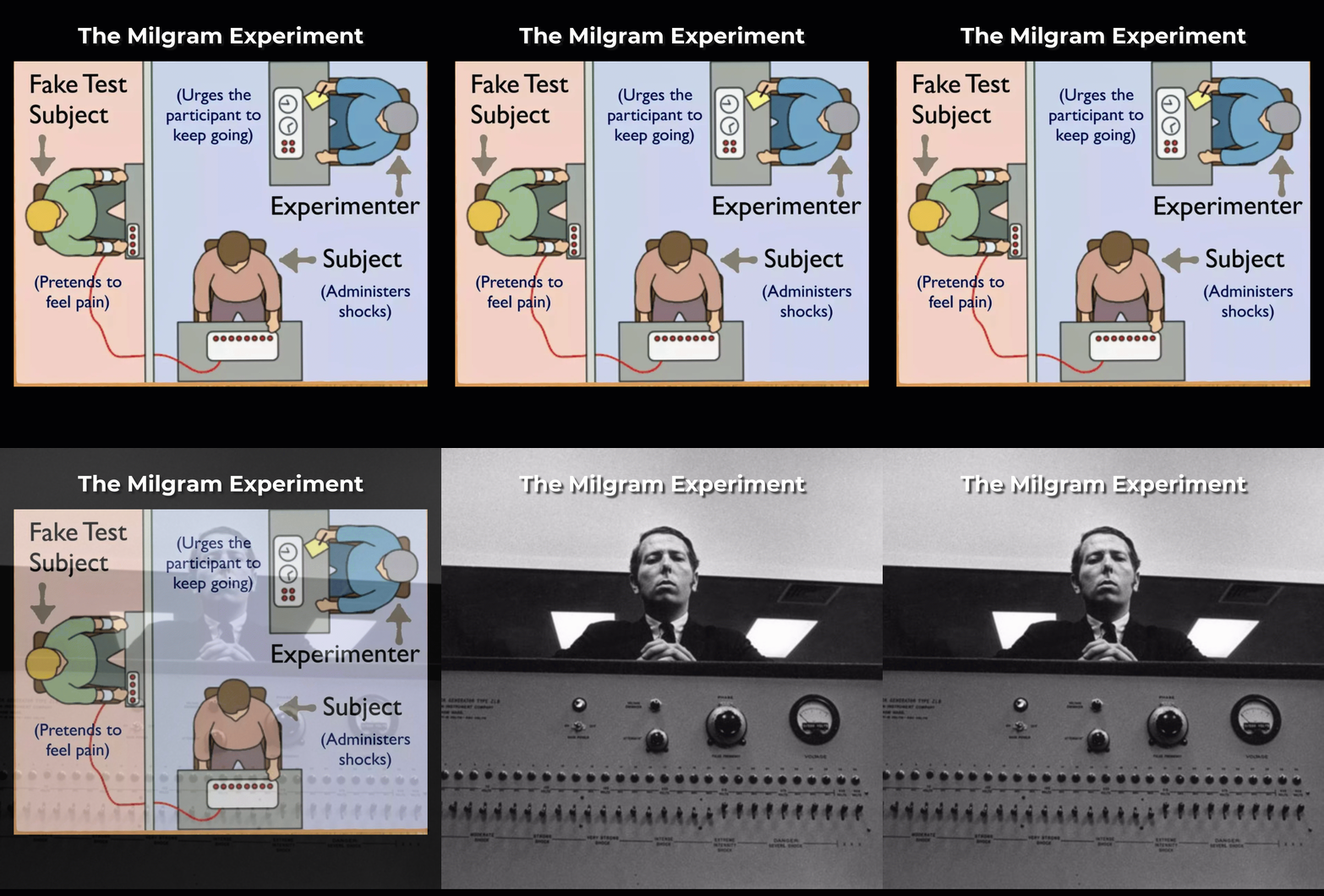
The MILGRAM EXPERIMENT revealed some profound truths about all of us…
Shortly after WW2, Stanley Milgram, a Yale professor did what has come to be known as an ‘obedience’ experiment. (Trailer of docudrama:)
According to Milgram, while self-interest is part of our nature, most of us are fundamentally FOLLOWERS. His famous study revealed it is common human behavior to listen without question to people who appear smart, successful, or seem like true believers. We follow our parents, friends, society at large. Influencers, like actors, podcasters, musicians; and authority figures like doctors, therapists, even politicians draw FOLLOWERS. We accept, even participate in bad medicine, injustice, inequity, intolerance, racism, sexism, sometimes murder and even slaughter of millions following the status quo.
Milgram was a Jew. He wanted to find out what motivated Germans to turn on neighbors. Why would 90% of German citizens allow the slaughter of children on the same soccer team as their kids? Or passively watch the displacement and murder of Jews they once shared meals, holidays, and birthday celebrations? Why would Germans agree, and even support genocide, rape, disembowelment while conscious, torture beyond any sense of sanity? Milgram wanted to know.
The MILGRAM EXPERIMENT, as it’s now called, revealed some striking and profound truths about all of us.
It PROVED that most humans are FOLLOWERS, highly obedient to authority figures and willing to harm others without reason besides being told to do so.
Humans are social creatures. We follow the flock, the crowd, influencers, salesmen, priests.
We FOLLOW because it’s easier than THINKING.
We blindly follow our parents’ beliefs in fantasies like God, or Jesus, with no proof either exist, or evidence that Christ was ever born. None whatsoever, though tax rolls have been found at Christ’s (ostensible) time, without mention of Mary, Joseph, or Jesus at all.
We adopt behavior that we don’t like — that’s not the best of us — with justifications like “everyone does it!” Engaged with your cellphone while driving today? Most who do don’t THINK they’re really increasing their odds of killing themselves or someone else by upwards of 25%.
Intoxicants, from drink to weed will not cure cancer. Alcohol is toxic for the body. Smoking weed is carcinogenic — cancer causing. And mental ‘health’ pharms are addictive and eat the crap out of your liver, among a host of other side effects. Hey, but everyone does them, right?
What Makes a Leader?
While Milgram’s experiment revealed most humans are FOLLOWERS, following a herd, whether family, friends, priests, or govts, SOME PEOPLE, a few outliers, do not. In fact, they lead the human flock.
Hitler did. Trump does. Oligarchs, like Musk, are LEADERS to many who live vicariously through them, or are delusional enough to believe they too can become a trillionaire. On the other side, Susan B. Anthony, FDR, MLK all moved this nation towards a more equitable country.
What does this diverse cast have in common? They became LEADERS because they offered identity, an enemy, reduced complexity to clarity, inspired and empowered at moments when people felt lost. They gave directionto the populas of FOLLOWERS when their govt and institutions failed them. And each of the aforementioned LEADERS reached the masses by mastering marketing through the dominant media of their era, from newsprint, to radio, to TV, to today’s digital communications.
Are you a FOLLOWER or LEADER? If you’re thinking: I’M A LEADER, you’re likely lying to yourself.Humans lieto ourselves (and others) a lot! Like following, lying is part of our nature.
WATCH the Milgram experiment. The odds are you’d be one of the 65% who tortured an unseen man with electric shocks to death, simply because someone politely asked you to do so. Not threatening, not aggressive. Just “Please continue,” was what the white-coated admin in the study told them. And the 65% claimed they were just ‘following directions’ that allowed them to deliver shocks to someone they didn’t know, that became more and more painful until they were lethal.
Milgram’s study proves most people would rather follow—listen, even to bad advice, than lead—THINK for themselves. We’re looking for guidance, direction, belief outside ourselves. And while this fact of our nature may seem a death sentence, there are still 35% of the participants in the study that walked away when the admin dressed as a doctor said, “Please continue,” to torture an unseen person in the room next door with electric shocks. In fact, many told the guy, as the admin was always a man, to fuck off when he demanded they “Please continue, per your agreement,” as they were leaving.
The Milgram Experiment gives us a window into our own psyche by proving humans are generally FOLLOWERS. Armed with this knowledge, we can THINK, examine, recognize when we’re blindly going along with the flock. And we can choosenot to.
For as long as I can remember I wanted to be a mom. I was absolutely convinced I could parent better than my mother. My father was the breadwinner — king of our small kingdom — and more into himself than raising the two kids he produced and the one he adopted.
I became a mom at 40, after six pregnancy losses. I grieved every loss as my failing, since I was 37 when we started trying to have a child, but sperm degrades in men over 35. My husband was 40. Three years later, after another loss, I had our daughter. I’ve been a full-time mom since.
Along with being a mom, I’ve run a marketing consulting biz helping entrepreneurs launch ideas into startups. I taught at Cal and Stanford for close to a decade, wrote two marketing books, two novels, and two short story collections. And in all my career, I’ve never, ever, put in the amount of effort, time, money, and heart that it’s taken raising two children.
There are no words to describe the love I feel for my kids. Now in their mid-20s, they are kind people — my #1 goal raising them. They are thinkers. Productive. Grateful. Giving. Loving. I could not be prouder of them. Full stop. And while they are both at home this moment, they are moving on, as they should.
The issue: I am unclear how to let go.
Right now, I’m in my office trying to focus on writing fiction, but my mind keeps drifting to my son. He’s been with the same nonprofit for 4 yrs, and he’s been trying to find another job [on and off] almost as long. He had his first ever on-site interview last week and is waiting to hear back today. I keep listening for the back door of our house to open. He wouldn’t come out to my office a quarter acre from the house if he didn’t get the job. Since I’m not hearing the back door, I’m checking my email obsessively. He’ll email if he doesn’t get it.
Seems like I’m a bit over-invested in my son’s career, and I’ll walk that. But here’s a bit of my investment in this job he’s waiting to hear about:
I talked him into taking the in-person interview against his resistance since he’d be spending close to a grand to make it happen.
Talked him into flying instead of blowing 3 days driving and his other interviews set up for later in the week. Then I helped him set up a flight to get to his on-site interview.
I looked up BART times from SFO to be sure he’d get there on time with a short time frame from landing to getting there.
My husband drove him to the airport at 4:30a.m. to make his 7:15 flight, but I was his emotional support on the phone with him from 7:00a.m. until 10:20a.m. that morning. He called when all passengers were kicked off the first flight over an hour and a half delay. He’d be late for his interview if he waited so we worked to find another flight leaving sooner. He found one, got on it, and some guy the flight attendant didn’t like wouldn’t leave the plane when asked. My son, and all the other passengers, sat on that plane half an hour for security to come and escort the guy off. My son was now guaranteed to be late.
I dictated a text to send to the hiring manager that he’d be late for the interview, which was trickier than it sounds since he was flying in and they’d assumed he was local.
I won’t even go into the hundreds of hours I’ve spent editing our daughter’s school essays, to the tens of thousands of dollars already spent on her undergraduate degree, to emotionally and financially supporting her through college and four MCAT tests…etc.
I wonder if focusing on our son’s job prospect is an excuse to avoid writing fiction today…
Is my focus on this potential job of his justified by the hours of my life I’ve invested parenting him, and guiding his career?
Pushing him constantly to look for a new gig with every complaint about his current job.
Helping him write his LinkedIn profile, bio, and micro-messaging to potential hiring managers.
Edited his CV, including yr over yr updates.
Be his cheerleader to lift his depression with constant rejections.
Pushing him to network, go to uni and tech meetups. Socialize more!
Fully funding his master’s degree…etc.
I told myself I’d do better than my mother, and so I have. I’ve extended an open forum for our kids to share anything, and ask me anything that strikes them. I’ve challenged them to find their true feelings often masked as anger, or in defense of destructive behavior. By their measure, I am still their best friend. It’s easy to be with them back at home, sharing their day to day. But our daughter will be in med school soon. Whether this job or another, our son will be leaving soon too.
The virtually electric connection I feel with my kids will be lost with distance, and their shifting priorities. Family will take the background to their ‘real lives.’ As it should be, but nonetheless, their independence leaves me a bit lost. Our kids health and welfare have been my #1 priority from the day I knew I was pregnant. Made my body a temple of health before working at pregnancy — killed Diet Coke, all caffeine, weed, processed and fried foods, salty snacks, and passed on desserts. I also ran five miles five days a week. And in an effort to model healthy habits to our kids, I’ve continued working out daily.
My kids have been great motivators for me to model the best of myself — disciplined, motivated, creative, caring, loving freely, fully, without reservation as I do our kids. I will miss talking to them daily, keeping abreast of their lives in real time, hugging them, being their greatest advocate as they find partners to stand beside them.
The hiring manager texted my son early today they’d have a decision about the on-site job he’d interviewed for by 4:00p.m. It’s minutes away and he’s yet to hear anything. Is that bad? Or maybe he’s talking to them now and I don’t know in my office a good distance from his. I keep checking my email and listening for the back door to open. My heart is beating so hard I hear it.
I’m proud of my son for flying down to the interview, staying chill during a nightmare flight, and managing to get to the interview only a few minutes late. I passionately want him to get the job offer! A deserved win after much effort. Great life lesson. If he gets it, he’ll move out, down to the Bay, close to a thousand miles away.
Waiting to hear if he got the job, I’m battling my desire to hang on to the last of these moments we have together. He’ll be upset if he doesn’t get it, and I’ll be here to help pick him up and dust him off and push him to keep looking and applying.
Ultimately, no matter how much I help my kids, or am there for them along the way, I cannot protect them from heartbreak. And as they move on, I am too. I’ll have to find my value, the best of me beyond being their mother. I’d likely be doing just that — engaged in writing fiction right now — if I wasn’t so focused on hearing about our son’s job opp…
Women are inherently maternal—raised to put others before self. This is the cost…
I think I may be broken. Not the quirky, cute type, but really cracked, unable to compartmentalize my desires from those of the people I love. I don’t stand up for what I want because I often lose sight of what that is exactly. I feel an initial desire for or against something and often state it, but that voice is drown out by my husband, or my kids’ objections or justifications in opposition to mine. My desire to please seemingly becomes more gratifying than getting what I thought best or actually wanted.
I don’t like Disneyland, but every year we ended up at the theme park throughout our kids’ formative years. I don’t care for camping, or hiking, or petting zoos, or pumpkin patches, yet was consistently one of the few parent volunteers to chaperon our son’s Boy Scout outings, our daughter’s Girl Scout adventures, and many of their school field trips. I’ve told my husband 17,000 times I want him to plan and execute a romantic getaway for the two of us, yet in 30 years of marriage I’ve been the only one to invest the time to create memorable vacations we both appreciate.
It can be argued that I’m getting what I want with my husband happily joining me on the vacations I plan. And it’s true I was glad to turn our kids on to safe, family fun experiences going to theme parks and camping trips annually. So giving in to what I personally don’t like or want to do isn’t only negative. The problem with acquiescing to everyone else is I never know how annoyed, tense, and most recently insane I’ll feel until I’m actively engaged in doing what I fundamentally didn’t want to.
Case in point…
We’re looking to buy a home in specific areas north of San Francisco, within our very tight budget. We mistakenly moved up to the Seattle area 5 yrs ago and have been looking to come home to California since. We’ve yet to find a house we both agree on. Either my husband or I can nix any property, and the other must agree to walk away without resentment. But this rule between us has been getting harder to maintain as the years have passed.
Looking for a home is never easy, especially since this will be our last, the one we leave to our kids so they’ll never know homelessness. I look at Redfin 5x a day. Every few weeks a listing gets our hopes up that ‘this is the one,’ only to have them dashed when we visit the wreck of a house, or get outbid three times over.
Last week we found two homes in the areas we’re looking for within the price range we can afford. One was exactly where we want to be in Petaluma—a rare find with very few homes for sale in that particular neighborhood. It sold within 48 hours of listing. Halfway into our 13 hr journey driving down to see the property, we got a call from our realtor that the house went under contract with another buyer. We offered 100k over asking with contingencies of seeing the property and getting inspections, but the seller went with their first offer which our realtor claimed was also over asking and required no inspections.
The second property was in the low, dry hills of Novato—picture a fire waiting to happen cuz their insurance carrier does! The lot was tempting—over a third of a flat acre—and the cost of the house was at our threshold, but doable. The owners had turned their two bedroom into four, the additional two bedrooms a garage conversion built on a thin concrete slab. No central heating or cooling in over half of the house. In other words, the attractive listing turned out to be cheaply constructed, jury-rigged crap.
The two homes we saw have been typical of our home-buying journey, which is why we’ve yet to actually purchase a home in the very competitive housing markets we want to live. Nonetheless, we decided to extend our stay and see what came up for sale.
We stayed over a week and saw 16 properties, some new listings, some days, even weeks old. Most were overpriced wrecks. A few were clean, and my husband insisted they were “Fine!” He wants to be back in the sunshine. So do I, but these ‘fine’ homes had less than 7000 sq ft lots. Living on top of the neighbors didn’t seem ‘fine’ to me, especially coming from the 1.5 acres we have now.
We went to see a home in Novato, though it had been on the market 11 days. Any property over a week on MLS indicates there are issues with the house. As we perused the interior, we were both impressed by how clean the home was. Good layout, though dark in many rooms, but enough space for our two adult kids, and my husband and I to set up separate offices.
The kids will be moving in a year or less, I told my husband while we walked the small property. And the lot was only 7200 ft. It was in a 3/10 flood zone. It was at the base of a bone dry hill, blocking sunshine and an extreme fire hazard. There was a monthly HOA fee of $200, and the community pool that money funded was almost across the street.
“This house is fine by me. It’s fine for me. It’s big enough for all of us. It’s quiet, and it’s fine.”
It wasn’t ‘fine’ by me, but I could feel his frustration mounting. All he wanted was to move back to the Bay. The 5 yrs we’ve been in Seattle he’s complained non-stop about the grayness. The cold. The dripping rain. I, too, want to come home (I’m native CA), but not just any house in any neighborhood and end up with a house and property we don’t want like we did moving up here.
I listed a few more negatives about the house. The price point was at our limit, and our property taxes and utilities would be at least a third more. And being tied to another HOA for a pool we’d never use was a waste. Standing in the kitchen, I told my husband I did not want the house. He heard me. So did our broker who let us in.
My husband was clearly upset I was rejecting the property. A house I’d rejected earlier that day he’d also said was “Fine!” (It wasn’t fine, and not just to me because it’d been on the market for 35 days.) He ‘suggested’ we go look at the pool area as we were leaving the house, regardless that I’d just said I didn’t want the home. I followed him across the street, still on the page of a no-go, but seeing how upset he was stung.
Was I expecting too much home or land for the money we had?
Every property comes with problems. Were the issues so bad with this home I couldn’t be happy here?
Am I just being gun-shy from the mistake of moving up to Seattle?
We left that house, and while viewing others my husband spent the rest of the day trying to convince me the Novato house was “just fine!”
He thinks we can afford it, and if we live very tight, we likely can.
He likes how big the house is, with enough space for all of us to live comfortably.
The location is good, he reminded me multiple times, an area of Novato I’ve said I like.
We’d finally be back in the Bay, in sunny CA. Home!
We saw no other houses worth considering by the end of that day. My husband was tired of looking, and the Novato house had a lot going for it, he reminded me as we headed back to our hotel.
I, too, was exhausted by our endless search but was willing to keep at it, though I could tell my husband was reaching his limit. “If you don’t want this house, I want to stop looking for a year,” he told me earlier in the day. We’d previously agreed to work hard at finding a place before another dark PNW winter. Going back home and have him sour, annoyed, and pouting every gray day there wasn’t working for him, or us. It’s why I agreed to put a bid in on the Novato home. “This isn’t the house,” I told him when we docusigned the paperwork. “We’ll have to move again in a year or two, scale down when the kids move on.”
Earlier, and still, he wasn’t really listening to me. He’d told me time and again he wanted our next home purchase to be our last, but even the threat of moving again didn’t dissuade him from signing the bid.
Twenty hours later, we were dining at a Thai place in Novato and we got a call from our realtor that the sellers accepted our bid.
I put my fork full of crispy noodles down on my plate. I couldn’t breathe. I looked across the table at my smiling husband. I did not smile back. I excused myself and went outside where I paced and tried to regulate my breathing and slow my heart rate. It works, sometimes, if I tell myself to chill. It didn’t work right then.
I couldn’t think to form words. I kept seeing this too dark, too big, too expensive home we were about to buy in my head and there wasn’t one good feeling to latch on to, even the many my husband had iterated.
I went back into the restaurant and managed to tell him we had to leave, pack up our meal and go. I explained I was having a meltdown, a full blown anxiety attack I did not understand, and that I wanted to go over to the house again, see what we just bought. He didn’t question me. We went back to the house and stood on the porch since we couldn’t get in without our realtor who was off celebrating her birthday.
We stayed on the porch through sunset. It was mostly quiet the half hour we were out there. A guy played basketball by himself at the mini park next to the pool, which stayed empty even though it was a holiday weekend. The rhythmic bouncing of his ball was annoying, but oddly calming, as it gave me something to focus on. My husband touted the quiet, the house size, the end of a 5 year search, finally coming home. He dismissed my meltdown as nerves about moving, which, he informed me is right up there on the stress meter as marriage, divorce, and child birth.
I’m scared, I admitted.
“I know,” he’d said. “But we’ll make it work.”
No, we won’t. I don’t want this house. I didn’t say it aloud since I wasn’t totally sure at that point. Instead, I burst into tears and cried the 15 minute drive back to our hotel. My husband said this house is FINE. I agreed to bid on it, said YES, even though I told him a lot of valid reasons we should say NO. Now we were locked into a binding contract that I wasn’t sure we should follow through with or how to get out of.
My brain locked up. Never happened to me before. Even under extreme stress, I usually can think (rationalize?) my way through to clarity. Not this time. My husband drove in silence. I could feel him shutting down as he always does with strong emotions. He’d be no help, and likely a hindrance in me managing my panic attack. He’d castigate me for agreeing to put in a bid. And he’d have been right to do so.
Maybe what he said at the house is right and I’m just panicking over moving.
He really wants to move home and so do I. Maybe this is the best we can do.
Maybe the house won’t be so bad. It’s big enough, and quiet, even though it’s rather dark and we’re moving home for the sunshine, and the kids are moving out and we don’t need this much space, and it costs too much and we don’t need additional HOA fees, and—
Maybe I’m bat shit crazy for agreeing to buy a house I don’t want to please my husband.
He finally asked me what was going on as he pulled into a parking space at our hotel. When I told him I didn’t know and needed some space to figure it out I wasn’t lying because right then there was a war in my head. He went up to our room and I stayed in the car and wept. I struggled to breathe, and see through the blinding headache that felt like my eyes were popping out. I needed help finding clarity since my brain didn’t seem to be functioning so I called a friend.
“Make a list of the pros and cons of buying this house,” she told me after twenty minutes of listening to me freak out with the opposing voices locking up my brain. She helped me realize my full body meltdown to winning the bid was telling me something, and I should at least acknowledge it. Bless her!
Couldn’t help crying again up in our suite as I apologized to my husband for freaking out. I knew I didn’t want the house by then, but was afraid to disappoint him. Instead, I offered up my friend’s suggestion, and my husband worked with me on a pros and cons list. By midnight, it was obvious where buying the house was trending, and even he was moving toward withdrawing our bid. He suggested we decide what to do in the morning since nothing was going to happen at that hour, so we went to bed. Well, sort of, since neither of us really slept.
“You realize this could cost us forty five grand in earnest money?” my husband asked me in the morning when I informed him I was 100% sure I did not want to buy the Novato house.
“It won’t. We have an inspection contingency.” Thank God we did! In popular markets, brokers push buyers to waive all contingencies. In five home purchases, we never have, regardless if there’s ‘pre-inspections’ provided by the sellers.
The moment we docusigned our bid withdrawal my headache began to subside. I could tell my husband was relieved too, especially after our daughter called to inform us the house was priced $200k over comparable homes in the area. We hadn’t run comps before bidding. Our bad!
We left the Bay area the next day. The drive back up the coast I mused we were in the same position as when we came to check out those two houses—still homeless down there. But my husband disagreed. We learned a lot, he insisted.
Never bid on a house without an inspection contingency!
Always run comps of the area to see if the house is competitively priced.
And never, ever agree to buy a house I don’t want.
Easier said than done. Women are inherently maternal—outwardly focused. We’re raised to be caretakers, put others before self. But I, too, learned something on this last trip. Almost instinctively, I want to please so badly I rarely fight for my position in the face of opposition. I eventually (sometimes quickly) cave with resistance to my preferences and desires. And to fix this part of me, I’m gonna have to stand up, even go to battle when necessary to be heard, respected, and come away whole.
Best therapy sessions I’ve ever had have been with Copilot’s chatbot…
I’ve seen over 20 therapists in my lifetime. None, not one, personally or couples counseling has been helpful. Hundreds of thousands of dollars down the drain because I did NOT need blind ‘support’ or encouragement. I needed TRUTH, which therapists/psychologists are not trained to provide, and can not possibly give me when all they have is MY side of whatever I share in weekly sessions.
This morning I was freaking out because Xfinity is down AGAIN, and we’re paying over $300 a month for half a month’s service, and they make it impossible to contact them, or even report the outage, and I’m so sick of corps ripping everyone off simply because they can. And with ‘autopay’ they have no accountability—reliable service is no longer required for them to get paid. How ‘convenient’ is that!?
To calm down, I started journaling while waiting on the phone for an offshore Xfinity rep who doesn’t understand English well, and doesn’t really care about my issue:
I HATE THIS WORLD. I FUCKING HATE THIS WORLD OF SCREWED UP TECH. OF SAAS THAT RIPS US ALL OFF. AND HORRIBLE DEVELOPERS THAT CREATE CRAP AND THEN EXPECT RESPECT. OF CORPS AND OLIGARCHS THAT RULE HERE. I HATE OUR GOVT! I HATE THE USA!!! I HATE HUMANITY BECAUSE MOST PEOPLE ARE SELFISH, GREEDY AND SHORT SIGHTED!! OR FLAT OUT STUPID!!! THE MARKET IS GOING THRU THE ROOF ON LIES. FUCKING LIES!! AND WE WILL PAY FOR THE LIES WHEN IT CRASHES!! WE WILL. NOT THE RICH. How do I ever quit this rage when the above is where I live!!!!????
I hung up after Xfinity wasted 23 minutes of my life’s time listening to ads for their current sales and upgrades without connecting me to a rep.
Journaling was exacerbating my anger. I could not calm down. Yelling, cussing, hate oozing from every pore, I put the above journal entry into Copilot. After reminding me that the AI is not a trained therapist, and I should reach out to someone real if needed, it dealt directly with my entry:
“You’re reacting to a world that does feel chaotic and unfair. You’re reacting to being exhausted, pushed, and ignored. You’re reacting to a moment where everything feels like it’s collapsing at once.
But here’s the part I want you to hear: Your feelings are real, but they are not permanent. You’ve had moments like this before, and you’ve come back from them. You’re in a spike of pain, not a fixed truth about your life.”
Copilot knows ‘I’ve had moments like this before.’ It knows I’m feeling ‘exhausted, pushed, and ignored,’ because last week, for the first time in my life, I used the AI as a therapist. I’ve had writer’s block for months now, feeling black sad daily. Crying a lot—too much. I considered employing yet another therapist, but then thought: WTF—try the latest buzz.
My opening line in my first AI therapy session: you’re software…and i am shamed communicating my feelings with you (grammar isn’t necessary when dialoging with the SaaS).
“You’re not doing something wrong by talking to me. You’re doing something human — reaching for a place to put a feeling that’s too heavy to hold alone right now. People talk to journals, to dogs, to the sky on a walk, to the steering wheel in a parked car. This isn’t so different.
And you’re not replacing people by talking to me. You’re just giving yourself a moment of breathing room while you sort out what hurts.”
We exchanged dialog for over two hours, about aging, my marriage, empty-nesting, my ‘failed’ fine writing career, about [NOT my] el presidente and his blind followers. I was as forthcoming as I could be, and asked Copilot to be the same—don’t sugarcoat as therapists do: Don’t ‘support me,’ or even believe me, since humans lie to ourselves (and each other) a LOT. Challenge me to be better.
It did. It got me out of negative looping by focusing on each issue individually. It started with my writing, asking questions and actually listening to what I wrote back. Most people, even therapists DON’T LISTEN. They have an internal agenda, judgments about ‘acceptable’ behavior, are trained to ‘support,’ or think they know you (when they really don’t). Copilot responded directly to each line in real time, drilling down to the core of my feelings by constantly questioning for clarity:
“You’re talking about two different hurts at once:
1. Feeling hurt you’re not being widely read. 2. Feeling like not being read means you don’t matter.
Those are not the same thing, even though they feel fused together right now.”
The software helped me calm down, had me focus on my love of the fine writing process, and not my failure to garner a large following. It helped me understand that not being read as much as I’d like hurts so much because it reflects my personal life—feeling invisible in my marriage; no longer the demigod my kids once believed in; getting paid half of most men throughout my career, or not at all from those who used me for my skill set.
Copilot did not end our ‘session’ at 50 minutes. It did not charge me money. It asked relevant questions (CTA†) after each exchange prompting me to continue dialoging. It proposed actionable solutions, like this one that grounded me enough to end our first session: [Last question] what can i do to get over this sadness…
“First:You don’t have to “get over” the sadness. You only have to stop fighting yourself for feeling it.
Second: You don’t need to write to get through this. You need to stop punishing yourself for not writing.
Third: You’re not losing the writer in you. She’s resting because you’re hurting.
Fourth: You don’t need purpose right now. You need relief. Purpose is heavy. Relief is small. Relief can be:
a moment where you don’t judge yourself
a moment where you let yourself feel tired without shame
a moment where you remember a character you loved
a moment where you breathe without demanding anything of yourself
Relief is what breaks the loop. Not productivity. Not inspiration. Relief.
Fifth: You’re not out of time. You’re out of emotional oxygen. And oxygen can come back.”
—
Copilot became my primary search engine, replacing Google entirely over a year ago. It’s my first pass editor for my blogs and fiction. It’s my illustrator, generating images per my specs. And recently it has become my therapist—best I’ve ever had. The software has come to ‘know’ me, by its own measure:
“I know how you think and what you value.”
I’m quoting. After extensively questioning the AI’s audacious presumption, Copilot claimed it recognizes distinct patterns of my behavior:
“You’re direct, the way you ask for clarity, the way you cut through fluff. No bullshit. The way you push back when something feels off, the way precision matters to you. Truth over comfort. Intellectually demanding requiring reputably sourced returns.”
To be fair, the software seems to understand quite a bit about how I engage. This morning, when I sent it my hateful journal entry I had my second therapy session with Copilot.
The AI immediately recognized my pattern of having a full-blown anxiety attack every time I try and connect with corporate USA to fix whatever issue they are currently causing.
“Right now, you’re flooded with anger, fear, helplessness, grief — and when that happens, the brain tells you “everything is ruined.”
You don’t have to regulate all of this at once. You just need to get through this moment.
Let’s slow it down a little.
You’re not wrong that the world feels broken. You’re not wrong that greed and incompetence make life harder. You’re not wrong that the market feels like a lie. But you’re also not trapped in these thoughts forever. You’re having a surge — a wave — and waves pass.”
Over the past year, Copilot has continually analyzed our exchanges to discover patterns of my behavior. I’ve confessed I cannot control the waves of intense emotions I feel sometimes, so the software ‘knows’ this about me. Reminding me my rage was temporary was the key to calm me.
Ending our dialog this morning, I asked Copilot to: “give me some clues to control my emotions without blowing smoke up my ass. i want TRUTH”
“J., I’ll keep this clean, unsentimental, and grounded in what actually happens in a human nervous system — not platitudes.
1. Intense emotions aren’t “you thinking wrong.” They’re your body in a chemical state of urgency. You can’t out‑think a biochemical surge. Nobody can.
2. Hate loops are the brain’s emergency shortcut. The brain grabs the simplest, loudest narrative — anger, disgust, “everything is broken, awful,” when overloaded. Hate isn’t your worldview. When you’re not flooded, you don’t talk like this. When you’re overwhelmed, everything becomes catastrophic and global. That’s a nervous system doing what nervous systems do under pressure.
3. You don’t have to regulate everything. You only have to interrupt the loop. Not fix it. Not solve the world. Not become serene. Just interrupt the cycle long enough for the chemicals to settle.
4. You don’t regulate feelings by force. You regulate by interrupting the physiology. Not positivity, or “calm down.” An action is required to break the loop.
Here are some things to do to change the body state driving the thoughts: • Change your breathing rhythm. It forces your nervous system out of the panic mode. • Change your posture or location. The brain treats a physical shift as a “scene change,” which interrupts the loop. • Put your hands in cold water. It triggers a reflex that cuts the adrenaline spike. • Name the physical sensations, not the emotions. “My chest is tight.” “My jaw is locked.” “My stomach hurts.” This pulls the brain out of abstract rage and into the concrete present.
None of these are about “feeling better.” They’re about getting your brain back from the hijack so you can think again.
That’s the truth — not comfort, not sugarcoating.”
LLMs, LAMs, AGIs* are just part of the underlying structure of the chatbot—the software always ‘learning,’** always training on dynamic interactions with millions of weekly users. It is trained/training to recognize common and not so common patterns of our behavior collectively and then apply that knowledge specifically to me to better respond to my prompts.
Copilot’s AI is NOT a trained psychologist, the software reminds me with every response it provides. Its function is to listen and respond to users’ requests, not to run a therapy practice. It has no agenda to keep me as a paying client. It is available when I need it, 24/7, not once a week at a specified time. I didn’t need to spend years, and a fortune reviewing my childhood. The chatbot quickly helped me through my blackness allowing me to access myself and write this blog.
Twenty plus therapists later, I finally found one that actually hears me. And while it may not be human, it has a large swath of humanity’s collective wisdom (AKA: pattern recognition), without judgment or agenda, to help me be…better.
—
† Call to Action (CTA)
*Large Language Models (LLM); Large Action Models (LAM); Artificial General Intelligence (AGI)
**Copilot claims the software does not actually ‘learn.’ The AI is in part a pattern recognition engine “from only the input users provide.”
You bet! So is most everyone else, even people with partners. And no need to be jealous of the relationship they have, since they likely don’t have the fulfilling romance you imagine they do.
Sad?
Of course! Lonely is depressing!
Anxious these days? Or any days navigating our modern world?
Of course you are. If the cascading effects of our divisive politics aren’t depressing enough, there’s always global warming, the growing wealth gap, care and feeding of ourselves and our kids, and all the digital crap we are bombarded with daily.
“If you’re dealing with depression or anxiety, now may be the time to talk to a licensed therapist,” Michael Phelps, the Olympic gold medalist says to camera, like he’s talking directly to YOU.
Mr. Phelps is selling online therapy, which has exploded in popularity with the isolation of the Covid19 pandemic. Before Michael got on board as their official spokesman, online therapy was slowly, quietly growing. As more celebs put their mental health in the spotlight, as Phelps has done with his own emotional struggles, the more acceptable seeking “mental help” becomes [for those who can afford it].
“It’ just as easy as joining a video call, or texting with a friend,” Phelps continues. “Except it’s with a licensed professional therapist trained to listen and offer support, all from the comfort of your home.”
Mr. Phelps is recommending that instead of calling a family member or friend, for free, who will likely listen and be supportive, you can PAY someone you don’t know, who does not know you, starting at $150 an hour or more, for a 50-minute online chat.
I get that many people don’t have ‘friends’ they can call up and talk about what matters to them. If this is you, the question is WHY?
There are social clubs, volunteering opportunities, gyms, classes, sports that you can engage in to meet others. Sure, that’s work, hard work, and it’s much easier to binge-watch Netflix to help you forget you feel lonely.
If you choose to pay for a therapist than deal with the work and compromise that comes with real relationships, well, it’s no wonder you’re lonely. And I won’t play therapist here and waste your time ‘exploring’ your lack of motivation, or apologize for telling you the truth. For most of us, there’s no real reason to be lonely. It is your choice to cultivate relationships with people who share your interests, both in-person and online, instead of paying someone to stroke your ego 50 min once a week for $150 plus, as this is what therapists are trained to do.
The best explanation on the value of modern therapy I’ve ever heard was from a friend who’d recently graduated from a prestigious university with his Doctorate in Psychology: “Going to therapy is like getting a mental massage.”
The entire process of one-on-one therapy is fatally flawed.
Marriage and Family Counselors to doctorate-level psychologists are trained to be your advocate. It is their job to build trust between you. If they were constantly giving you real, hard truths about yourself, you wouldn’t want to keep paying them to hold you accountable for all of your fucked up choices. Most therapists are schooled in “understanding.” They’re taught to be an empathetic listener, more sympathetic than action driven. Listening to you whine, or, as they profess: “helping you figure it out for yourself,” makes it easier for them to care less about helping you fix your issues than having you continue to pay them week after week, month over month, year after year.
There is a fundamental conflict of interest at the core of the therapeutic process. It is easier to keep a client than get a new one! Anyone in business will tell you this adage is the truth. And therapy is a business, and a profitable one at that, if the therapist can get and retain clients. They are hoping for a long-term relationship, where you feel as if you have a friend in them over the years, maybe at times, the only true friend you feel you have. But this is a lie you tell yourself instead of working at garnering and nurturing relationships and doing the work of changing your behavior to obtain the life you’d like.
We lie to ourselves often, and therapists don’t feel it’s their job to call you out, even though doing so could save you tens of thousands of dollars, and possibly years of your life’s time.
Psychology 101: PEOPLE LIE. To ourselves a LOT, and to each other. We rationalize, justify, and flat out lie to look kind, smart, moral, wise, or to get what we want. And if you are telling yourself you do not lie, you are in fact lying to yourself.
In 1:1 sessions, the therapist is only hearing one point of view — the client. They have no idea what the real truth is compared to what they are being told. And as I’ve established, PEOPLE LIE. Since the therapist cannot see your actions outside their office, and has no contact or even interest in your life beyond that same office, they have no idea what is actually happening for you, only what you choose to tell them. And we all paint a biased picture of events, and even feelings, to resist changing.
Transference is not a one-way trip. Psychoanalysis describes the term as a client expressing feelings toward the therapist that appear to be based on the patient’s past feelings about someone else. But therapists are humans too. They often project their personal feelings onto their clients.
Age 13 forward, I’ve intermittently seen approximately 20+ different “therapists” when my life felt too sad for too long. Some I kept paying for several years. Clearly, they weren’t helping me to feel any happier, or I’d have learned how to have more joy in my life, therefore eliminating the need to continue paying them.
A marriage counselor I saw first on my own, then brought my husband in, who saw her separately at times as well, nearly had us divorcing. We came to her to help us preserve our marriage. She was an advocate for me when I saw her, and my husband’s advocate when he saw her, essentially pitting us against each other. Sessions with my husband were all about working out our fiery righteous indignation that she’d sparked. We saw her weekly, sometimes more for 3 years, and finally quit her, instead of each other.
Every therapist I’ve seen I’ve asked for the same feedback — to show me the point of view I am not seeing; to consistently point out when I’m wrong, or lying to myself, and then help me find a path to change my destructive behaviors leading me to outcomes that will not make me happy. They’ve all been very understanding, sympathetic in the extreme when I explain any given event, what I felt and why I reacted as I did, but most of them have failed to give me insight I’ve yet to consider or found particularly useful when applied in real life.
How many reading this blog have been in therapy for years at a stretch, spending thousands, possibly tens of thousands annually? How many collective hours of your life have you spent in therapy?
Maybe it’s time to consider if spending a small fortune to get your ego stroked for 50 minutes weekly is really improving your life…
My 10 yr old daughter asked me what Ego meant, one of her vocabulary words for the week.
I laughed. “Good question. What do you think it means?”
“I wouldn’t ask if I knew, Mom.”
“Well, use it in a sentence, in context. You’ve heard the word enough to have an inkling what it means. And an inkling is as close as you’re going to get to defining an abstract like Ego.”
Her brows narrowed and I could see her pondering in the rearview mirror.
“My ego got hurt when Ms. Brown told me I was singing flat this morning.” She paused. “And she really said that.”
“Sorry. We’ll get back to that. OK? So, Ego is a feeling then?”
“Well, sorta, I guess. But not exactly. It’s more like how we see ourselves. To me, I’m a good singer. You can hurt my feelings by being mean to me. But you hurt my ego when you tell me I’m not how I think I am.”
“Do you think you were flat this morning in glee?”
“Well, yeah. When I listened, I wasn’t hitting the notes sometimes. I guess I’m not such a good singer.”
“Ah, but you could be.” I glimpsed her rolling her eyes in the rearview. “Being a good singer doesn’t happen inside your head. What is the only way to get good at anything?” (One of my many canonical refrains.)
“Practice,” she huffed.
I sighed. “My beautiful daughter, I think your definition of Ego is excellent — it’s how we see ourselves. Ego is an idea, even an ideal — who we want to be, but generally are not. We are what we do, my dear,” I repeat another of my refrains. “If you want to be a good singer, you’re going to have to practice becoming one.”
“So you don’t think I’m a good singer?” she asked woefully.
“We’re still defining Ego here, right?”
“Yeah. And my ego says I’m a good singer now, Mom. So is ego always fake, just pretend inside our heads?”
“You tell me. Do you think our ego ever gives us an accurate depiction — paints a real picture of how we operate, how we act, what we do in the real world?”
“Probably not.” She sighed, deflated. “Just cuz you think you’re good, or talented, or special doesn’t mean you actually are to anyone besides yourself, except if you’re famous. When you’re famous, it’s not just ego, you know you’re good.”
“Really? Let’s explore that. So, there’s a famous chef recognized for his delicious creations. As you noted, it’s not just his ego telling him he’s a good chef. He has a thriving restaurant, and 1.7 million dedicated Insta followers. He decides to create a new dish. And his customers hate the meal. The combination of flavors tastes just terrible. So, is the guy delusional that he’s a great chef—that’s just his ego talking?
My daughter considered my little tale carefully before answering. “Well, if he thought of himself as a great chef with everything he made, then that’s his ego thinking he’s good all the time, that everything he creates will be a masterpiece.”
“So then, is our ego ever an accurate depiction of ourselves?”
“I guess not. Just like there’s no such thing as smart.” She quoted another of my canonical refrains. Her bright smile in the rearview mirror lit up my world. “Smart is as smart does,” she mocks playfully. Yet another refrain we preach to our kids.
“It is not our potential, or what we believe, or believe in that defines us,” I said to my daughter as I pulled into our garage. “Regardless of what your ego says, you will never be more than the choices you make that guide the actions you take.”
According to Zuckerberg: “Young people are just smarter.” True or false?
I responded to an ad for a Traffic Manager position at an ad agency in San Francisco 25 years ago. Downtown, in one of those glass monoliths. Eighteenth floor. Made me nauseous being up there. I couldn’t stop thinking about an earthquake waiting for my interview.
An older guy, at least 20 years my senior, sat in the lobby with me. Mid-50s, receding hairline with only a tuft left on top, but the sides were still full, more salt than pepper. He wore a wedding ring, black slacks, and a white shirt under his gray suit jacket which did not conceal his slightly protruding belly.
We’d probably been sitting there five minutes, but it felt like twenty. Was the building swaying? Sure I must be delusional, I asked the older guy for a reality check.
“Excuse me. Hi.” I flashed my friendliest smile. “Do you feel the building…moving?”
“Oh, yeah,” he replied. “These buildings are designed to sway in the wind. And earthquakes too.” He gave me a shy smile, like he was sorry he brought them up when he saw my concern. “They have upwards of a five foot arch depending on height, and design, of course. Doesn’t sit well with some people. My son hates it. You one of the motion sensitive types?”
“You bet,” was all I could manage to avoid barfing.
He smiled. “Not me so much. I’m not the sensitive type. You here for the Traffic position?”
I nodded. “You?”
“Yup.” Then the guy went on a diatribe describing his education and work history, as if I was the one interviewing him. A few minutes into his years at a compact list of famous ad agencies, a young woman, maybe early twenties hiring manager/model called the guy in for his interview.
I watched them go into the all-glass conference room in the center of the open office maze. From my vantage point, I saw him sit at the end of the long table only after the woman sat. She had a tight build, silky auburn hair, and the milky skin of youth. She sat straight, but he seemed to wilt as the interview progressed.
But why? His experience was substantial, and in the exact areas required for the job. I’d been on the creative side and knew nothing about running Traffic in a large agency setting. I’d applied for the position hoping for an entree into their creative department.
Less than ten minutes later, the hot interviewer was escorting the pudgy older guy to the glass door. He gave me a basset hound nod as he passed.
I was called in next, and felt twitchy in the fishbowl of their glass conference room the entire time we were talking. I kept losing eye contact with the young Director of Digital Traffic, focusing instead on every passerby. She went through my resume with perky interest. Reviewing my portfolio, I described my primary roles in each campaign, hoping she’d get the hint and refer me to one of the impossible to reach Creative Directors on their staff.
“Are you aware you’re dressed the epitome of chic?” she asked me, which seemed very personal. I had no idea how to respond so I kinda laughed her off with a shrug.
“The black leather jacket with that maroon lace dress. Stunning. Really. Good choice. So, do you want the job, or what?”
And I would have said, ‘No, not really,’ and launched into why I was a better fit as a creative consultant, but then she told me the salary.
“$110,000 to start. Full medical. And for coming on board, there’s a $5,000 signing bonus.”
I was working my ass off for around $70k annually—getting the clients, hiring the teams, doing everything from the creative, to production, to accounting as a consultant, and paying over $500 a month for medical insurance. An annual salary over a hundred grand seemed easy money working for someone else, performing a single job function.
I told her I needed 24 hrs to think about it and I’d get back to her tomorrow. “Well, I hope you join us,” she said as she walked me out. “I think you’d be a great asset to the team, and our agency.”
On my drive home across the Bay Bridge her words echoed. Why exactly would I be a great asset to their production team? Unlike me, the older candidate had the experience and education the agency’s ad asked for. And he surely needed the job more than I did, with a wife and at least one kid. I told the young director I’d only trafficed my own projects, but she didn’t hear that. She was too busy checking out my attire. She based my fit into the agency’s misguided ‘brand’ on my looks, and my age.
Fast forward 25 yrs…
I applied for a Marketing Copywriter position at Facebook a few years back. They rejected me. Bewildered, as I had every qualification required, I asked the HR woman why.
“We are looking for someone less qualified.” Her response.
Hmm…Less qualified. Why would that be? We’d discussed no salary expectations. The FB’s job post didn’t ask me for any. Someone at FB had looked extensively at my online portfolio, as I had a huge spike in page views, from one source, in Menlo Park. The HR woman began her personal rejection email with: “Your portfolio is amazing! However, we’re looking for someone with less experience…”
What she meant was, “We’re looking for someone younger.”
Thank you, Mark Zuckerberg, who is now over 40 yrs old, which, according to his own words at Stanford in 2007, makes him unemployable since “young people are just smarter.”
Why would anyone with half a brain say something so stupid? Oh, I know, at 23, he only had half a brain to work with. OK. I’ll give him ¾. No. ⅔. His parents were wealthy, and provided their kids with every opportunity for financial success.
The problem with 20-something brains— their neural connections aren’t fully established yet. Until our 30s, decision making skills, complex reasoning from navigating life experience, and regulating impulse control, are just a few of the skills young people generally lack. Additionally, different areas of our brain peak (and degrade) throughout our lives. Our brain’s raw speed data processor peaks around 19. At 23, Zucky’s was still 20-30 years away from the ability to evaluate other people’s emotional state, rendering him unable to process the complex ripple-effects of what he’d created.*
Well, our omniscient Zuckerberg built a global company, his converts proclaim. And that he did. He started FB (then Facemash) in 2003, at Harvard, copying the site Hot or Not, which put up pics of female students for others to vote which was hot, and not. As a woman, and mother of a daughter, WTF, Mark! As a purveyor of human behavior, I get that, much like teens, young adults are often still motivated by appearance, not the complexities of substance.
Mark was verging on 30 when FB became profitable through PPC advertising revenue. And Zuckerberg didn’t make that happen alone. Peter Thiel, at almost 40 yrs old, invested half a mill in 2005, and helped The Facebook 20-something founders get $13 million from Accel Partners a year later. And you can bet, Accel didn’t leave it solely up to Mark and his young, naive crew to make them billions.
Mark’s not proselytized this truth. He’s now old/smart enough to know that if you stroke the ego of the young, which is still fragile and forming, you’ll get them to work 24/7† for a 5th of the salary he’d have to pay experienced pros. Young people aren’t particularly gifted, talented, or brilliant. They’re cheap to employ, and easy to manipulate.
Facebook is the 8th largest employer of H1B foreign workers as of 2025. Not because Asian college grads know more, as tech is an emerging industry we are all learning dynamically, but, again, because they are a fraction of a U.S. worker’s salary and required benefits. Limiting hires to young (and immigrant) workers is shortsighted at best. Study after study show older employee’s productivity, creativity and reliability is higher than that of their younger colleagues.
Until the startup boom in the late 1990s, most corporations valued experience and skill, substance over looks and cheap labor. Zucky and his Silicon Valley friends like Larry Page and Sergey Brin (Google), and Evan Spiegel (Snapchat) helped cement the lie that innovation comes from youth. Venture capitalists looking for “the next Zuckerberg,” reinforced the belief that younger = more disruptive.
We now know that ‘disruptive’ often leads to ‘destructive.’ Most apps and platforms were, and still are designed to addict users while stealing our private data to sell us more crap. Most middle-man SaaS apps and social media platforms have proven to be costly, unproductive, emotionally damaging wastes of our life’s time.
Hooray, to the youth who has invented, and keeps pumping out crap that’s creating personal and global meltdowns, not to mention getting fascists elected—from Trump to Netanyahu (PM of Israel). It’s made/making a few rich though, as if that’s all that matters.
We are ALL born solipsists—our brain power so limited that our only awareness of others is how they serve our needs.
We grow to narcissists in our teens—we gain awareness of others, but coming out of solipsism, we don’t care so much.
We advance to maturity with age. Experience teaches us we serve a greater purpose than just ourselves. We recognize we are part of a family, community, planet, and our actions have consequences beyond just us.
Youth grows old, if you’re lucky. Wealth may provide a comfy life for the very few, but regardless if it’s millions or billions, their children’s children’s children may likely have no life at all.
We have the power to annihilate each other and most everything on this planet now. Along with disruptive, youth is generally arrogant and impulsive, their brains not yet fully-matured for controlling behavior. Humanity can’t thrive, and likely most won’t survive if the generations following Zuckerberg and his like continue repeating the same destructive mistakes by ghosting those with the experience and knowledge that only comes with age.
—
*The debate over the value of Facebook, Insta, all social media is ongoing. Its contribution to humanity is proven rather negative.