My First, Last, and Only MVP

Startup MVPs are a FAILED biz model, but I did one anyway…

“Looks like cancer to me,” the PA said while I wiped off the ultrasound goop. She’d just taken samples of the 15mm ‘lesion’ in my neck with a fine needle.

I stared at her trying to process what she’d just said while she continued.

“I’ve been doing this for 20 years and your tumor looks wonky.”

“You mean with tendrils?” I’d found through my research that tendrils mean malignant.

“Yeah,” the PA said casually. “It has an irregular border and that’s a tell-tale sign of cancer.”

I continued staring at her, tears welling then spilling down my face. It wasn’t her job to give me a diagnosis. That was for the biopsy labs, and the radiologist who read my scans. Regardless, I believed her, thanked her, and left. I willed myself to stop crying as I navigated the hospital maze to meet my husband waiting in the lobby.

“What?” he asked the moment he saw my face.

“I’ll tell you in the car.” I wanted to stave off crying till then but tears fell in the elevator and didn’t stop when we were both safely ensconced. “She said I have cancer.”

“What?”

I told him in detail exactly what she’d said. “Seems to me nurses and PAs must know what they’re talking about since they’re the ones doing these procedures all day long,” I added, sinking further into darkness.

My husband sat there trying to process what I’d told him. The silence under four floors of concrete in the parking garage made it feel like a tomb. Dying was suddenly real, present. Cancer. Would I die like my mother, a slow, painful death ‘before her time,’ lingering as a guinea pig with every new drug and treatment trial? I don’t want that for my family.

“I’m here for whatever you need,” my husband finally said.

I felt him looking at me but I didn’t look up. “Thanks.” And I took his hand as he slid it onto my leg. “Right now I wanna go home.”

My husband driving, we were crossing the bridge, the water sparkling in the late morning sunshine, the forested hills beyond, and only one thought kept looping in my head. “I haven’t had enough fun,” I said. “I’ve worked since I was 14 and I haven’t had enough fun.”

The next six weeks I could not wrap my head around writing fiction or anything else while I waited for the complete test results. I spent the first week in my office researching cancer malignancies. Death rates. Age. Weight. Race. Genetics. Environments that increase cancer rates. Too much information turned into self-sabotage.

I vowed to stay busy between the travel and venue experiences my husband and I arranged. By week two I’d abandoned all hope of producing even a blog and defaulted to social media marketing my body of work. I’ve done SMM for 20+ yrs. Creating digital campaigns and posting them organically is a lot simpler — takes way less thought — than, say, writing The Power Trip. Except I hate marketing! It may come more easily to me, as it’s been my ‘real job’ for most of my career, but I really don’t like doing it. I like creating the campaigns. I just don’t care for posting them, responding to comments, monitoring for spam…etc. Admining SMM is mind-pummelingly dull. And now, more than ever, I want fun!

Week three we’re traveling, staying along the coast off Hwy 1, when My Chart emailed me test results, which were inconclusive and recommend nuclear testing on my biopsy samples. I’m back in my office midweek in hopes my muse will emerge from the blackness within and join me in my head, but no such luck. Again I defaulted to SMM, but am so disgusted I’m doing so with my limited life’s time, I go on Amazon and look for “relaxing activities” that don’t take much thought or require continuity of focus like writing does. This was my introduction to Adult Coloring Books.

I perused Amazon’s selection and don’t find anything that strikes me. They were either too complicated, too spiritual, or too realistic. I’ve never liked coloring in the lines, but clearly others do, as several of the coloring books had thousands of 5-star ratings. I clicked on one with over 6,000 ratings [ostensibly] from satisfied customers. The author/illustrator had a How To video on her sales page on coloring techniques with markers. She kept up a light patter as she colored, at one point saying that her coloring books practically “sold themselves” with just “organic SMM.” She assured her viewers that adult coloring books are a vibrant, growing market, ripe with targets looking for ways to unplug and relax, “guaranteed.”

Waiting for definitive test results, I still could not sustain the extended linear thinking that writing requires. Books that sell themselves instead of me having to market them sounded too good to be true, but it was hard to think right then, and I wanted it to be true so badly. The siren of Hope taunted, lifting my muse from the black hole she was in and sparking creative thoughts. I’ve been drawing since I was a little kid. My undergrad degree is in art/design. And the best bit — drawing requires very little brain power. It’s easy, simple fun! And maybe I could finally make some money on a book.

This was the birth of my MVP: Flowering Fractals and More: YA and Adult Coloring Book.

I’ve taught hundreds of student entrepreneurs at Stanford and Cal Berkeley that launching an MVP without PRODUCTIZING their IDEA BEFORE BUILDING IT was ignorant in the extreme — a waste of time, resources, and money. I’ve presented countless examples of startups that never launched, or failed in the first few years — and that’s for the few that lasted beyond their first.

In deciding to create a coloring book without establishing any real differentiators, without targeting any specific markets, without researching competitors, their sales, their ratings beyond the bestsellers presented by Amazon, I simply ignored a decade of the advice I’d been preaching. I went after doing what was fun — illustrating a coloring book I’d enjoy coloring.

I should have recognized the fatal flaw in my thinking right then. I wasn’t creating art. I’d made a business decision to build an MVP. For money, not the love of the craft, as I do with fine (fiction) writing. From a marketing perspective (my ‘real’ career), creating products and in-person or online services isn’t only about pleasing ME. Producing sellable offerings is about the utility/solutions [like nothing else out there] that it offers other people.

I projected a month to produce the coloring book. I’d know if I have cancer by then, and I played out scenarios for both positive and negative results as I created pages of line renderings. A few weeks into completing under 10 canvases that I considered worthy of publishing, I realized I’d taken on a project that was guaranteed to exceed deadline, which I’d never done before in my consulting gigs.

“Benign!” my husband read my nuclear biopsy results aloud on My Chart [since I was too scared to read them].

We exchanged places and I sat in front of his laptop and read the entire report, which, indeed, indicated the “lesion” is benign. After kisses and a long hug, I went back to my office to continue working on my MVP coloring book. On the walk there I considered ‘what’s next.’ The diagnosis had given me Time, but the experience has been a stark reminder I don’t have much left.

My muse was suddenly beside me, lacing her fingers in mine and flooding my brain with The Power Trip edits and additions. Writing fiction seemed doable again! By the time I sat down at my desk and opened my laptop on the illustration I was currently working on, finishing my MVP seemed a lot less fun.

Creating MVPs — building, and often launching a product or service BEFORE PRODUCTIZING the IDEA — came from Eric Ries’ book The Lean Startup. A Yale BS in CS graduate, Eric co-founded IMVU and built a similar platform to the metaverse Second Life. IMVU released their metaverse in 2004. The MVP had a ton of bugs, crashed constantly, and had little function beyond what Second Life had launched a year before them.

In 2004, ‘pick your skin’ interactive virtual communities, where you could be whoever you wanted to be, were just coming online. Most gamers were playing FPS on Nintendos back then. The few who chose to engage on real-time metaverse platforms were either curious, or lonely, or pervs. (LOTS of porn on SL and IMVU.) Until 2008, this small group of gamers, mostly incel coders (their primary target market) were the dedicated user-base of IMVU. They helped turned the piece of crap software Eric Ries and his co-founders launched into a functioning interactive platform. It peaked in 2011 and has been losing users ever since. Too buggy. Not enough functionality, are some of the complaints. In today’s world, gamers have enough choices that they don’t have to tolerate crap. And now there are fewer incel coders willing to work for free to improve some startup’s MVP.

MVP is a failed business model and a primary reason that 90+% of all startups fail. Investing your time, talent, and even money into doing the “fun” part of building your idea into an MVP before PRODUCTIZATION is a fool’s play. And I know all this, but did one anyway.

Took me a total of three months — two over scheduled — to complete the coloring book, publish it, and create SMM to organically promote it, (per the bestselling author’s ‘guarantee’ of sales in her How To video). Most MVPs run over-schedule (and often budget) to produce. I never bothered to develop a business/marketing plan with hard deadlines; or defined unique features/benefits of my coloring book idea, or specific target markets who may find value in my offering.

In the weeks that followed, while posting my digital campaigns on Pinterest to Insta, their rec engines pulled up thousands of adult coloring books I did not see on Amazon with my cursory search which started me down the MVP path. I hadn’t done competitive analysis, nor identified my product’s differentiators before I built and launched my coloring book, so I had no idea that regardless how uniquely beautiful my illustrations, thousands of adult coloring books preceded me. Flowering Fractals and More was going to be a tough sell. And marketing is not fun!

A cancer scare wiped my ability to write, which led me to look for a relaxing pursuit, which led me to adult coloring books, which inspired me to create an MVP — a business offering. But truth is, it was more hobby than business. Ultimately, investing my limited life’s time creating a product that doesn’t sell is not fun.

Engage in Learning About People

Marketing 101: How to motivate people to DO what you want them to do…

An entrepreneur recently asked me: “What specific skills or knowledge do you believe will be most crucial for aspiring entrepreneurs in 2025 to navigate this complex and dynamic environment?”

My response: “The greater understanding one has of what motivates people, individually and in groups, the greater chance of success in any field. The trick — how to open yourself up beyond just yourself to become aware of those around you.”

Most of us live inside our own heads, thinking about whatever, but rarely watching others closely. Time to step outside your own head, and think differently. To become proficient at marketing, you must watch what people DO to understand what attracts our attention and motivates us to ACT — buy; try; subscribe; give.

All of us engage in marketing every day of our lives. We market to ourselves to exercise, eat right, take care of business when we really would rather be binging Netflix. We market to our kids to get good grades, clean their rooms, make friends IRL, not just on their devices. We market to our partners to be fair and equitable. We market to potential bosses for a job, or actual bosses or clients to sell them on our efforts.

I teach Lean Startup Marketing @Stanford. I also mentor startup teams and individual entrepreneurs with an idea they want to license or build into a sustainable business. Below is one of the first Challenges I give my students to help them become proficient at marketing — i.e. motivating people to do what we want them to do.

CHALLENGE #3

1. For ONE WEEK, seven full days, observe and journal about the people you see (at work, at home, at Starbucks). Watch what we actually do, (not what we say we will), and write down what you observe, into your laptop, onto your phone, or actual pieces of paper.

• Keep each observations under 100 words (preferably less). Observe and journal only scenes to which you play no part. You must be an impartial observer of what you choose to describe.

• Create separate documents per day with [at least] five observations of any individual’s behavior, or of two or more people interacting. Observations can be people at school, work, or someone at a cafe, but you must not have any interaction within the scenes you observe and document.

• OBSERVE CAREFULLY, and write down only what you see and hear. Do NOT add or embellish anything you see when documenting your observations. Do NOT judge, or give your opinion on what you see. Simply transcribe each event as they unfold.

Choose to document scenes of interest. Do NOT describe someone passing you on the sidewalk staring at their cellphone like everyone else you pass by. NOTICE the subtleties, if they exist. What are they doing on their phone (if you can see)? Three out of the five cellphone screens that I could see at Back-to-School night at my kids high school, the people — mostly women, mid 30s to late 50s, White and Asian, upper-income — were checking their email, or Facebook feed, or playing some inane online game like Candy Crush.

Pay close attention to your subject’s mannerisms, how they talk — expressive, with a lot of hand gestures? Low key, quietly leaning in to whomever they are speaking? You may see an extreme expression like a frown, or a broad smile or outright laughter, but try NOT to interpret an expression as “they looked bored,” or “happy,” or any other judgment call. Do NOT give any interpretation of what you see. Write only what you observe and hear watching any individual, couple, or group of people.

2. Log Demographic, Geographic, Psychological, and Behavioral data:

• Title each entry with the DATE, TIME and LOCATION of each observation.

• Start your observation with gender, age (approx.), race, and other obvious demographic data, like someone wearing a religious symbol, we can assume they follow that particular religion.

• Note mannerisms and behavior. Does your subject look away when someone looks at them? Do they boldly stare back? Solicit conversation with someone close by, or are so absorbed in their cellphone they hold up the line at your cafe?

• Note purchases at shops in the mall, or at the grocery store when you’re waiting in the checkout line. What is being purchased, in what sizes (small or large), in what quantity, by whom?

Example: I’m in Nordstrom’s, watching a 20-something, slender Black woman in a tan blouse tucked into a straight, knee-length navy blue skirt, try on six pairs of shoes. She finally purchases a pair that look just like the black pumps she wore into the store.

You likely have not gone a day in your life without marketing to yourself or someone else. Even screaming during infancy is essentially marketing to a parent or guardian to take care of your needs.

At the foundation of marketing — figuring out what really motivates ourselves and others — is Psychology. And the human psyche is massively complex. We lie. ALL of us lie — to ourselves and everyone else — to look smart, capable. To feel good about our choices and behavior regardless how counter-productive, or flat our destructive it may be.

Potential and intent are worthless constructs, marketing we tell ourselves and tout about others. (He is so smart!). To understand what really motivates people, you must observe our behavior and actions.

Want to get that job, get your husband to do the dishes, convince your kids to study? Sell your baked goods or software service (SaaS)? Take CHALLENGE #3 to learn how to get this person (even yourself), or that group to DO what you want them to do.

The Virus Killing Silicon Valley Startups

There is a pandemic in Silicon Valley. It is making startups sick, and 90+% of all small businesses fail. This virus didn’t start in China, or any country. It didn’t begin in crowded, filthy wet markets from different animals swapping genes. It began with Google and Facebook, and their unrelenting greed for profits.

I am currently mentoring startup students at Berkeley-Haas. I also teach entrepreneurs at Stanford and Cal how to achieve that illusive 10% of sustained business success. Without exception, all are starting up in the exact same backasswards way.

1. They begin their business by developing their product or service.

These entrepreneurs have invested their time, and often their own money in creating a MVP (minimum viable product), a concept introduced by Eric Ries in 2011, and the 2nd of 3 primary reasons most startups fail. NEVER begin your business by producing two-thirds of an idea hoping to ‘find’ your customers, and get them to tell you how to improve your offering. In fact, producing your initial offering at all is the wrong way to start any business.

2. The startup, with their developed MVP, create ‘digital’ marketing campaigns.

They launch their website, and create SMM (social media marketing) and PPC (pay per click) ads to get ‘traction.’ Impressions, Engagements, and Likes are virtually meaningless. Sure, Branding is essential to build awareness of a startup, but sales are what makes a business successful. SALES. That’s it. Without sales, or paid subscriptions, or donations in nonprofits, you have a hobby, not a viable business.

Let’s get real. It’s ridiculously simple to use Google Ads, or to place Facebook ads. These platforms spend millions annually to convince entrepreneurs that slamming the net with crappy advertising will make your company successful. It’s BULLSHIT. They are lying to you, pocketing your $3,000 – 5,000 monthly to ‘train’ their AI engines to “target” your business better than you can. In fact, you should KNOW YOUR TARGET AUDIENCE BEFORE YOU PLACE ANY ADS, or even develop your website.

Beyond Google and Facebook, there are tens of thousands of “Digital Marketing” agencies, selling you the same crap Google and Facebook are. They promise to make you money if you spend your money with them because it is equally easy for them to place these PPC ads as these platforms have made it for you. Stop buying into their deadly virus!

The real ROI on “digital advertising” is very hard to find. Google, Facebook and ‘digital’ agencies make these stats almost impossible to come by. Reality check on ROI of “digital” advertising, according to Search Engine Journal: “the average ROAS (return on ad spending) for small accounts is 1.5 to 1% – or barely break even.” Additionally, PPC or CPC means COST PER CLICK, not sales. It is estimated that 25 – 40% of all clicks on ads are fake, meaning you are paying for clicks from Click Farms in the Philippines, or automated systems meant to profit Google while costing you for every fraudulent click.

3. The startup goes after “building market share” with freemium offers, hoping to convert users to paying customers somewhere in the theoretical future.

It’s easy to get people to try, or even use your offering for free, when they have no skin—money—in play. SALES means getting folks to pay for your offering/s. Getting actual sales is a lot harder!

To garner actual SALES, you must first understand the competitive landscape of your product or service. Many startups have no idea the market share they’re seeking has been garnered by another company with the same or similar offerings. And here’s a heads-up to all the entrepreneurs who think your offering is so unique there’s nothing out there like it. Bullshit. In 5 minutes I can find similar offerings to just about anything. Even if your offering has a few more bells and whistles, it’s hard to get people to pay to switch from what they’ve become accustomed to using.

First and foremost, MARKETING is NOT “digital advertising.”

Broadcast, to PR, to networking, the ROI from these mediums average between 2 – 20+%, way more than the .05 – 1% ROI of ‘digital’ advertising.

BUSINESS, any business, BEGINS with MARKETING. Regardless how great your products or services are, your business will NOT be successful without constantly marketing your offerings. Branding is a tool of marketing—campaigns meant to build awareness of your offerings and company. And Marketing takes many forms, way beyond the extremely low ROI of “digital” campaigns.

The Marketing process is far more complex than designing a logo, putting up a website, and slamming the internet with “digital ads,” organic or paid. BEFORE you build your offering, construct a MARKETING FOUNDATION for your startup, (or existing business—better late than never) to create a thriving, sustainable company.

Before investing the time and money to build a product or service, then waste more countless hours and dollars advertising it, BEGIN any startup or business venture by PRODUCTIZING each and every offering IDEA.

PRODUCTIZATION begins by getting intimate with the offering you hope to create. Make lists, actual, physical lists of your idea’s FEATURES, and the BENEFITS or SOLUTIONS the FEATURES your potential offering will provide. Next, create lists of who will benefit from the features of your offering. These are your TARGET AUDIENCES, the people you will market your offering to. These lists also provide SEO content marketing when you begin the process of creating advertising campaigns.

PRODUCTIZING your offering/s means doing COMPETITIVE ANALYSIS every month or so, to be sure you understand what companies are producing similar offerings, and the market share they’re collecting. If your startup has any success at all, others are going to copy what you’re doing, and go after the same targets you’re hoping to attract, and keep. Understanding what your competition has will help you define what makes your offering unique. Your startup’s marketing should always be selling your UVPs (unique value propositions)—what makes your offering better than your competitors.

It is a lot more fun developing products and services—turning a concept into a reality—than PRODUCTIZING an idea. PRODUCTIZATION is time consuming and detail oriented, and a drag comparatively speaking. If you want to have fun, then enjoy your hobby of creating offerings. If you want to be among the 10% that build SUSTAINABLE companies, you must first build a MARKETING FOUNDATION under your startup, which begins with the PRODUCTIZATION of each and every potential offering.

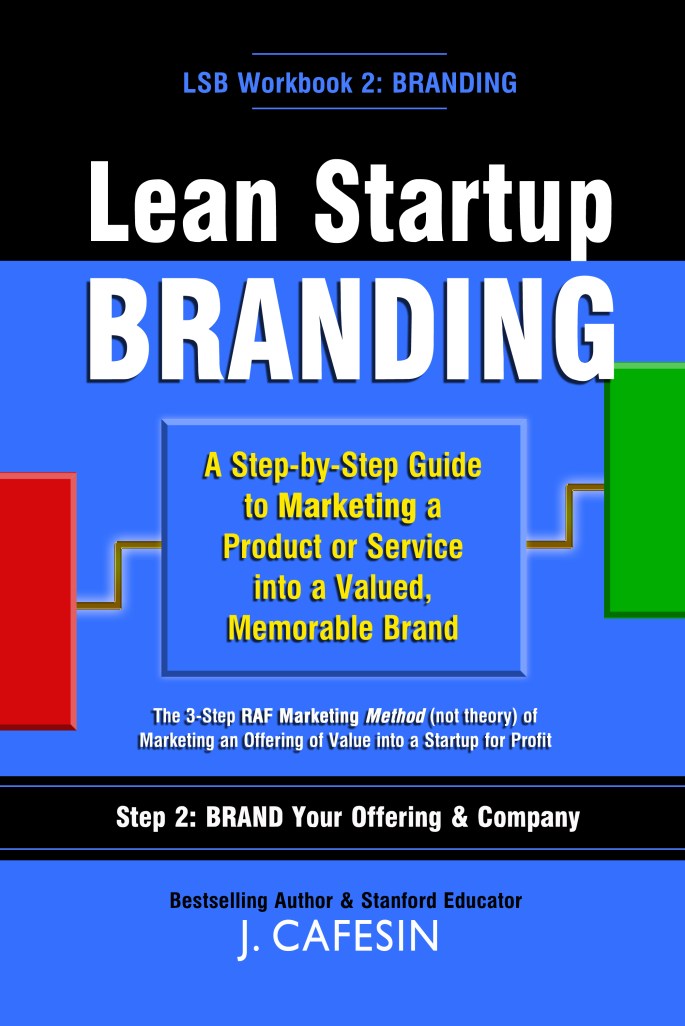
New Release: Lean Startup BRANDING

Lean Startup BRANDING (LSB) Workbook 2, is the first marketing book to unify the marketing/branding process. LSB brings together target marketing methods with graphic design techniques, to produce smart marketing strategies and striking campaigns that uniquely brand your products, services, and company.

Bestselling author, and Stanford Marketing instructor, J. Cafesin, introduces an entirely new Branding paradigm. LSB takes you step-by-step through the branding and marketing of your new venture. Create corporate and product identity packages. Examine the fundamental principles of effective design, and learn to produce multichannel print and digital marketing campaigns that get greater response.

You must continually produce campaigns to create a thriving business. Through text, slides, challenges and projects, LSB Workbook 2 empowers entrepreneurs to CEOs with the knowledge to create and produce professional-quality digital and print marketing, that generate the greatest conversion (clicks; try; buy; subscribe).

● Learn to create a complete Corporate Identity. Establish product and/or company names, then create striking logos that can scale from social media feeds to the side of your building. Establish your startup’s voice with taglines that tout your company’s unique value.

● Study graphic design techniques, such as layout, eye-tracking, responsive grid systems, typography, and how to execute attention-grabbing branding and advertising campaigns.

● Discover the components in imagery that create visual impact, and the myriad of sources to get spectacular visual content, at little to no cost.

● Examine print and digital reproduction. Begin a visual library of high-quality images and video clips to use in your marketing efforts for both print and online campaigns.

● Review SEO (search engine optimization) techniques and best practices.

● Explore online technology, and how to increase engagement with your digital marketing efforts.

● Course projects include developing a complete identity for your offerings and startup, as well as an array of effective print and digital marketing campaigns to introduce your new offerings, and promote your business.

At the completion of LSB Workbook 2: BRANDING, you will have gained the ability to design and inexpensively produced tightly targeted, professional-quality marketing campaigns to turn your startup into a thriving, sustainable business.

https://lnkd.in/gE9h4ej