PROVE IT…BEFORE YOU BUILD IT, with the Productization process.
Over 500,000 startups launch in the U.S. annually. More than 90% fail from bad to no marketing.
Marketing is NOT advertising!Marketing any product or service BEGINS (or should) in product development of the IDEA. Running ads through Google or on Insta, to print and viral campaigns only happens after your IDEA has been validated—productized—as a marketable offering of value.
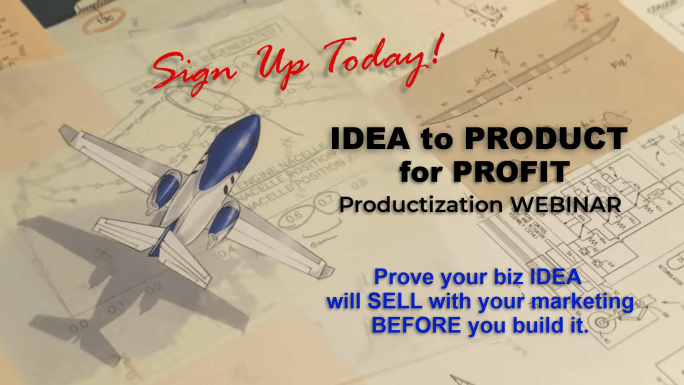
“IDEA to PRODUCT for PROFIT,” is a 50 minute presentation exposing a distinct pattern that leads to business failure time and again, then introduces a unique marketing paradigm to build, brand, and grow a successful business. Originally developed for the Stanford entrepreneurial community, the RAF Marketing Method is a proprietary marketing model that makes effectively marketing a business doable, in sequential, actionable steps.
This webinar is Lean Business Marketing PROCESS, a step-by-step marketing template that delivers a clear and specific path, a roadmap for consistently creating (or directing those you hired to produce) digital, print and viral campaigns that build your brand image and motivate sales. Attendees will learn how to set up a solid foundation for marketing their offerings, and branding their venture into a sustainable business.
This presentation empowers entrepreneurs, engineers to CEOs with a proven method of effectively marketing an idea, or a new or existing offering, step-by-step, into a thriving company.
Attendees will learn:
MBA to Marketing novice, learn Marketing PROCESS, like never before.
The RAF Marketing Method to avoid the three primary points of business failure.
Productization of your product, service, or nonprofit, into a marketable offering of value.
How to effectively build Brand awareness of your offerings and company.
Effective Multichannel marketing for branding and conversion.
10 minute Q & A follows the presentation.
Speaker Bio
Creative/Art Director Jeri Cafesin, inspired by over two decades marketing seed startups to Fortune 500s, brings practical, doable, lean Marketing PRACTICE to Silicon Valley. A MarCom specialist for over two decades, and founder of IPPglobal.org—Lean Marketing Workshops for Entrepreneurs—her marketing strategies and campaigns have helped build thriving companies that realize sustained business growth.
My second job out of college I was the Art Director for 1928 Jewelry Co. The company is still alive and vital today, quite a monument to startup lore. My boss, Fred Burglass, was the best boss I’ve ever had. Funny. Kind. Patient. Smart. I really loved that man. He was like a father to me, taught me many things about marketing, business, and people. Yet I still struggle to adhere to possibly his greatest lesson.
I’d been working there over a year and had neglected to attend any of the executive parties the company threw in their beach house in Malibu. Fred called me into his office one afternoon and insisted I come to the upcoming holiday party, as it was part of my job to schmooze with our current and potential new buyers, and my executive co-workers.
The Friday night before the Saturday party I called my assistant into my office. She’d wanted to go to the party, so I suggested she pretend that she’d come with me. I asked her if anyone was looking for me there, like our boss, Fred, to tell them she just saw me on the beach, or on the deck, or downstairs talking with the Macy’s buyer. I thought I was being clever, outsmarting Fred by telling him I’d be there, and then setting up my assistant to lie for me so he’d never know I wasn’t. The Malibu property was an estate home and easy to get lost in. My assistant was charming and smart and would have no problem pulling it off.
Monday morning Fred called me in his office. I know you weren’t there on Saturday night, he began. But the truth is, you’re just screwing yourself. You want to build your career, maybe your own company down the line, or even write novels full time? Business success, in whatever you choose to do, requires networking, he assured me.
Sadly, I’d pretty much tuned him out. Network. Network. Network. Building relationships is the only way you’ll propel your career forward, Fred consistently preached, so I’d heard all this before.
Problem was, I’ve always been a recluse. An artist by nature and trade, I likely landed in the arts because I have a hard time being with people. I suck at small talk. And I’ve learned getting too personal with questions or opinions is a fast way to shut down dialog. It’s exhausting walking the line of popular decorum, putting on that public face and pretending I believe the guy, or am even interested in how successful he thinks his startup is going to be when he doesn’t even know the SaaS he’s built is already being done by someone else. Ever hear of Competitive Analysis? I want to ask him, but don’t. I used to, but it wasn’t received well.
I give myself all kinds of excuses for not networking. I’m just not good with people. I’m better at creating than chatting. I’m an empath—get too much input around people so I need to limit my contact. But I know it’s all bullshit. You are a brilliant creator, Fred used to tell me. But no one will know that if you don’t meet the right people who recognize your talent and connect you with others to help you exploit it. You must network!
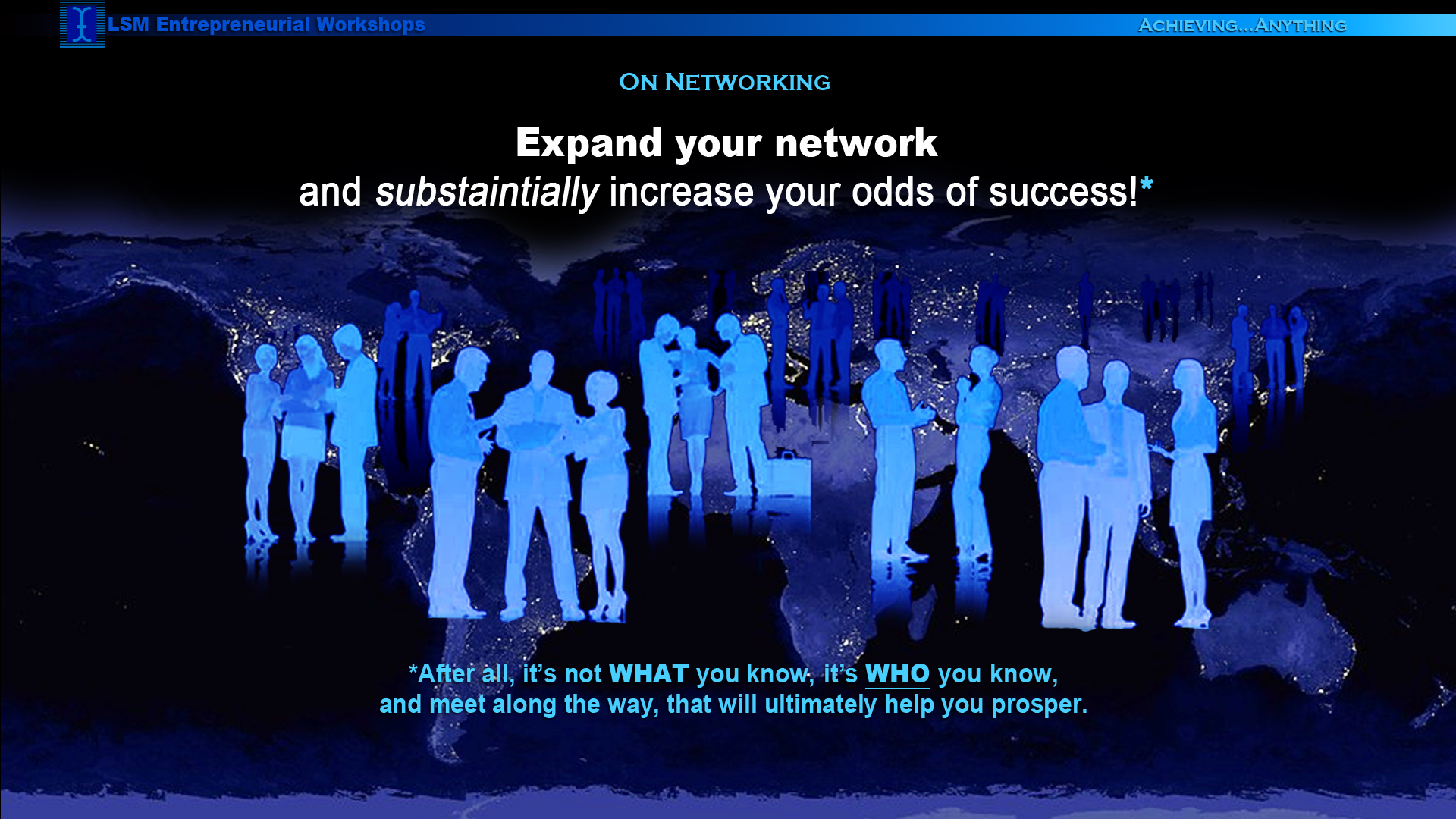
He was right, of course. Digital advertising—Facebook to Google to TikTok—has a very low ROI, generally between .05 – 1.5%. Print is usually higher, but not by a lot, assuming the targeting and messaging are equally tight. Building relationships in-person or online can yield far greater ROI, if done right. Amazon built an empire on exceptional customer service, eliminating the risk of online purchasing by making returns easy, garnering staunch brand advocates. Shark Tank candidates aren’t on the show just for VC money. They’re there for Lori Greiner’s connection to the shopping channel, QVC. The tech entrepreneurs want Mark Cuban’s contacts in the Silicon Valley community.
While networking ROI may seem harder to quantify than digital ads or even direct mail, consistently talking with people in your industry [and related industries] at meetups, SIG meetings, trade shows, webinars, conferences, biz and tech talks, and even office parties, over time will yield better ROI—broader brand recognition and more sales—than any other form of marketing/advertising.
Starting a startup, or finding a job or getting clients, the more you network with your industry and target markets, the greater your odds of building a thriving business. After all, it’s not what you know, but who you know that will help you pave your path to success.
I teach my students at Berkeley and Stanford that the foundation of marketing is psychology. Marketing is manipulating people to do what we want, so to get people to do what we want, we have to understand how they think, what they feel, and why.
I also teach that the foundation of psychology, what motivates all of us to do whatever we do, is self-interest. I explain that even saints like Mother Teresa, who spent her life feeding the poor, caring for the sick, did so out of self-interest. Mother Teresa was not altruistic. There is no such thing as Altruism. It is a religious construct to motivate good deeds, to get people out of our own heads, even for a moment, to consider others.
Many students, especially believers of religion, have a problem with this lecture. And, no doubt, many reading this blog are bridling right now. “Of course Altruism is REAL. It’s what we strive for, our highest attainment— to give selflessly, because we are fundamentally caring, loving beings.”
Not so much. We are fundamentally self-serving.
And this is NOT a judgment call. This is a fact of human nature. What can be judged is what we DO with this fact of our nature.
I teach self-interest religiously with every Marketing lecture I give. As Mother Teresa spread the word of Christ around the world with every sick child she fed, she was fulfilling her function as a nun. And her brain rewarded her efforts with Dopamine, Serotonin, Oxytocin— ‘happiness’ hormones that made her feel good. In the face of that kind of poverty, I’d be crying daily. I don’t do what she did because it would not make me feel good in any way. I’d be profoundly sad, every day, knowing Christ will never save these children. People are going to have to do that.
We ALL act in self-interest. We scoff at Chevron fracking as the height of corruption, yet we blithely ignore our roles in global warming by driving SUVs we don’t need, or leaving lights or electronics on all the time because we’re too distracted to turn them off. Or we drive while on our cellphones, and cause over 1.5 MILLION accidents annually, and KILL, murder, 9 or more people A DAY so we can check our Instagram or Tiktok feeds.
I teach Marketing, not Morality, I tell students who balk at my contention our motivation, without exception, is self-interest. It is important to tell them this fact about us, this truth, giving them the ability to produce effective advertising down the line when they begin marketing their startups. To get people to buy into your product, service or message, you must understand their psychology— what they think they need or want, and why, then offer them solutions to their issues and desires.
Bernie Madoff did it to a lot of greedy people. He fulfilled their desire to get rich quick without effort when he convinced them to invest with him. Purdue Pharma fulfilled the desire of people in temporary and chronic pain, while simultaneously fulfilling the greed of medical professionals with kick-back payments that turned doctors into drug pushers.
Humans are self-interested beings. What we do with this fact is what matters, NOT that we ARE.
On the other end of the spectrum, Toyota fulfilled the desire of people interested in preserving our planet when they invented the Prius. And Tesla and other car makers have done the same with their all electric vehicles. Toyota and Tesla produce the cars they do to make money. And while serving themselves, they are moving closer to serving the greater good, by producing cars that have low emissions. Even better than electric cars, is solar and wind to power them, since over 60% of our electricity still comes from burning coal and other fossil fuels, which continues to do immeasurable damage to our planet.
Martin Andrew Green is an Australian professor at the University of New South Wales who’s dedicated his career to developing solar cells. Mr. Green’s self-interest is scratching a mental itch. He’s curious about light energy, and in learning how to manipulate it, his brain rewards him, makes him feel powerful, smart, valuable, serving his emotional needs.
Self-interest is NOT a curse. It is simply a state of being… human, in our case, but self-interest seemingly dictates the behavior of everything else that lives on Earth. Survival of the fittest is how species last over millennium. Not survival of the kindest, whatever ‘kind’ means. With every mouthful of food, every article of clothing, every vaccination Mother Teresa provided the sick and poor, she also fed them Christianity. She was not kind in spreading gospel that Jesus saves their souls. Instead of teaching the value and necessity of socially responsible behavior, which would have served the greater good, preaching rewards in the afterlife does not serve the living or their future.
There is no need to fear the fact that human behavior is driven by self-interest. Regardless of the religious allegory that Altruism is not only real, but mandatory for society to function, self-interest does NOT need to manifest as narcissism. Green, or Toyota, or the parents who work to provide for their kids, or helping a friend in need, most of us contribute to supporting our society or there would be no human race at all. We have no great physical strength or stealth prowess. Building communities, exchanging ideas and skill sets, being here for each other is all we have to sustain us.
We all have the capacity to be giving, generous, thoughtful beings. Our motivation is irrelevant. It is our ACTIONS that determine our morality, whether we are contributing to creating a society that thrives, or participating it our own demise.
Self-interest is encoded in our DNA, and is not a threat to humanity, but a valuable characteristic, a useful asset. We just need to lengthen our time horizon beyond our own lifetime, broaden our self-absorbed view. We must learn that acting ‘altruistically’ means recognizing our impact on each other and this planet, and that accounting for the needs of others as well as our own IS in all of our self-interest.




 jcafesin.com