The Virus Killing Silicon Valley Startups

There is a pandemic in Silicon Valley. It is making startups sick, and 90+% of all small businesses fail. This virus didn’t start in China, or any country. It didn’t begin in crowded, filthy wet markets from different animals swapping genes. It began with Google and Facebook, and their unrelenting greed for profits.

I am currently mentoring startup students at Berkeley-Haas. I also teach entrepreneurs at Stanford and Cal how to achieve that illusive 10% of sustained business success. Without exception, all are starting up in the exact same backasswards way.

1. They begin their business by developing their product or service.

These entrepreneurs have invested their time, and often their own money in creating a MVP (minimum viable product), a concept introduced by Eric Ries in 2011, and the 2nd of 3 primary reasons most startups fail. NEVER begin your business by producing two-thirds of an idea hoping to ‘find’ your customers, and get them to tell you how to improve your offering. In fact, producing your initial offering at all is the wrong way to start any business.

2. The startup, with their developed MVP, create ‘digital’ marketing campaigns.

They launch their website, and create SMM (social media marketing) and PPC (pay per click) ads to get ‘traction.’ Impressions, Engagements, and Likes are virtually meaningless. Sure, Branding is essential to build awareness of a startup, but sales are what makes a business successful. SALES. That’s it. Without sales, or paid subscriptions, or donations in nonprofits, you have a hobby, not a viable business.

Let’s get real. It’s ridiculously simple to use Google Ads, or to place Facebook ads. These platforms spend millions annually to convince entrepreneurs that slamming the net with crappy advertising will make your company successful. It’s BULLSHIT. They are lying to you, pocketing your $3,000 – 5,000 monthly to ‘train’ their AI engines to “target” your business better than you can. In fact, you should KNOW YOUR TARGET AUDIENCE BEFORE YOU PLACE ANY ADS, or even develop your website.

Beyond Google and Facebook, there are tens of thousands of “Digital Marketing” agencies, selling you the same crap Google and Facebook are. They promise to make you money if you spend your money with them because it is equally easy for them to place these PPC ads as these platforms have made it for you. Stop buying into their deadly virus!

The real ROI on “digital advertising” is very hard to find. Google, Facebook and ‘digital’ agencies make these stats almost impossible to come by. Reality check on ROI of “digital” advertising, according to Search Engine Journal: “the average ROAS (return on ad spending) for small accounts is 1.5 to 1% – or barely break even.” Additionally, PPC or CPC means COST PER CLICK, not sales. It is estimated that 25 – 40% of all clicks on ads are fake, meaning you are paying for clicks from Click Farms in the Philippines, or automated systems meant to profit Google while costing you for every fraudulent click.

3. The startup goes after “building market share” with freemium offers, hoping to convert users to paying customers somewhere in the theoretical future.

It’s easy to get people to try, or even use your offering for free, when they have no skin—money—in play. SALES means getting folks to pay for your offering/s. Getting actual sales is a lot harder!

To garner actual SALES, you must first understand the competitive landscape of your product or service. Many startups have no idea the market share they’re seeking has been garnered by another company with the same or similar offerings. And here’s a heads-up to all the entrepreneurs who think your offering is so unique there’s nothing out there like it. Bullshit. In 5 minutes I can find similar offerings to just about anything. Even if your offering has a few more bells and whistles, it’s hard to get people to pay to switch from what they’ve become accustomed to using.

First and foremost, MARKETING is NOT “digital advertising.”

Broadcast, to PR, to networking, the ROI from these mediums average between 2 – 20+%, way more than the .05 – 1% ROI of ‘digital’ advertising.

BUSINESS, any business, BEGINS with MARKETING. Regardless how great your products or services are, your business will NOT be successful without constantly marketing your offerings. Branding is a tool of marketing—campaigns meant to build awareness of your offerings and company. And Marketing takes many forms, way beyond the extremely low ROI of “digital” campaigns.

The Marketing process is far more complex than designing a logo, putting up a website, and slamming the internet with “digital ads,” organic or paid. BEFORE you build your offering, construct a MARKETING FOUNDATION for your startup, (or existing business—better late than never) to create a thriving, sustainable company.

Before investing the time and money to build a product or service, then waste more countless hours and dollars advertising it, BEGIN any startup or business venture by PRODUCTIZING each and every offering IDEA.

PRODUCTIZATION begins by getting intimate with the offering you hope to create. Make lists, actual, physical lists of your idea’s FEATURES, and the BENEFITS or SOLUTIONS the FEATURES your potential offering will provide. Next, create lists of who will benefit from the features of your offering. These are your TARGET AUDIENCES, the people you will market your offering to. These lists also provide SEO content marketing when you begin the process of creating advertising campaigns.

PRODUCTIZING your offering/s means doing COMPETITIVE ANALYSIS every month or so, to be sure you understand what companies are producing similar offerings, and the market share they’re collecting. If your startup has any success at all, others are going to copy what you’re doing, and go after the same targets you’re hoping to attract, and keep. Understanding what your competition has will help you define what makes your offering unique. Your startup’s marketing should always be selling your UVPs (unique value propositions)—what makes your offering better than your competitors.

It is a lot more fun developing products and services—turning a concept into a reality—than PRODUCTIZING an idea. PRODUCTIZATION is time consuming and detail oriented, and a drag comparatively speaking. If you want to have fun, then enjoy your hobby of creating offerings. If you want to be among the 10% that build SUSTAINABLE companies, you must first build a MARKETING FOUNDATION under your startup, which begins with the PRODUCTIZATION of each and every potential offering.

Copywriting “Test”

Had an interview for a Copywriting contract that required a ‘test.’

Here’s the ‘test:’

Create five (5) YouTube Channels that can “go viral,” which, according to this ‘digital marketing agency’ was “20 million views in one week,” with these prompts:

  • Create a “Seek and Find” YouTube channel.
  • Create a “Mouse Maze” YouTube channel.
  • Create a [tween] YouTube channel: “Imagine you are 13 and develop a superpower…”.

I stopped reading the “Test Deliverables” after that because this agency asked for a total of 5 unique YouTube channel ideas, their only instruction to create channels to “go viral, with 20M views weekly.” I hope the absurdity of this request is not lost on you, since about .03% of all YouTube Channels get 1M+ views on any given video.

And remember, this is a Copywriting ‘test,’ not a product development gig, which, seemingly, this marketing agency does not know a BRANDED YouTube channel actually is a product offering, and should be developed and marketed accordingly.

Five, free, viable YouTube channel ideas requiring little copy—this agency did stress an ‘attention-grabbing’ visual—including thumbnail layouts and storyboard drawings. Oh, and they required I sign an NDA saying that whatever I came up with on their ‘test’ was theirs to keep. Five (5). Free Channel ideas. Per applicant.

Their ‘test’ gave no OBJECTIVE for creating these channels—no sales goals for any company, or the channel itself to realize profitability. No reason for asking applicants to create these brain dead types of channels, other than the unmentionable of making the user the PRODUCT by selling their data, then slamming those same users with pay-per-click ads on every webpage visited forward.

The prompts in their ‘test’ were pulled from the latest trending crap on YouTube. The agency asked applicants to pile on more intellectually void baseline garbage to these senseless trending channels, following the Fire, Aim, Ready marketing method of business failure. Clearly this ‘marketing’ agency doesn’t really understand, well, marketing, assuming they were really looking for a copywriter, and not just garnering free content ideas. There are three business MARKETING reasons (not personal, ego-building social sharing) for a YouTube Channel:

  1. As a marketing/branding channel for a business.
  2. As a data collection tool for tightly targeting future marketing campaigns.
  3. Selling collected data to Affliate Marketing brokers.

Applicants for this copywriting gig were not asked to market an offering of value, nor to build a marketing campaign (or YouTube channel) for any specific targets, nor did they instruct applicants to actually create and MARKET (i.e. BRAND) a YouTube channel for any specific business. They are under the delusion if they just get “views,” they’ll get sales, which data shows is a lie (https://freakonomics.com/podcast/advertising-part-2/), promoted by these very ‘digital marketing’ agencies to get clients. (https://www.ippglobal.org/post/truth-about-data-science)

Of course, after reading their ‘test,’ I turned down the prospect of consulting for them. I felt angry though, that they were not only asking for free, unique IP, but also the IP they were asking for was truly thoughtless, flat out bad marketing, sure to put more ‘digital’ garbage on the ever mounting pile of crap already on YouTube. To quell my anger, with my rejection of consulting for their agency, I included an answer to their first prompt:

Create a Hide & Seek” YouTube Channel:

A Year of Free Beer for Finding NAME OF FAMOUS IPA BEER.

AR (augmented reality) game to find the bottle of famous IPA BEER (or any other idiotic thing that’s trending). Everyone 21 or older with mobile can play. AR has NAME OF FAMOUS IPA BEER bottles in places around each major cities, but also standard beer bottles, and area sports team logos, (even cross-sell with image placements) that ‘lead’ you to the ‘right IPA.’ First to find NAME OF FAMOUS IPA BEER (in any given round, which may be a week or more per round) to collect all that global data, (which then can be sold to screw us all further), wins the free beer for a year, every month getting new IPA flavors.

The TARGET USERS of this YouTube Channel will be:

  1. Lowest hanging target is the sudo-intellectual, over-educated ivy-league crowd, mostly White men; Christians, Jews, Agnostics—higher education levels; MMORPG, FPS, and MOD gamer; Software, Marketing, Admin, Finance; STEAM; democrats; mid – upper income; 21 – 60.
  2. Lazy, generally fat, FPS gamers, beer and sports-loving men. White mostly. Conservatives. Apatheist, Christians; low – mid income; blue-collar job; pensions; 18 – 65.

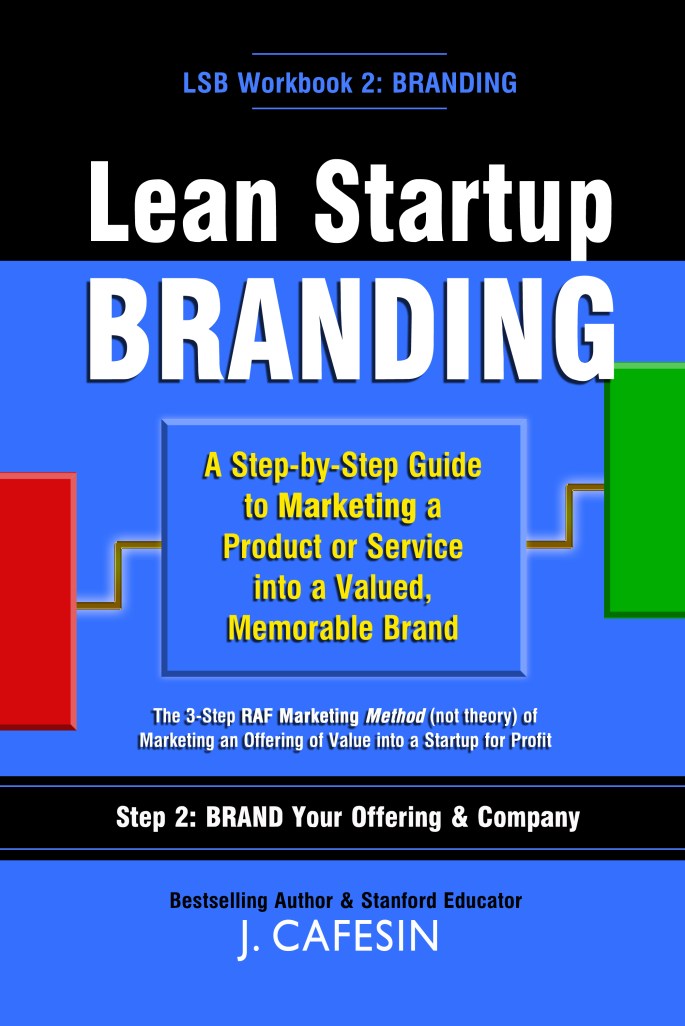
New Release: Lean Startup BRANDING

Lean Startup BRANDING (LSB) Workbook 2, is the first marketing book to unify the marketing/branding process. LSB brings together target marketing methods with graphic design techniques, to produce smart marketing strategies and striking campaigns that uniquely brand your products, services, and company.

Bestselling author, and Stanford Marketing instructor, J. Cafesin, introduces an entirely new Branding paradigm. LSB takes you step-by-step through the branding and marketing of your new venture. Create corporate and product identity packages. Examine the fundamental principles of effective design, and learn to produce multichannel print and digital marketing campaigns that get greater response.

You must continually produce campaigns to create a thriving business. Through text, slides, challenges and projects, LSB Workbook 2 empowers entrepreneurs to CEOs with the knowledge to create and produce professional-quality digital and print marketing, that generate the greatest conversion (clicks; try; buy; subscribe).

● Learn to create a complete Corporate Identity. Establish product and/or company names, then create striking logos that can scale from social media feeds to the side of your building. Establish your startup’s voice with taglines that tout your company’s unique value.

● Study graphic design techniques, such as layout, eye-tracking, responsive grid systems, typography, and how to execute attention-grabbing branding and advertising campaigns.

● Discover the components in imagery that create visual impact, and the myriad of sources to get spectacular visual content, at little to no cost.

● Examine print and digital reproduction. Begin a visual library of high-quality images and video clips to use in your marketing efforts for both print and online campaigns.

● Review SEO (search engine optimization) techniques and best practices.

● Explore online technology, and how to increase engagement with your digital marketing efforts.

● Course projects include developing a complete identity for your offerings and startup, as well as an array of effective print and digital marketing campaigns to introduce your new offerings, and promote your business.

At the completion of LSB Workbook 2: BRANDING, you will have gained the ability to design and inexpensively produced tightly targeted, professional-quality marketing campaigns to turn your startup into a thriving, sustainable business.

https://lnkd.in/gE9h4ej

A True Email Tale

This morning I came into my office and there was an email from my husband. It was title, “The terminator is coming…” No joke. That was the exact SUBJECT LINE of his email.

I don’t care that another Terminator movie is coming out. I liked only the first and second Terminator movies, and thought the rest (and Arnold Schwarzenegger) were crap.

I didn’t open his email. I trashed it. I didn’t see the link he had inside it, but even if I did, I wouldn’t have paid attention it with his email subject line.

As I reviewed my emails, I watched the news, as I do every morning. The segment was on Boston Dynamics, a well-known robotics firm. They were showing off the agility their Atlas robot, doing a back flip! I was so blown away, it looked so real, like a person, I sent the video clip to my husband and kids. My subject line: “Totally cool robot moves!”

My husband sent me back an email, “I sent this video to you this morning.”

Hmm…he did? I didn’t see it.

“It was in the email about the terminator coming,” he wrote. “I guess I gave my email a bad title.”

No shit.

WORDS MATTER! Marketing/Copywriting must choose the RIGHT WORDS for the right audience to get response.