The Cost of Convenience

It’s surprising how little I think of my daughter now that she’s living 2,000 miles away at school. We talk on the phone frequently, but since she’s not involved in my daily life anymore, she’s more of an abstraction (when we’re not directly talking), a pleasant thought when she crosses my mind.

I figured she was having the same experience I was when she went off to college. The thought of me made her feel glad (or angry, or… since I’m her mother and that comes with mixed feelings), but I didn’t consider she thought of me often in her busy life. So, when I recently had exploratory surgery looking for cancer, I did not realize she even remembered me mentioning the appointment on the phone a couple of weeks ago.

This morning I’m in my office going through my email. I find one from my husband letting me know he and our daughter signed me up for online notifications of my medical records, including test results, last night while I slept. They gave the MyChart app my husband’s phone number and his email because they both know how much I hate putting my data online, never stopping to consider that my husband would be notified of my test results likely before I would by snail mail.

I’ll be getting my test results by snail mail because I do not want my medical information online. I get that it already is, which my daughter reminded me when I came at her full bore with anger on the phone this morning for signing me up without my permission (after coming unglued on my husband).

It isn’t just my medical records that shouldn’t be online, sitting in a cloud, accessible to everyone from Walgreens to United Health Care [insurance]. It makes my skin crawl that almost every time I want to access anything on the net now, the site attaches ‘cookies’ to my machine that track my usage. Many sites require I fill out forms for entry, collecting, aggregating and categorizing even more of my personal data to sell and/or exploit with targeted marketing.

My daughter is on the medical track studying to become a physician. She works as a scribe in a medical practice, and is an intern at Palomar Medical Center and uses MyChart on the job. So do the patients of the practice and the hospital, she assured me. They all love the convenience of being able to look up their medications and/or test results as soon as they’re posted on their e-chart.

She was trying to sell me on the real world, the one she, and most everyone else lives in daily—perpetually attached to the net via cellphones, laptops and tablets. Banking to paying bills to shopping, my daughter uses these online ‘services’ (which is kind of an oxymoron since these apps make it self-serve), to ‘keep it simple’ while juggling two internships, a job, and a full course load every quarter, including this summer.

Do you understand there is a cost to convenience? I asked her on the phone, after she apologized for setting up the account without my permission and promised to delete it when we disconnected.

She did, she assured me. But she really doesn’t. She’s too young, too many generations removed from WWII.

The Third Reich was a diagnosis regime, obsessed with sorting the population into categories, cataloging people by race, religion, politics, sexuality, criminality and purported biological, mental and behavioral defects. Nazi officials created massive population indexes that compiled individuals’ medical, financial, educational, criminal and welfare records — even sports club files. By 1942, approx. ten million Reich citizens had been indexed. These files, then, established the grounds for sterilization, deportation and extermination.” (https://lnkd.in/d9txaahS)

Nothing to hide? I rhetorically asked my daughter on the phone, still admonishing her for signing me up for an online account of my medical information and then giving access to her dad via email. She placated my perceived conspiracy theory with, I get it, Mom! I do. It’s likely dangerous to have all our personal information online, but it already is, Mom.

1942 may as well be 1642 to my daughter, and [ostensibly] most of her gen— too far back to remember or care.

I didn’t care about using internet-based services either until the ‘cloud.’ It was mid-2000s and we were all on the free and open information highway when Amazon introduced its cloud-based storage service, but I didn’t get its impact until my bank started offering SaaS [self] ‘services,’ like Direct Deposit and online payments ‘for our convenience.’ At first I didn’t care about that either, as I had no intention of banking online since putting my bank account numbers through unsecured servers didn’t, and still doesn’t seem wise to me. Banking security is another oxymoron, and my internet connection through Xfinity isn’t exactly an impenetrable firewall.

By the mid-2010s cloud computing had scaled, especially with the advent of the ‘smart’ phone. Bank of America started making it hard to come into their branches in-person, cutting its staff in half and forcing customers to wait in long lines to talk to a teller. Many young people adapted quickly to avoid the hassle the banks created, which left a lot of older folks, and holdouts with old tech cellphones like me, having to wait sometimes 45 minutes to deposit a check.

I had a red slide phone with a real [small] keyboard and no internet connection until 2021 when AT&T switched to 4G and forced me to “upgrade” to a ‘smart’ phone [like the rest of the known universe did a decade earlier]. I’ve yet to enable an internet connection on my new cellphone, and don’t use location SaaS apps, ever. I navigate using printed maps, or use my memory the second visit to anywhere I’ve been. With my phone offline and not accessing any location services, at least it stops communicating with nearby cell towers so Google and State Farm [car insurance] doesn’t know where I am on the planet (GPS), or how fast I’m driving. They also don’t know whether I’m in my car, or on a plane, through the accelormeter sensor now inside our ‘smart’ phones which detects motion—whether we’re still, walking, biking, driving, flying.

I used to be among the 2+ billion frequent users of Amazon’s marketplace until every bookstore, hardware store, curio, card and gift shop in my neighborhood closed. And while it’s ‘convenient’ to get things delivered to my front door, not so much when it’s snowing out and UPS won’t deliver to our house on the hill and I need a specific tool to fix my irrigation pipe that froze and busted open. I now drive 12 miles, instead of the 3 it used to be before the local hardware store closed. I’m back to buying my tools directly, in-person, as I do for most everything else I shop for now to support the survival of local businesses.

Intellectually, I know I am fighting Goliath with a slingshot trying to retain even a modicum of my privacy from the Content Monster we call the ‘cloud.’ Stalking us everywhere we go IRL, and visit online on our devices, to everything we buy, to our marital status and genetic offspring, corporations have created and continue to create—unobstructed by laws or ethics—“massive population indexes that compiles individuals’ medical, financial, educational, criminal and welfare records — even sports club files,” or lack thereof since most Americans don’t exercise. Insta, Google, FB, TicTok, ChatGPT and every other big data SaaS app out there is “sorting the population into categories, cataloging people by race, religion, politics, sexuality, criminality,” including biological and mental characteristics of behavioral and genetic health.

Many, in fact most large corps these days are marketing us into buying, and believing (religion, politics, social views and values) by targeting their messaging using the very data we give them with every click on a webpage, swipe on a screen, every text or IM, every form we fill out, every poll we take, questionnaire we answer, and every medical exam or procedure we have now is stored on a cloud, and not just one cloud, but many. Redundancy is key in data storage.

I feel like the Borg is trying to assimilate me into submission of my privacy for the convenience of becoming part of the hive—i.e. ‘cloud’[ed] mind, I tried to explain to my daughter on the phone this morning. And the convenience [of self-service] turns out to be for the corps, killing customer service, tying us up in phone loops, and making their mistakes our problems to fix while continually charging our credit cards their monthly fee. So much for the convenience of AutoPay.

Mother, my daughter proclaimed in all seriousness, all our information is already online and in the cloud, or separate clouds that are all connected, or whatever, and there’s nothing any of us can do about it. I signed you up for MyChart last night because I want you to get your test results as soon as they’re posted and then share them with me so I can stop worrying, or, at least know what is going on with you. I love you, Mom, and I feel really scared about your biopsy results.

Heavy sigh. She played the Love card.

Assimilation is hard to resist when delivered by those you love most.

I apologized for making her worry, and again felt surprised that my daughter remembered and was concerned about my biopsy. I promised to tell her the test results as soon as I get them, which is likely a lie, unless they’re good. I’ll need to privately process bad results before making her worry even more.

Regardless of whom I choose to share my biopsy results with, they are mine alone to share, or they should be. The fact is, my insurance company will know if I have cancer before I will. If my doctor prescribes me drugs, Wallgreens will know what kind of cancer before I will by snail mail. Under the Affordable Care Act, my insurance can not charge me more, or exclude coverage for pre-existing conditions, but get another Republican president, and that can change. We’ll go back to leaving diabetics to the disabled uninsured.

My world growing up was much like my parents. In my day, corporations worked for their customers and clients. With the advent of SaaS and the ‘aide’ of apps, we are now all products of these corporations selling us on using technology with the lie of ‘convenience’ while hording our private information to maximize their profits.

Nothing to hide? Nazi Germany won’t ever happen here?

  • Trump, and his millions of minions.
  • Fox ‘News.’ Newsmax. Breitbart…etc.
  • Conservative Christians
  • Catholic Supreme Court (8 out of 9 justices)
  • Neo-Nazis
  • White Nationalists/Supremacists/Warriors
  • …etc.

Storytelling is Truth Tweaked

Way before writing novels, I was a storyteller. Before I could write, I used to come to breakfast and recount tales of elaborate adventures I’d had during the night with my stuffed dog, Checkers. The purpose was to garner my mother’s attention, a precious commodity given mainly to my manic-depressive brother and egocentric sister. The stories I chose to relay often had a point, a message I was trying to communicate. I was saved from evil kidnappers by a kind stranger because my parents weren’t there to help me. I climbed the Matterhorn ride at Disneyland and rescued the children stuck at the top, illuminating my prowess, and kindness.

Like most professional writers, I’ve written since learning to write, at first in diaries, then personal journals. I now publish essays, short stories, and novels. I love the process of writing, even editing, again and again—honing my words to transmit to the reader the scenes unfolding in my head, and the essence of those in the narrative.

Similar to storytelling as a little kid, each work I pen to publish has a point. I write fairy tales that challenge social norms. I write personal essays against the grain of the status quo that often inflame readers. But beyond writing to publish, I still am and will always be a storyteller. I use stories as parables, to teach with, to convey ideas, thoughts, and feelings, to my kids, my husband, my students, my peers, basically most anyone I interact with. The stories I share are things that happened—sometimes to me, though often just things I’ve heard along the way—to communicate, or to fit the lesson. More precisely, I elaborate on things that happened. I fabricate truths to add drama, or context to the tale, or to drive a point home. Admit it, or not, we all do.

Long time ago, I was told the best way to pull off a lie is to keep it as close to the truth as possible, just “tweak the truth.” It’s easy to pull off a realistic tale this way, since most people aren’t paying that close attention anyway. We take what is said (or what we read) at face value, only questioning its validity if it’s too far out there. I find I need to tweak the unvarnished truth more often than not to be heard, or believed, as truth is either too boring, or too bizarre—truly stranger than fiction so much of the time.

Fiction may be truth, tweaked, but so are blogs, memoirs, non-fiction, even ‘news’ articles—they are all simply the point of view of the writer/storyteller trying to communicate a feeling or message. FOX Media is the Republican point of view, and will give you a completely different take on the ‘news’ than CNN, or PBS. But truth tweaked goes far beyond the news media. Even the most far out fiction like Twilight or Harry Potter resonates with us because they communicate real, true feelings that are familiar to us all. They exploit the truth of our hopes for a better world, a more just society.

Storytelling is the foundation of human communication. Before written languages, sharing stories was how we passed on our history, learned from our experiences, instilled morality into our communities, and advanced our race. We all elaborate on our stories, writing them down, or simply recounting an event in our day. We all tweak the truth to serve us, to present an image, teach our children, or convey our fears, desires, and dreams.

For as long as I can remember, most every time I tell anyone I’m a writer, they respond with, ‘Oh, I write, too,’ (because they keep a diary), or, ‘I’m going to write my story soon.’ Used to bug me. I felt dissed by their self-proclaimed association, while they invested little to no effort in my chosen, but absurdly challenging profession. And though most will never actualize their writing ambitions, the fact is, they too are telling a tale to communicate an image to me, and to themselves—that their stories are valuable, their life meaningful, tweaking the truth to serve their agenda. We are all storytellers indeed. 

Marketing 101

I hate running.

It hurts my legs, my lungs, my back, my tits.

I run between 3 and 4+ miles, five days a week. And I’ll continue to run as long as the benefits outweigh the drawbacks.

I hate feeling fat, and running is the quickest calorie burn I know of (my me-time is hugely limited with an active career and two kids). Running helps me think. It not only activates neural connectivity, it’s also a quiet space, undisturbed by kids or clients. I get to listen to my music, blasting through my earbuds, let it absorb me, the rhythm drive me, and in moments it feels like I’m flying.

I run whether I’m healthy, sick with a cold or flu, or anything else that isn’t laying me out on my death bed. I’m afraid if I give myself one excuse not to run it will lead to another, and in short order I’ll quit running. But I won’t quit, as long as the benefits serving my needs outweigh the hardships.

Benefits that fulfill Need/Desire is, or should be, the foundation of all marketing efforts.

Digital advertising is now the hip slick and trendy way to market. And no doubt, there are great marketing opportunities online. Websites, landing pages, social media marketing, e-blasts, analytics…etc, are TOOLS to market with. But marketing online, or offline, IS THE SAME THING. The basic principles of marketing must be applied to sell and grow any company.

Print, online, or on the friggin moon, Marketing is selling BENEFITS that fulfill WANT. There is no such thing as NEED. It is merely a construct of desire. Advertising, PR, branding, visual design, copywriting, marketing communications are, or should be, developed, designed and produced to SELL products/services/ideas/messages. ‘Likes, Engagements, Views, Impressions’ are all bullshit “vanity” metrics to stroke egos so you’ll buy more online ad space.

Startups these days typically begin their marketing efforts by flooding the internet with digital ads, videos, polls, games and such. These branding and selling campaigns push products and services without distinguishing a clear desire or solution for anyone. They do not tout the benefits of what these startups are selling, or identifying any specific groups of people who will likely find value in the features of their offerings. No matter what Google and Facebook tell you about their targeting AI algorithms, online ads are not tightly targeted to people likely to benefit from your specific product, service or message. This “Fire, Aim, Ready” approach clearly illustrates why 90+% of all startups fail.

I’ve been a MarCom specialist in the San Francisco Bay Area for 20 yrs. I’ve worked with a ton of startups who do not consistently promote their offerings features and benefits, or realign their marketing efforts to outshine competition, nor do they invest in developing new products that fulfill anyone’s desires. And I’ve watched them fold again and again, sometimes in ridiculously short order.

Marketing 101— IN ORDER (Ready, Aim, Fire!):

1. Get Ready and Productize Your Idea: Identify the features, benefits and differentiators of your offering that fulfill a desire, or offer a solution to specific target markets likely to find value in your product, service, or message/mission (non-profit).

2. Take Aim and Create Brand Identity, and Marketing Campaigns: Establish an identity (logo), and voice (tagline), as well as marketing efforts—digital, print, and pitch (in-person) campaigns that fulfill a desire, or offer a solution to each specific target audience.

3. Fire!—Launch Marketing Campaigns: Motivate people to ACT—to click, to subscribe, try, or purchase your offering, or buy into your message.

The new order of entrepreneurs are weened on social media and tech. Universities, startup schools and bootcamps generally teach their students to launch backasswards. They promote the MVP model of innovation. Building a MVP (minimum viable product) may have worked for a handful of successful startups, but it took them a hell of a lot longer to reach profitability than necessary. In most cases, MVP is a recipe for failure. Relying on consumers to figure out what benefits your offering should fulfill for them is time consuming, expensive, and lazy. It is the job of the entrepreneur to produce a product or service of value for specific groups of people before launching your business.

Unfortunately, opting for A/B testing, and SEO keyword tricks over real content—selling benefits fulfilling a desire—and relying on Google Analytics doesn’t actually SELL much. Measuring response rates isn’t new. It’s been in the background since advertising began, and generally offers limited utility. Marketing is dynamic! Results vary by target audiences, the day a campaign launches, time of day, day of week, the weather, behavioral trends, sociological and financial climates, to name just a few factors that determine response.

The principles of Marketing may be simple, but motivating people to bend to our will is not easy. Beyond the primary building blocks of any campaign, (Ready, Aim, Fire), at the core of effective Marketing is psychology. Online, or on Mars, understanding your customers and potential customers’ psychology is mandatory if you want the greatest response to your marketing efforts. Marketing pros study people, not code, since coding, especially with ever-emerging technologies, is time consuming to learn, and generally requires a different kind of awareness than psychology. I’ve yet to meet a web developer/designer who’s demonstrated mastery in marketing. Competent at software development means they’re investing their time in technology, not in the study of human behavior.

I tell my clients that digital marketing is not ‘the answer’ to effective marketing. New avenues of selling will arise, and others fade away. But the growth of any business, or nonprofit message, or even activity, like running, depends on the benefits continually fulfilling a desire for a specific group of people.

The Psychology of Marketing

I teach my students at Berkeley and Stanford that the foundation of marketing is psychology. Marketing is manipulating people to do what we want, so to get people to do what we want, we have to understand how they think, what they feel, and why.

I also teach that the foundation of psychology, what motivates all of us to do whatever we do, is self-interest. I explain that even saints like Mother Teresa, who spent her life feeding the poor, caring for the sick, did so out of self-interest. Mother Teresa was not altruistic. There is no such thing as Altruism. It is a religious construct to motivate good deeds, to get people out of our own heads, even for a moment, to consider others.

Many students, especially believers of religion, have a problem with this lecture. And, no doubt, many reading this blog are bridling right now. “Of course Altruism is REAL. It’s what we strive for, our highest attainment— to give selflessly, because we are fundamentally caring, loving beings.”

Not so much. We are fundamentally self-serving.

And this is NOT a judgment call. This is a fact of human nature. What can be judged is what we DO with this fact of our nature.

I teach self-interest religiously with every Marketing lecture I give. As Mother Teresa spread the word of Christ around the world with every sick child she fed, she was fulfilling her function as a nun. And her brain rewarded her efforts with Dopamine, Serotonin, Oxytocin— ‘happiness’ hormones that made her feel good. In the face of that kind of poverty, I’d be crying daily. I don’t do what she did because it would not make me feel good in any way. I’d be profoundly sad, every day, knowing Christ will never save these children. People are going to have to do that.

We ALL act in self-interest. We scoff at Chevron fracking as the height of corruption, yet we blithely ignore our roles in global warming by driving SUVs we don’t need, or leaving lights or electronics on all the time because we’re too distracted to turn them off. Or we drive while on our cellphones, and cause over 1.5 MILLION accidents annually, and KILL, murder, 9 or more people A DAY so we can check our Instagram or Tiktok feeds.

I teach Marketing, not Morality, I tell students who balk at my contention our motivation, without exception, is self-interest. It is important to tell them this fact about us, this truth, giving them the ability to produce effective advertising down the line when they begin marketing their startups. To get people to buy into your product, service or message, you must understand their psychology— what they think they need or want, and why, then offer them solutions to their issues and desires.

Bernie Madoff did it to a lot of greedy people. He fulfilled their desire to get rich quick without effort when he convinced them to invest with him. Purdue Pharma fulfilled the desire of people in temporary and chronic pain, while simultaneously fulfilling the greed of medical professionals with kick-back payments that turned doctors into drug pushers.

Humans are self-interested beings. What we do with this fact is what matters, NOT that we ARE.

On the other end of the spectrum, Toyota fulfilled the desire of people interested in preserving our planet when they invented the Prius. And Tesla and other car makers have done the same with their all electric vehicles. Toyota and Tesla produce the cars they do to make money. And while serving themselves, they are moving closer to serving the greater good, by producing cars that have low emissions. Even better than electric cars, is solar and wind to power them, since over 60% of our electricity still comes from burning coal and other fossil fuels, which continues to do immeasurable damage to our planet.

Martin Andrew Green is an Australian professor at the University of New South Wales who’s dedicated his career to developing solar cells. Mr. Green’s self-interest is scratching a mental itch. He’s curious about light energy, and in learning how to manipulate it, his brain rewards him, makes him feel powerful, smart, valuable, serving his emotional needs.

Self-interest is NOT a curse. It is simply a state of being… human, in our case, but self-interest seemingly dictates the behavior of everything else that lives on Earth. Survival of the fittest is how species last over millennium. Not survival of the kindest, whatever ‘kind’ means. With every mouthful of food, every article of clothing, every vaccination Mother Teresa provided the sick and poor, she also fed them Christianity. She was not kind in spreading gospel that Jesus saves their souls. Instead of teaching the value and necessity of socially responsible behavior, which would have served the greater good, preaching rewards in the afterlife does not serve the living or their future.

There is no need to fear the fact that human behavior is driven by self-interest. Regardless of the religious allegory that Altruism is not only real, but mandatory for society to function, self-interest does NOT need to manifest as narcissism. Green, or Toyota, or the parents who work to provide for their kids, or helping a friend in need, most of us contribute to supporting our society or there would be no human race at all. We have no great physical strength or stealth prowess. Building communities, exchanging ideas and skill sets, being here for each other is all we have to sustain us.

We all have the capacity to be giving, generous, thoughtful beings. Our motivation is irrelevant. It is our ACTIONS that determine our morality, whether we are contributing to creating a society that thrives, or participating it our own demise.

Self-interest is encoded in our DNA, and is not a threat to humanity, but a valuable characteristic, a useful asset. We just need to lengthen our time horizon beyond our own lifetime, broaden our self-absorbed view. We must learn that acting ‘altruistically’ means recognizing our impact on each other and this planet, and that accounting for the needs of others as well as our own IS in all of our self-interest.

The Virus Killing Silicon Valley Startups

There is a pandemic in Silicon Valley. It is making startups sick, and 90+% of all small businesses fail. This virus didn’t start in China, or any country. It didn’t begin in crowded, filthy wet markets from different animals swapping genes. It began with Google and Facebook, and their unrelenting greed for profits.

I am currently mentoring startup students at Berkeley-Haas. I also teach entrepreneurs at Stanford and Cal how to achieve that illusive 10% of sustained business success. Without exception, all are starting up in the exact same backasswards way.

1. They begin their business by developing their product or service.

These entrepreneurs have invested their time, and often their own money in creating a MVP (minimum viable product), a concept introduced by Eric Ries in 2011, and the 2nd of 3 primary reasons most startups fail. NEVER begin your business by producing two-thirds of an idea hoping to ‘find’ your customers, and get them to tell you how to improve your offering. In fact, producing your initial offering at all is the wrong way to start any business.

2. The startup, with their developed MVP, create ‘digital’ marketing campaigns.

They launch their website, and create SMM (social media marketing) and PPC (pay per click) ads to get ‘traction.’ Impressions, Engagements, and Likes are virtually meaningless. Sure, Branding is essential to build awareness of a startup, but sales are what makes a business successful. SALES. That’s it. Without sales, or paid subscriptions, or donations in nonprofits, you have a hobby, not a viable business.

Let’s get real. It’s ridiculously simple to use Google Ads, or to place Facebook ads. These platforms spend millions annually to convince entrepreneurs that slamming the net with crappy advertising will make your company successful. It’s BULLSHIT. They are lying to you, pocketing your $3,000 – 5,000 monthly to ‘train’ their AI engines to “target” your business better than you can. In fact, you should KNOW YOUR TARGET AUDIENCE BEFORE YOU PLACE ANY ADS, or even develop your website.

Beyond Google and Facebook, there are tens of thousands of “Digital Marketing” agencies, selling you the same crap Google and Facebook are. They promise to make you money if you spend your money with them because it is equally easy for them to place these PPC ads as these platforms have made it for you. Stop buying into their deadly virus!

The real ROI on “digital advertising” is very hard to find. Google, Facebook and ‘digital’ agencies make these stats almost impossible to come by. Reality check on ROI of “digital” advertising, according to Search Engine Journal: “the average ROAS (return on ad spending) for small accounts is 1.5 to 1% – or barely break even.” Additionally, PPC or CPC means COST PER CLICK, not sales. It is estimated that 25 – 40% of all clicks on ads are fake, meaning you are paying for clicks from Click Farms in the Philippines, or automated systems meant to profit Google while costing you for every fraudulent click.

3. The startup goes after “building market share” with freemium offers, hoping to convert users to paying customers somewhere in the theoretical future.

It’s easy to get people to try, or even use your offering for free, when they have no skin—money—in play. SALES means getting folks to pay for your offering/s. Getting actual sales is a lot harder!

To garner actual SALES, you must first understand the competitive landscape of your product or service. Many startups have no idea the market share they’re seeking has been garnered by another company with the same or similar offerings. And here’s a heads-up to all the entrepreneurs who think your offering is so unique there’s nothing out there like it. Bullshit. In 5 minutes I can find similar offerings to just about anything. Even if your offering has a few more bells and whistles, it’s hard to get people to pay to switch from what they’ve become accustomed to using.

First and foremost, MARKETING is NOT “digital advertising.”

Broadcast, to PR, to networking, the ROI from these mediums average between 2 – 20+%, way more than the .05 – 1% ROI of ‘digital’ advertising.

BUSINESS, any business, BEGINS with MARKETING. Regardless how great your products or services are, your business will NOT be successful without constantly marketing your offerings. Branding is a tool of marketing—campaigns meant to build awareness of your offerings and company. And Marketing takes many forms, way beyond the extremely low ROI of “digital” campaigns.

The Marketing process is far more complex than designing a logo, putting up a website, and slamming the internet with “digital ads,” organic or paid. BEFORE you build your offering, construct a MARKETING FOUNDATION for your startup, (or existing business—better late than never) to create a thriving, sustainable company.

Before investing the time and money to build a product or service, then waste more countless hours and dollars advertising it, BEGIN any startup or business venture by PRODUCTIZING each and every offering IDEA.

PRODUCTIZATION begins by getting intimate with the offering you hope to create. Make lists, actual, physical lists of your idea’s FEATURES, and the BENEFITS or SOLUTIONS the FEATURES your potential offering will provide. Next, create lists of who will benefit from the features of your offering. These are your TARGET AUDIENCES, the people you will market your offering to. These lists also provide SEO content marketing when you begin the process of creating advertising campaigns.

PRODUCTIZING your offering/s means doing COMPETITIVE ANALYSIS every month or so, to be sure you understand what companies are producing similar offerings, and the market share they’re collecting. If your startup has any success at all, others are going to copy what you’re doing, and go after the same targets you’re hoping to attract, and keep. Understanding what your competition has will help you define what makes your offering unique. Your startup’s marketing should always be selling your UVPs (unique value propositions)—what makes your offering better than your competitors.

It is a lot more fun developing products and services—turning a concept into a reality—than PRODUCTIZING an idea. PRODUCTIZATION is time consuming and detail oriented, and a drag comparatively speaking. If you want to have fun, then enjoy your hobby of creating offerings. If you want to be among the 10% that build SUSTAINABLE companies, you must first build a MARKETING FOUNDATION under your startup, which begins with the PRODUCTIZATION of each and every potential offering.

Copywriting “Test”

Had an interview for a Copywriting contract that required a ‘test.’

Here’s the ‘test:’

Create five (5) YouTube Channels that can “go viral,” which, according to this ‘digital marketing agency’ was “20 million views in one week,” with these prompts:

  • Create a “Seek and Find” YouTube channel.
  • Create a “Mouse Maze” YouTube channel.
  • Create a [tween] YouTube channel: “Imagine you are 13 and develop a superpower…”.

I stopped reading the “Test Deliverables” after that because this agency asked for a total of 5 unique YouTube channel ideas, their only instruction to create channels to “go viral, with 20M views weekly.” I hope the absurdity of this request is not lost on you, since about .03% of all YouTube Channels get 1M+ views on any given video.

And remember, this is a Copywriting ‘test,’ not a product development gig, which, seemingly, this marketing agency does not know a BRANDED YouTube channel actually is a product offering, and should be developed and marketed accordingly.

Five, free, viable YouTube channel ideas requiring little copy—this agency did stress an ‘attention-grabbing’ visual—including thumbnail layouts and storyboard drawings. Oh, and they required I sign an NDA saying that whatever I came up with on their ‘test’ was theirs to keep. Five (5). Free Channel ideas. Per applicant.

Their ‘test’ gave no OBJECTIVE for creating these channels—no sales goals for any company, or the channel itself to realize profitability. No reason for asking applicants to create these brain dead types of channels, other than the unmentionable of making the user the PRODUCT by selling their data, then slamming those same users with pay-per-click ads on every webpage visited forward.

The prompts in their ‘test’ were pulled from the latest trending crap on YouTube. The agency asked applicants to pile on more intellectually void baseline garbage to these senseless trending channels, following the Fire, Aim, Ready marketing method of business failure. Clearly this ‘marketing’ agency doesn’t really understand, well, marketing, assuming they were really looking for a copywriter, and not just garnering free content ideas. There are three business MARKETING reasons (not personal, ego-building social sharing) for a YouTube Channel:

  1. As a marketing/branding channel for a business.
  2. As a data collection tool for tightly targeting future marketing campaigns.
  3. Selling collected data to Affliate Marketing brokers.

Applicants for this copywriting gig were not asked to market an offering of value, nor to build a marketing campaign (or YouTube channel) for any specific targets, nor did they instruct applicants to actually create and MARKET (i.e. BRAND) a YouTube channel for any specific business. They are under the delusion if they just get “views,” they’ll get sales, which data shows is a lie (https://freakonomics.com/podcast/advertising-part-2/), promoted by these very ‘digital marketing’ agencies to get clients. (https://www.ippglobal.org/post/truth-about-data-science)

Of course, after reading their ‘test,’ I turned down the prospect of consulting for them. I felt angry though, that they were not only asking for free, unique IP, but also the IP they were asking for was truly thoughtless, flat out bad marketing, sure to put more ‘digital’ garbage on the ever mounting pile of crap already on YouTube. To quell my anger, with my rejection of consulting for their agency, I included an answer to their first prompt:

Create a Hide & Seek” YouTube Channel:

A Year of Free Beer for Finding NAME OF FAMOUS IPA BEER.

AR (augmented reality) game to find the bottle of famous IPA BEER (or any other idiotic thing that’s trending). Everyone 21 or older with mobile can play. AR has NAME OF FAMOUS IPA BEER bottles in places around each major cities, but also standard beer bottles, and area sports team logos, (even cross-sell with image placements) that ‘lead’ you to the ‘right IPA.’ First to find NAME OF FAMOUS IPA BEER (in any given round, which may be a week or more per round) to collect all that global data, (which then can be sold to screw us all further), wins the free beer for a year, every month getting new IPA flavors.

The TARGET USERS of this YouTube Channel will be:

  1. Lowest hanging target is the sudo-intellectual, over-educated ivy-league crowd, mostly White men; Christians, Jews, Agnostics—higher education levels; MMORPG, FPS, and MOD gamer; Software, Marketing, Admin, Finance; STEAM; democrats; mid – upper income; 21 – 60.
  2. Lazy, generally fat, FPS gamers, beer and sports-loving men. White mostly. Conservatives. Apatheist, Christians; low – mid income; blue-collar job; pensions; 18 – 65.

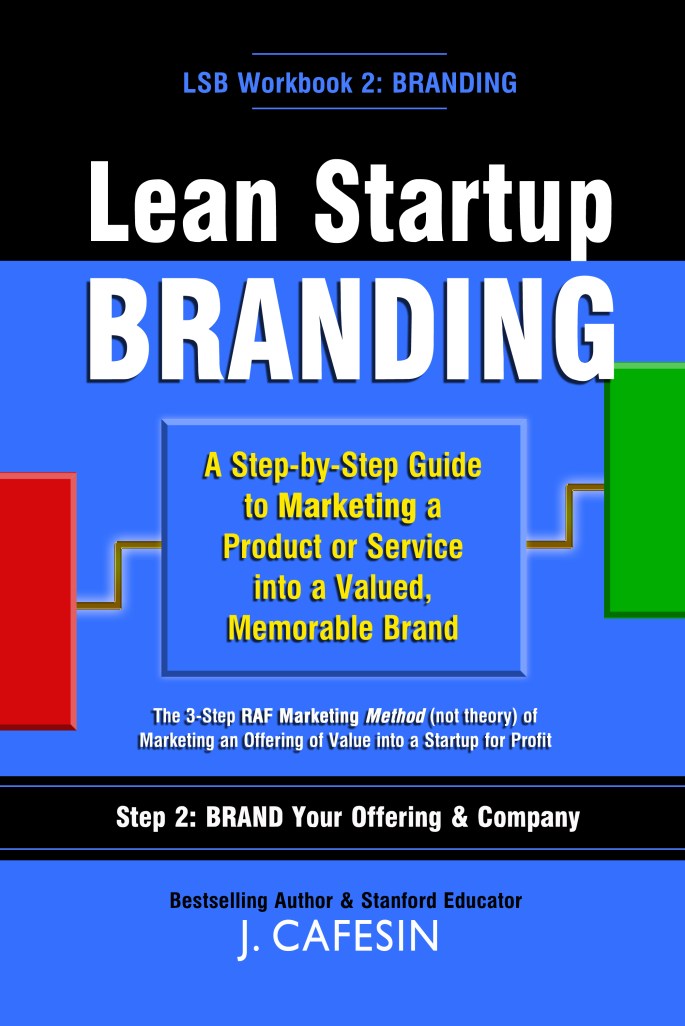
New Release: Lean Startup BRANDING

Lean Startup BRANDING (LSB) Workbook 2, is the first marketing book to unify the marketing/branding process. LSB brings together target marketing methods with graphic design techniques, to produce smart marketing strategies and striking campaigns that uniquely brand your products, services, and company.

Bestselling author, and Stanford Marketing instructor, J. Cafesin, introduces an entirely new Branding paradigm. LSB takes you step-by-step through the branding and marketing of your new venture. Create corporate and product identity packages. Examine the fundamental principles of effective design, and learn to produce multichannel print and digital marketing campaigns that get greater response.

You must continually produce campaigns to create a thriving business. Through text, slides, challenges and projects, LSB Workbook 2 empowers entrepreneurs to CEOs with the knowledge to create and produce professional-quality digital and print marketing, that generate the greatest conversion (clicks; try; buy; subscribe).

● Learn to create a complete Corporate Identity. Establish product and/or company names, then create striking logos that can scale from social media feeds to the side of your building. Establish your startup’s voice with taglines that tout your company’s unique value.

● Study graphic design techniques, such as layout, eye-tracking, responsive grid systems, typography, and how to execute attention-grabbing branding and advertising campaigns.

● Discover the components in imagery that create visual impact, and the myriad of sources to get spectacular visual content, at little to no cost.

● Examine print and digital reproduction. Begin a visual library of high-quality images and video clips to use in your marketing efforts for both print and online campaigns.

● Review SEO (search engine optimization) techniques and best practices.

● Explore online technology, and how to increase engagement with your digital marketing efforts.

● Course projects include developing a complete identity for your offerings and startup, as well as an array of effective print and digital marketing campaigns to introduce your new offerings, and promote your business.

At the completion of LSB Workbook 2: BRANDING, you will have gained the ability to design and inexpensively produced tightly targeted, professional-quality marketing campaigns to turn your startup into a thriving, sustainable business.

https://lnkd.in/gE9h4ej

A True Email Tale

This morning I came into my office and there was an email from my husband. It was title, “The terminator is coming…” No joke. That was the exact SUBJECT LINE of his email.

I don’t care that another Terminator movie is coming out. I liked only the first and second Terminator movies, and thought the rest (and Arnold Schwarzenegger) were crap.

I didn’t open his email. I trashed it. I didn’t see the link he had inside it, but even if I did, I wouldn’t have paid attention it with his email subject line.

As I reviewed my emails, I watched the news, as I do every morning. The segment was on Boston Dynamics, a well-known robotics firm. They were showing off the agility their Atlas robot, doing a back flip! I was so blown away, it looked so real, like a person, I sent the video clip to my husband and kids. My subject line: “Totally cool robot moves!”

My husband sent me back an email, “I sent this video to you this morning.”

Hmm…he did? I didn’t see it.

“It was in the email about the terminator coming,” he wrote. “I guess I gave my email a bad title.”

No shit.

WORDS MATTER! Marketing/Copywriting must choose the RIGHT WORDS for the right audience to get response.