R.I.P. Information Hwy

I’m watching The Politician on Netflix while working out. Deep into the second season, the scene unfolds on a teen and mom in their kitchen, arguing about which state senator to vote for in the upcoming New York election.

Teen is a first-time voter, just 18, and wants to vote for the 24 yr old male candidate running on the Green ticket, vs. the mid-aged female 20 yr incumbent, virtually unchallenged in every election till now.

Boomer,” the child mocks her mother who is listing the contributions of the older incumbent against the sole climate platform the 24 yr old is running on. “The world is gonna end in 10 yrs, Mom.”

“I am barely a boomer, okay?” the mom defends. “So don’t throw that shit at me,” she says. “And the world is not going to end in 10 yrs, Jayne!” She goes on and lists all she does for her daughter, the vegan cooking, the composting, and even the hyper-vigilant recycling her child insists on. “And still, I am the problem, according to you.”

“Not YOU, Mom. People your age.”

Right about now I feel my body tense as I run on the machine. I AM her mother’s age.

“Let me tell ya something, Jayne. People YOUR age think you know everything and you are fucking naive. When I was your age, I thought I knew everything too.”

“We’re not naive, Mom. We’re INFORMED. You had, what, like two newspapers, three networks. I’ve got a SUPER COMPUTER in my pocket.”

She is, of course, referring to her cellphone, and, in fact, showing the viewer how naive this child really is.

Unfortunately, Mom didn’t come back at Jayne. Mom doesn’t know (nor the writers of the show apparently) that the SUPER COMPUTER in both their pockets, well, isn’t informing them of anything but what they already believe. So, in effect, it is MANIPULATING this ignorant, yet rather arrogant child, and anyone else who believes they have a SUPER COMPUTER in their cellphone.

The cellphone you all carry around, (as I don’t have a smartphone, so really, it is all of you), is a RECOMMENDATION ENGINE. It isn’t INFORMING you, it is RECOMMENDING you read, watch, buy, and even think about what Google, Facebook, Instagram…etc., wants you to. Every social platform you are on, every YouTube vid you watch, every document you SEARCH for, shows you what they think you will be RECEPTIVE to. Marketing pros know that it’s off-putting to get information opposed to what we already believe, regardless of the truth in the information. And they want to endear themselves to customers, not piss us off.

Today’s internet is NOT unlimited access to unfettered information like the world wide web once was. You’ll be hard-pressed to find anything through SEARCH that isn’t already somewhere in your belief system. Searching for anything now, you will only get back what Google thinks you should see, to manipulate you to buy the offerings, or into the messaging of their affiliate marketers. A crystal-clear example of this can be seen in the Netflix film The Great Hack. Russia paid Google and Facebook fortunes in ad campaigns pushing the conservative Republican agenda to get Trump elected.

Now, the internet is a MARKETING ENGINE to make these social media platforms money. Every time you log onto Instagram, Facebook, YouTube, or Google, they ‘scrape’ your posts, simultaneously putting ‘cookies’ on your mobile and laptop to follow you wherever you go on the net, and in real life. Your mobile has an accelerometer in them, which says how fast you are moving, and GPS to inform Google and their like where you are on the planet, revealing when and where you shop, what you buy, how much you spend, what you read, watch, glance at, or frequently visit.

Machine Learning, Natural Language Process, Deep Learning, AI, are all software processes that analyze all that data from trillions of posts, texts, IMs, and searches, and then CORRELATE that data for patterns of behavior through COLLABORATIVE FILTERING.

COLLABORATIVE FILTERS [à la] Wikipedia:

Collaborative filtering is a method of making automatic predictions (filtering) about the interests of a user by collecting preferences or taste information from many users (collaborating).

In other words, gathering and filtering your data from the net tells Google and Facebook what you (and those like you) will likely buy, or what rhetoric you’ll likely believe in the future. Then these social platforms slam you with marketing targeted AT You, not “For You,” as they claim.

They tell you it’s to HELP YOU find things you’ll like quicker. But this is a flat-out lie. They want to SELL YOU offerings and ideas supported by their affiliate marketers (like Russia).

Google SEARCH is the only way to find anything now, locally or globally, since phone books don’t exist anymore. But Google is ONLY returning the businesses buying the most ad space and spending the most money on their platforms. I used to get pages and pages of returns on any given subject 10 yrs ago. Now I only get a few pages before Google says, “We have omitted some entries very similar to those already displayed.” And while they do indicate you can search the omissions, this too is a joke. Google simply will not give you information that they feel you don’t need (and won’t serve their agenda), based on your internet and cellphone usage history.

My 19 yr old daughter, and most of her friends, are on the same page as Jayne in The Politician. They are simply ignorant of what it is they are addicted to, and how their phones are manipulating them to THINK, FEEL and ACT the way these social platforms and their affiliate marketers want them to. She is SURE that “no one is manipulating ME, Mom!” She “knows” when she’s being hit with ads, and she “just ignores them.”

BULLSHIT.

My daughter, you, me, can’t ignore them when we don’t even know they are happening while we IM through Facebook on our mobile.

Example:

Mary is IMing a good friend on Facebook, whining about her marriage “in crisis.”

Facebook’s algorithms are scraping her and her friend’s IM for SENTIMENT ANALYSIS to find out where Mary might be vulnerable to purchase something…anything really, as FB has advertisers that sell just about everything.

The next ad Mary sees on her mobile is for a singles dating site. The ad is targeted at divorcees, showing an older woman having fun with a stunning man, and the copy says, “Your second chance at true love.” In a few short sentences, the copy describes the relationship you’ll find on their site like a Cinderella story, the evil stepmom played by the partner’s spouse.

A while later, Mary goes on to YouTube, and the next series of ads she sees vacillate from singles dating sites to divorce lawyers. The ads appear on the side of her emails, and in her Instagram feed, and most anywhere she goes online.

Mary never mentioned divorcing her husband when IMing her friend. She’d not even thought of it, really. In fact, she’s frequently sounded off about her relationship to friends through IM, as many do. And it isn’t the first time Mary has gotten these dating and lawyer ads. It’s been going on a long time now, one ad after the other every time she even posts a back-handed joke about marriage in general, regardless if through her phone or laptop. And after this last fight with her husband, well, like the ads keep saying, Mary deserves more! Like the ads say, she can find someone better than her husband. And like the ads say, a divorce will, “Open her life to the possible!”

These ads appear whenever Mary is feeling vulnerable about her marriage. (Marketing is an iterative process.) And instead of looking to make it work with her husband, after a while all Mary wants to do is divorce and open her life up to new possibilities.

To Google, Facebook, Mary’s divorce is a WIN! Their algorithms and the engineers who code them don’t know they’ve torn apart a family, for their profit. The software did its job and rewarded their advertisers. Some lawyer who advertises on their site just got themselves a client. Some dating app that spends millions annually in affiliate marketing on their platform just got a new subscriber. Multiply that with the hundreds of thousands of businesses doing affiliate marketing on the net, and you have, well, today’s internet.

NOT a SUPER COMPUTER. And no longer, “The Information Highway.”

But simply a RECOMMENDATION ENGINE, a marketing tool in which YOU are a PRODUCT of the platforms you frequent.

Writing for a Living

What it means to be a ‘successful’ writer…

There are bookstores around the country that will put an author on a bestsellers list if the store decides to carry their book, regardless of sales. One of these was Rakeshaw Books in Danville, CA. I’d finished my first novel, REVERB, and got a small publisher to pick it up, but as with most publishers, even famous ones, the author is still required to market their work.

I went to Rakeshaw Books, only a few miles from my home, to ask them to carry my book since I was a local writer. It was 10:10 in the morning, just after they opened. The sales clerk was the only one in the store, an older woman, gray hair, sagging face, crinkles around her blue eyes with her welcoming smile.

I asked her if Rakeshaw would carry my book. She told me NO. They only carried books from publishers like Random House. I felt like crying right then having hit this wall so often, and the clerk saw my expression and continued.

“I’ve been working here for 40 years,” she told me. “Part-time raising my kids. Full-time after that. You are one of the many writers I’ve had to turn away. But over the years I’ve noticed a pattern I’d like to share with you.” And she paused and stared at me, like asking for my permission to continue.

“Ok…” I said, but honestly, I really didn’t care at that point.

“There are writers, and there are authors,” she said. “The writers who come in here look a lot like you,” and her eyes walked over my leggings and ripped T, then to my mess of hair and my makeupless face. “Writers write. Most every day. They are recluses, absorbed by the process of writing itself. They aren’t genre-specific, but explore many and often integrate several into their work. They generally only get small publishers to pick them up, if they get one at all, which is a shame because they are usually great storytellers spending the bulk of their time writing — honing the craft.

Authors write books for recognition. They typically write the same characters over and over, putting them through different paces. They build an audience that way, writing formula fiction, but their passion isn’t the writing itself. Authors adore the limelight. They typically enjoy public readings and gatherings that writers do not.” She examined me across the counter. “They are gregarious people, always selling — themselves and their work. Do you understand what I’m trying to tell you?”

“That I’m screwed?”

She smiled but shook her head. “Take solace that your passion lies in the process of writing. You never need be bored. Whether you are widely read or not, your work will have an impact, likely a greater impact on those who read it than the work of most authors out there.” She bobbed her head up and down confirming her own rhetoric, but I was grateful for her kind sentiments.

I thanked her and left but her words have resonated. I’ve met many who write over the 20 years I’ve been writing to publish — to get read. Some are famous. You’d know them if I name-dropped. Most are not, even if in some distant past they were once a NYT Bestseller. Thing is, I too have noticed the pattern the clerk described. Whether they became famous and turned into authors, or they started as authors writing formula fiction, writing the same characters and basic narratives over and over sells books.

I am a genre-diverse writer, (which hasn’t helped my sales). I’m told by selling authors that I should pick a genre and write religiously to that genre to market myself more effectively. In fact, series are even better! Romantic detective series, or dystopian fantasies with a strong female lead. Shoot me now if being a selling writer means traveling the formula road. I write fiction to evoke feelings, thinking, challenge personal perceptions. I create relatable, complex characters in every story I tell, then join them on their journey of emotional growth in unique narratives that I hope will stick with readers for life.

If I told you the truth of how few books I’ve sold you’d call me out as crazy for continuing to write. I call myself out daily every morning I sit down at my laptop and start typing. Why am I still doing this!? Go back to marketing startups and make some real money! But I don’t. I write, and hope it will resonate with readers, thinking readers who love stories that spark self-reflection, and maybe even a new awareness.

Ray Bradbury once reminded me of why I write, and regardless of sales, I know I’ll never give it up. Writing fiction is intoxicating. Fully engaging. Hot. Sexual. Physical. Cerebral. Virtually touching real as I enter the scene. And I’m a million miles from Lonely.

Books: J. Cafesin on Amazon
Website Blog: jcafesin.com
Paywall Blog: Medium

Engage in Learning About People

Marketing 101: How to motivate people to DO what you want them to do…

An entrepreneur recently asked me: “What specific skills or knowledge do you believe will be most crucial for aspiring entrepreneurs in 2025 to navigate this complex and dynamic environment?”

My response: “The greater understanding one has of what motivates people, individually and in groups, the greater chance of success in any field. The trick — how to open yourself up beyond just yourself to become aware of those around you.”

Most of us live inside our own heads, thinking about whatever, but rarely watching others closely. Time to step outside your own head, and think differently. To become proficient at marketing, you must watch what people DO to understand what attracts our attention and motivates us to ACT — buy; try; subscribe; give.

All of us engage in marketing every day of our lives. We market to ourselves to exercise, eat right, take care of business when we really would rather be binging Netflix. We market to our kids to get good grades, clean their rooms, make friends IRL, not just on their devices. We market to our partners to be fair and equitable. We market to potential bosses for a job, or actual bosses or clients to sell them on our efforts.

I teach Lean Startup Marketing @Stanford. I also mentor startup teams and individual entrepreneurs with an idea they want to license or build into a sustainable business. Below is one of the first Challenges I give my students to help them become proficient at marketing — i.e. motivating people to do what we want them to do.

CHALLENGE #3

1. For ONE WEEK, seven full days, observe and journal about the people you see (at work, at home, at Starbucks). Watch what we actually do, (not what we say we will), and write down what you observe, into your laptop, onto your phone, or actual pieces of paper.

• Keep each observations under 100 words (preferably less). Observe and journal only scenes to which you play no part. You must be an impartial observer of what you choose to describe.

• Create separate documents per day with [at least] five observations of any individual’s behavior, or of two or more people interacting. Observations can be people at school, work, or someone at a cafe, but you must not have any interaction within the scenes you observe and document.

• OBSERVE CAREFULLY, and write down only what you see and hear. Do NOT add or embellish anything you see when documenting your observations. Do NOT judge, or give your opinion on what you see. Simply transcribe each event as they unfold.

Choose to document scenes of interest. Do NOT describe someone passing you on the sidewalk staring at their cellphone like everyone else you pass by. NOTICE the subtleties, if they exist. What are they doing on their phone (if you can see)? Three out of the five cellphone screens that I could see at Back-to-School night at my kids high school, the people — mostly women, mid 30s to late 50s, White and Asian, upper-income — were checking their email, or Facebook feed, or playing some inane online game like Candy Crush.

Pay close attention to your subject’s mannerisms, how they talk — expressive, with a lot of hand gestures? Low key, quietly leaning in to whomever they are speaking? You may see an extreme expression like a frown, or a broad smile or outright laughter, but try NOT to interpret an expression as “they looked bored,” or “happy,” or any other judgment call. Do NOT give any interpretation of what you see. Write only what you observe and hear watching any individual, couple, or group of people.

2. Log Demographic, Geographic, Psychological, and Behavioral data:

• Title each entry with the DATE, TIME and LOCATION of each observation.

• Start your observation with gender, age (approx.), race, and other obvious demographic data, like someone wearing a religious symbol, we can assume they follow that particular religion.

• Note mannerisms and behavior. Does your subject look away when someone looks at them? Do they boldly stare back? Solicit conversation with someone close by, or are so absorbed in their cellphone they hold up the line at your cafe?

• Note purchases at shops in the mall, or at the grocery store when you’re waiting in the checkout line. What is being purchased, in what sizes (small or large), in what quantity, by whom?

Example: I’m in Nordstrom’s, watching a 20-something, slender Black woman in a tan blouse tucked into a straight, knee-length navy blue skirt, try on six pairs of shoes. She finally purchases a pair that look just like the black pumps she wore into the store.

You likely have not gone a day in your life without marketing to yourself or someone else. Even screaming during infancy is essentially marketing to a parent or guardian to take care of your needs.

At the foundation of marketing — figuring out what really motivates ourselves and others — is Psychology. And the human psyche is massively complex. We lie. ALL of us lie — to ourselves and everyone else — to look smart, capable. To feel good about our choices and behavior regardless how counter-productive, or flat our destructive it may be.

Potential and intent are worthless constructs, marketing we tell ourselves and tout about others. (He is so smart!). To understand what really motivates people, you must observe our behavior and actions.

Want to get that job, get your husband to do the dishes, convince your kids to study? Sell your baked goods or software service (SaaS)? Take CHALLENGE #3 to learn how to get this person (even yourself), or that group to DO what you want them to do.

Marketing 101

I hate running.

It hurts my legs, my lungs, my back, my tits.

I run between 3 and 4+ miles, five days a week. And I’ll continue to run as long as the benefits outweigh the drawbacks.

I hate feeling fat, and running is the quickest calorie burn I know of (my me-time is hugely limited with an active career and two kids). Running helps me think. It not only activates neural connectivity, it’s also a quiet space, undisturbed by kids or clients. I get to listen to my music, blasting through my earbuds, let it absorb me, the rhythm drive me, and in moments it feels like I’m flying.

I run whether I’m healthy, sick with a cold or flu, or anything else that isn’t laying me out on my death bed. I’m afraid if I give myself one excuse not to run it will lead to another, and in short order I’ll quit running. But I won’t quit, as long as the benefits serving my needs outweigh the hardships.

Benefits that fulfill Need/Desire is, or should be, the foundation of all marketing efforts.

Digital advertising is now the hip slick and trendy way to market. And no doubt, there are great marketing opportunities online. Websites, landing pages, social media marketing, e-blasts, analytics…etc, are TOOLS to market with. But marketing online, or offline, IS THE SAME THING. The basic principles of marketing must be applied to sell and grow any company.

Print, online, or on the friggin moon, Marketing is selling BENEFITS that fulfill WANT. There is no such thing as NEED. It is merely a construct of desire. Advertising, PR, branding, visual design, copywriting, marketing communications are, or should be, developed, designed and produced to SELL products/services/ideas/messages. ‘Likes, Engagements, Views, Impressions’ are all bullshit “vanity” metrics to stroke egos so you’ll buy more online ad space.

Startups these days typically begin their marketing efforts by flooding the internet with digital ads, videos, polls, games and such. These branding and selling campaigns push products and services without distinguishing a clear desire or solution for anyone. They do not tout the benefits of what these startups are selling, or identifying any specific groups of people who will likely find value in the features of their offerings. No matter what Google and Facebook tell you about their targeting AI algorithms, online ads are not tightly targeted to people likely to benefit from your specific product, service or message. This “Fire, Aim, Ready” approach clearly illustrates why 90+% of all startups fail.

I’ve been a MarCom specialist in the San Francisco Bay Area for 20 yrs. I’ve worked with a ton of startups who do not consistently promote their offerings features and benefits, or realign their marketing efforts to outshine competition, nor do they invest in developing new products that fulfill anyone’s desires. And I’ve watched them fold again and again, sometimes in ridiculously short order.

Marketing 101— IN ORDER (Ready, Aim, Fire!):

1. Get Ready and Productize Your Idea: Identify the features, benefits and differentiators of your offering that fulfill a desire, or offer a solution to specific target markets likely to find value in your product, service, or message/mission (non-profit).

2. Take Aim and Create Brand Identity, and Marketing Campaigns: Establish an identity (logo), and voice (tagline), as well as marketing efforts—digital, print, and pitch (in-person) campaigns that fulfill a desire, or offer a solution to each specific target audience.

3. Fire!—Launch Marketing Campaigns: Motivate people to ACT—to click, to subscribe, try, or purchase your offering, or buy into your message.

The new order of entrepreneurs are weened on social media and tech. Universities, startup schools and bootcamps generally teach their students to launch backasswards. They promote the MVP model of innovation. Building a MVP (minimum viable product) may have worked for a handful of successful startups, but it took them a hell of a lot longer to reach profitability than necessary. In most cases, MVP is a recipe for failure. Relying on consumers to figure out what benefits your offering should fulfill for them is time consuming, expensive, and lazy. It is the job of the entrepreneur to produce a product or service of value for specific groups of people before launching your business.

Unfortunately, opting for A/B testing, and SEO keyword tricks over real content—selling benefits fulfilling a desire—and relying on Google Analytics doesn’t actually SELL much. Measuring response rates isn’t new. It’s been in the background since advertising began, and generally offers limited utility. Marketing is dynamic! Results vary by target audiences, the day a campaign launches, time of day, day of week, the weather, behavioral trends, sociological and financial climates, to name just a few factors that determine response.

The principles of Marketing may be simple, but motivating people to bend to our will is not easy. Beyond the primary building blocks of any campaign, (Ready, Aim, Fire), at the core of effective Marketing is psychology. Online, or on Mars, understanding your customers and potential customers’ psychology is mandatory if you want the greatest response to your marketing efforts. Marketing pros study people, not code, since coding, especially with ever-emerging technologies, is time consuming to learn, and generally requires a different kind of awareness than psychology. I’ve yet to meet a web developer/designer who’s demonstrated mastery in marketing. Competent at software development means they’re investing their time in technology, not in the study of human behavior.

I tell my clients that digital marketing is not ‘the answer’ to effective marketing. New avenues of selling will arise, and others fade away. But the growth of any business, or nonprofit message, or even activity, like running, depends on the benefits continually fulfilling a desire for a specific group of people.

The Psychology of Marketing

I teach my students at Berkeley and Stanford that the foundation of marketing is psychology. Marketing is manipulating people to do what we want, so to get people to do what we want, we have to understand how they think, what they feel, and why.

I also teach that the foundation of psychology, what motivates all of us to do whatever we do, is self-interest. I explain that even saints like Mother Teresa, who spent her life feeding the poor, caring for the sick, did so out of self-interest. Mother Teresa was not altruistic. There is no such thing as Altruism. It is a religious construct to motivate good deeds, to get people out of our own heads, even for a moment, to consider others.

Many students, especially believers of religion, have a problem with this lecture. And, no doubt, many reading this blog are bridling right now. “Of course Altruism is REAL. It’s what we strive for, our highest attainment— to give selflessly, because we are fundamentally caring, loving beings.”

Not so much. We are fundamentally self-serving.

And this is NOT a judgment call. This is a fact of human nature. What can be judged is what we DO with this fact of our nature.

I teach self-interest religiously with every Marketing lecture I give. As Mother Teresa spread the word of Christ around the world with every sick child she fed, she was fulfilling her function as a nun. And her brain rewarded her efforts with Dopamine, Serotonin, Oxytocin— ‘happiness’ hormones that made her feel good. In the face of that kind of poverty, I’d be crying daily. I don’t do what she did because it would not make me feel good in any way. I’d be profoundly sad, every day, knowing Christ will never save these children. People are going to have to do that.

We ALL act in self-interest. We scoff at Chevron fracking as the height of corruption, yet we blithely ignore our roles in global warming by driving SUVs we don’t need, or leaving lights or electronics on all the time because we’re too distracted to turn them off. Or we drive while on our cellphones, and cause over 1.5 MILLION accidents annually, and KILL, murder, 9 or more people A DAY so we can check our Instagram or Tiktok feeds.

I teach Marketing, not Morality, I tell students who balk at my contention our motivation, without exception, is self-interest. It is important to tell them this fact about us, this truth, giving them the ability to produce effective advertising down the line when they begin marketing their startups. To get people to buy into your product, service or message, you must understand their psychology— what they think they need or want, and why, then offer them solutions to their issues and desires.

Bernie Madoff did it to a lot of greedy people. He fulfilled their desire to get rich quick without effort when he convinced them to invest with him. Purdue Pharma fulfilled the desire of people in temporary and chronic pain, while simultaneously fulfilling the greed of medical professionals with kick-back payments that turned doctors into drug pushers.

Humans are self-interested beings. What we do with this fact is what matters, NOT that we ARE.

On the other end of the spectrum, Toyota fulfilled the desire of people interested in preserving our planet when they invented the Prius. And Tesla and other car makers have done the same with their all electric vehicles. Toyota and Tesla produce the cars they do to make money. And while serving themselves, they are moving closer to serving the greater good, by producing cars that have low emissions. Even better than electric cars, is solar and wind to power them, since over 60% of our electricity still comes from burning coal and other fossil fuels, which continues to do immeasurable damage to our planet.

Martin Andrew Green is an Australian professor at the University of New South Wales who’s dedicated his career to developing solar cells. Mr. Green’s self-interest is scratching a mental itch. He’s curious about light energy, and in learning how to manipulate it, his brain rewards him, makes him feel powerful, smart, valuable, serving his emotional needs.

Self-interest is NOT a curse. It is simply a state of being… human, in our case, but self-interest seemingly dictates the behavior of everything else that lives on Earth. Survival of the fittest is how species last over millennium. Not survival of the kindest, whatever ‘kind’ means. With every mouthful of food, every article of clothing, every vaccination Mother Teresa provided the sick and poor, she also fed them Christianity. She was not kind in spreading gospel that Jesus saves their souls. Instead of teaching the value and necessity of socially responsible behavior, which would have served the greater good, preaching rewards in the afterlife does not serve the living or their future.

There is no need to fear the fact that human behavior is driven by self-interest. Regardless of the religious allegory that Altruism is not only real, but mandatory for society to function, self-interest does NOT need to manifest as narcissism. Green, or Toyota, or the parents who work to provide for their kids, or helping a friend in need, most of us contribute to supporting our society or there would be no human race at all. We have no great physical strength or stealth prowess. Building communities, exchanging ideas and skill sets, being here for each other is all we have to sustain us.

We all have the capacity to be giving, generous, thoughtful beings. Our motivation is irrelevant. It is our ACTIONS that determine our morality, whether we are contributing to creating a society that thrives, or participating it our own demise.

Self-interest is encoded in our DNA, and is not a threat to humanity, but a valuable characteristic, a useful asset. We just need to lengthen our time horizon beyond our own lifetime, broaden our self-absorbed view. We must learn that acting ‘altruistically’ means recognizing our impact on each other and this planet, and that accounting for the needs of others as well as our own IS in all of our self-interest.

Copywriting “Test”

Had an interview for a Copywriting contract that required a ‘test.’

Here’s the ‘test:’

Create five (5) YouTube Channels that can “go viral,” which, according to this ‘digital marketing agency’ was “20 million views in one week,” with these prompts:

  • Create a “Seek and Find” YouTube channel.
  • Create a “Mouse Maze” YouTube channel.
  • Create a [tween] YouTube channel: “Imagine you are 13 and develop a superpower…”.

I stopped reading the “Test Deliverables” after that because this agency asked for a total of 5 unique YouTube channel ideas, their only instruction to create channels to “go viral, with 20M views weekly.” I hope the absurdity of this request is not lost on you, since about .03% of all YouTube Channels get 1M+ views on any given video.

And remember, this is a Copywriting ‘test,’ not a product development gig, which, seemingly, this marketing agency does not know a BRANDED YouTube channel actually is a product offering, and should be developed and marketed accordingly.

Five, free, viable YouTube channel ideas requiring little copy—this agency did stress an ‘attention-grabbing’ visual—including thumbnail layouts and storyboard drawings. Oh, and they required I sign an NDA saying that whatever I came up with on their ‘test’ was theirs to keep. Five (5). Free Channel ideas. Per applicant.

Their ‘test’ gave no OBJECTIVE for creating these channels—no sales goals for any company, or the channel itself to realize profitability. No reason for asking applicants to create these brain dead types of channels, other than the unmentionable of making the user the PRODUCT by selling their data, then slamming those same users with pay-per-click ads on every webpage visited forward.

The prompts in their ‘test’ were pulled from the latest trending crap on YouTube. The agency asked applicants to pile on more intellectually void baseline garbage to these senseless trending channels, following the Fire, Aim, Ready marketing method of business failure. Clearly this ‘marketing’ agency doesn’t really understand, well, marketing, assuming they were really looking for a copywriter, and not just garnering free content ideas. There are three business MARKETING reasons (not personal, ego-building social sharing) for a YouTube Channel:

  1. As a marketing/branding channel for a business.
  2. As a data collection tool for tightly targeting future marketing campaigns.
  3. Selling collected data to Affliate Marketing brokers.

Applicants for this copywriting gig were not asked to market an offering of value, nor to build a marketing campaign (or YouTube channel) for any specific targets, nor did they instruct applicants to actually create and MARKET (i.e. BRAND) a YouTube channel for any specific business. They are under the delusion if they just get “views,” they’ll get sales, which data shows is a lie (https://freakonomics.com/podcast/advertising-part-2/), promoted by these very ‘digital marketing’ agencies to get clients. (https://www.ippglobal.org/post/truth-about-data-science)

Of course, after reading their ‘test,’ I turned down the prospect of consulting for them. I felt angry though, that they were not only asking for free, unique IP, but also the IP they were asking for was truly thoughtless, flat out bad marketing, sure to put more ‘digital’ garbage on the ever mounting pile of crap already on YouTube. To quell my anger, with my rejection of consulting for their agency, I included an answer to their first prompt:

Create a Hide & Seek” YouTube Channel:

A Year of Free Beer for Finding NAME OF FAMOUS IPA BEER.

AR (augmented reality) game to find the bottle of famous IPA BEER (or any other idiotic thing that’s trending). Everyone 21 or older with mobile can play. AR has NAME OF FAMOUS IPA BEER bottles in places around each major cities, but also standard beer bottles, and area sports team logos, (even cross-sell with image placements) that ‘lead’ you to the ‘right IPA.’ First to find NAME OF FAMOUS IPA BEER (in any given round, which may be a week or more per round) to collect all that global data, (which then can be sold to screw us all further), wins the free beer for a year, every month getting new IPA flavors.

The TARGET USERS of this YouTube Channel will be:

  1. Lowest hanging target is the sudo-intellectual, over-educated ivy-league crowd, mostly White men; Christians, Jews, Agnostics—higher education levels; MMORPG, FPS, and MOD gamer; Software, Marketing, Admin, Finance; STEAM; democrats; mid – upper income; 21 – 60.
  2. Lazy, generally fat, FPS gamers, beer and sports-loving men. White mostly. Conservatives. Apatheist, Christians; low – mid income; blue-collar job; pensions; 18 – 65.

New Release: Lean Startup BRANDING

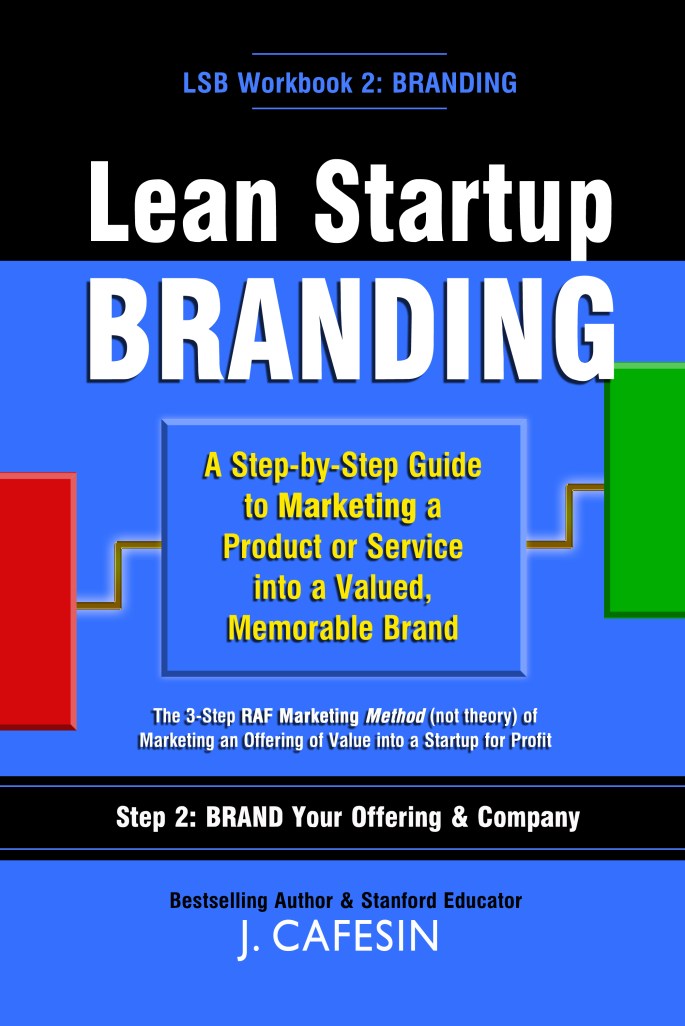
Lean Startup BRANDING (LSB) Workbook 2, is the first marketing book to unify the marketing/branding process. LSB brings together target marketing methods with graphic design techniques, to produce smart marketing strategies and striking campaigns that uniquely brand your products, services, and company.

Bestselling author, and Stanford Marketing instructor, J. Cafesin, introduces an entirely new Branding paradigm. LSB takes you step-by-step through the branding and marketing of your new venture. Create corporate and product identity packages. Examine the fundamental principles of effective design, and learn to produce multichannel print and digital marketing campaigns that get greater response.

You must continually produce campaigns to create a thriving business. Through text, slides, challenges and projects, LSB Workbook 2 empowers entrepreneurs to CEOs with the knowledge to create and produce professional-quality digital and print marketing, that generate the greatest conversion (clicks; try; buy; subscribe).

● Learn to create a complete Corporate Identity. Establish product and/or company names, then create striking logos that can scale from social media feeds to the side of your building. Establish your startup’s voice with taglines that tout your company’s unique value.

● Study graphic design techniques, such as layout, eye-tracking, responsive grid systems, typography, and how to execute attention-grabbing branding and advertising campaigns.

● Discover the components in imagery that create visual impact, and the myriad of sources to get spectacular visual content, at little to no cost.

● Examine print and digital reproduction. Begin a visual library of high-quality images and video clips to use in your marketing efforts for both print and online campaigns.

● Review SEO (search engine optimization) techniques and best practices.

● Explore online technology, and how to increase engagement with your digital marketing efforts.

● Course projects include developing a complete identity for your offerings and startup, as well as an array of effective print and digital marketing campaigns to introduce your new offerings, and promote your business.

At the completion of LSB Workbook 2: BRANDING, you will have gained the ability to design and inexpensively produced tightly targeted, professional-quality marketing campaigns to turn your startup into a thriving, sustainable business.

https://lnkd.in/gE9h4ej